Wednesday, June 5, 2024

Oath Helpers

 People in the Middle Ages totally believed in the rule of law.  They were not always sure what the law was, and often they seemed to be making it up as they went along, but they believed at least as much as do modern people in doing things in a lawful manner.  Even though modern laws in the West grew directly out of medieval legal practice, there are plenty of differences.

One of the best examples of this is oath helpers.  Most discussions of guilt and innocence, of who did what to whom, turned as they did today on witness testimony and physical evidence.  But how to tell if someone was actually telling the truth?

As I have discussed previously, someone's truthfulness might be tested by ordeal, that is that they would swear to something and grasp a red-hot iron as proof of their veracity.  If the burn healed up as it should, they were indeed telling the truth.  Understandably, most people would prefer to be proven to be truthful by less extreme means.  Indeed, more people threatened to undertake trial by ordeal than actually went through with it.  (In some ways it was a bluff, saying "I'm so certain I'm innocent that I'll accept a horrible burn to prove it," forcing the other side to start to doubt their accusations.)

An alternate method was to gather oath helpers.  These fidejussores as they were known in medieval Latin would swear to the truthfulness of someone else's oath.  They were not witnesses, as they need not have any insights into what had happened, and they were not even character witnesses, as they were not expected to say (for example) that the accused was an affectionate husband and father who wouldn't hurt a fly.  Instead they swore oaths that someone else's oath was true.

So someone accused of (say) murder would swear on holy relics that they had never touched the victim.  Everyone would watch to see if he started frothing at the mouth and falling down.  If he didn't, he would provide oath helpers who would similarly swear.  Six or twelve men (or some different number, it wasn't absolute) would swear that this oath was true.  If any of them gasped and choked and fell down while trying to swear falsely, guilt would be pretty well established (pending of course further discussion, medieval judgments always required a big discussion).

But even if the accused managed to get all his oath helpers to swear to his own oath's veracity, he was not necessarily found "not guilty."  Part of any trial was "what everyone knew."  If the accused was, in everyone's mind, clearly the murderer (in this example), then they'd keep going.  They might require an ordeal, with further oaths from the fidejussores.  They might have a combat or dunk the accused in water.  Best of all, they might find that the knife stuck in the victim's throat was the accused's own distinctive knife.

When someone ultimately found guilty was to be punished,  all his oath helpers were also punished.  In the stories they were sometimes hung, although that was probably an extremely rare outcome.  But being an oath helper was a serious business, as the fidejussor knew that if the person whose oath he was helping actually was guilty, he himself would be punished, by the court or by God.

(In the "Court Scar" series I've written with my husband, we include several examples of legal judgments that carry the plot along, based on real medieval events.)


© C. Dale Brittain 2024

For more on medieval law, see my new ebook, Positively Medieval: Life and Society in the Middle Ages.  Also available in paperback.


Monday, May 27, 2024

Manuscript Fragments

 A lot of medieval manuscripts survive only in fragments.  There is indeed a whole field within medieval studies, fragmentology, dedicated to finding and studying such fragments.  Some of the fragments are due to medieval and early modern monks (and nuns) reusing old parchment, some to modern antiquities dealers cutting up medieval manuscripts and selling them piece-meal.  And that doesn't even include the damage parchment often suffered from floods, fire, and nibbling by rats or mice.

Parchment was valuable, regardless of what was written on it.  Hence if a book or charter became outdated for some reason, there was a strong incentive to reuse the parchment.  A confirmation from king or pope would of course be kept, but the records of donations by petty landowners to a monastery, or the final settling of a quarrel involving people now dead, would have little intrinsic value once the recording charter was copied into a cartulary.  Similarly, if the liturgy had changed, old liturgical books would become useless.

The old parchment would especially be used in book binding.  It would be cut into the appropriate shape and used especially as a backing for the boards of the cover or to shape the curve of the spine.  The bookbinders would make no effort to erase what was written on the parchment.  Scholars studying such fragments are always on the lookout for them in old bindings, though taking them out for closer examination is difficult if one does not want to mess up the book of which they are now a part.

Recently endoscopic cameras have been used to peek inside the gap between the outside of a bound book's spine and the inner part, where the individual gatherings of pages are sewn together.  (Take an old hardcover book off your shelf and open it, and you'll see what I mean.  Most modern books just glue the pages in, but older ones still sewed the so-called signatures as medieval bookbinders did.)  Yes, this endoscopic camera, a tiny camera at the end of a flexible coil, is like what they use to give you a colonoscopy.

As well as monks themselves cutting up medieval manuscripts they considered useless, we have modern collectors providing a market for pieces of manuscripts considered lovely.  There was a nineteenth-century craze for cutting out the illuminated initials from manuscripts and pasting them into scrapbooks.

More recently, art and antiquities dealers have recognized that a lot of people find the Middle Ages interesting and would be delighted to own a small part of it.  A cut-up manuscript, sold page by page, yields a lot more revenue than selling a complete manuscript.  Undecorated manuscripts may end up in a library, but religious manuscripts with interesting initials and colors are often cut up.


This is a page from a missal (a liturgical manuscript) I myself own.  It's late medieval, probably from France or possibly Italy.  It was given to my father many years ago, by one of his students, and there is no record of how it got to the (long ago closed) gift shop in upstate New York where it was purchased.  Although I am now one of those owning such a fragment, I would never go out and buy one.  The argument for doing so is too similar to, "But the snow leopard was already long dead when I bought the coat made from its fur."

One of the most famous missals to be cut up and sold as individual pages is the one from late medieval Beauvais (France).  Lisa Fagin Davis, executive director of the Medieval Academy of America, is leading a project to try to find all the leaves (some are in libraries, some in private hands, some at universities) and create a "virtual" complete missal, images of all the pages in the right order.  They really are lovely, more highly decorated than my missal page (which is not part of the Beauvais missal, I checked).


© C. Dale Brittain 2024

For more on medieval manuscripts, see my new ebook, Positively Medieval: Life and Society in the Middle Ages.  Also available in paperback.

Sunday, May 19, 2024

Medieval Coins

 Medieval people used coins, as had the Romans before them, and a surprising number of such old coins still survive.  Where do they come from? you ask.  Well, a lot of numismatists (those who study coins) and archaeologists (those who study the material objects left by former peoples) would like to know, but the coin market is pretty much a Wild West.

Some coins come from hoards.  That is, at a certain point in the past someone took a lot of coins and hid them, probably digging a hole and burying them, planning to come back "soon."  But they never did, and the coins remained hidden over the centuries.  Coin hoards are very interesting to an archaeologist, because coins can generally be dated (at least roughly), and if one is digging up the foundations of a medieval barn and find a hoard where the newest coins are from the mid twelfth century, then one knows the barn was around then or not much later.


The image above is of a hoard found in Scotland.  It's all Roman coins, doubtless from a paymaster who was getting ready to pay his legionnaires but somehow didn't.  The coins are silver, about the size of a quarter.  This hoard was taken to a museum, as such finds should be.  But unfortunately a whole lot of hoards are broken up, sold one by one, with little or no indication of where they came from.  Such coins without a "provenance" as it's called (information on where it's been since created) can be bought surprisingly inexpensively.

The image below is of a twelfth-century Burgundian coin, given to me as a gift by someone who knew I worked on twelfth-century Burgundy.  It's a silver penny and about the size of a dime or a little smaller.


Silver was the standard for coins of value in the Middle Ages.  The Romans had had gold coins, used to buy more expensive objects, but gold coins were rarely minted in the Middle Ages.  A great deal of ordinary business was transacted with bronze coins, worth less than a silver penny.  Interestingly, the former Vikings of Iceland ran short of coins in the twelfth century, once they stopped raiding, when their only source of such money was Norway buying wool from them (and demanding the money back to pay for timber and other things that Iceland lacked).  So they started using lengths of wool cloth as currency, the Althing (their governing body) declaring each year how much a length was worth in silver pennies.  Sort of like writing a check, but bulkier.

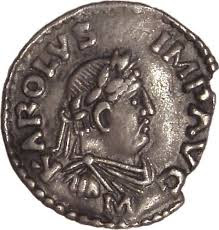
Being in charge of a mint in medieval Europe was a sign of power and status.  A lot of counts had their own mints (my little silver penny was minted under the authority of the count of Nevers).  Kings especially minted larger denomination coins and were proud to put their own image on them, as in this coin of Charlemagne's, where he is portrayed as a Roman emperor.


 Medieval rulers would routinely try to reduce the real value of their coins without reducing the nominal value.  So a silver penny might be made a tiny bit thinner, or the silver might be mixed with tin or bronze, just a tiny bit.  (Then a tiny bit more when the coins were melted down to make new ones.)  This was especially appealing if they had agreed to pay workers more.  ("See, 12 silver pennies, just like I promised.  What do you mean they look kind of funky.")

The Wild West aspect of collecting medieval coins is heightened by the fact that a coin is intrinsically valuable, for the silver (even if alloyed) and for the historical rarity.  So people with collections sell coins if they need (modern) cash.  And why bother verifying the provenance?  Or the grandkids may find a small collection in Grandpa's attic and sell them off one at a time.  Coins can travel great distances.

One of the largest collections of Byzantine coins in the US is in Lincoln, Nebraska, at the university.  The Perry-Campbell collection has some 4000 coins that Mr. Campbell collected in the first half of the twentieth century, while living in Istanbul.  He would buy coins from the locals, who'd found them in their house or dug them up or were breaking down an old collection, and he boasted he paid maybe 10 or 15 cents on average for each.  He liked to show his collection to others interested in old coins, and they'd often trade, further obscuring any provenance that might once have existed.  The coins ended up in Nebraska because that's where Mrs. Campbell was from.  They are uncatalogued, though a graduate student (Samuel Skokan) is doing a good job getting them organized.


© C. Dale Brittain 2024

For more on the medieval economy, see my new ebook, Positively Medieval: Life and Society in the Middle Ages.  Also available in paperback.

Thursday, May 16, 2024

Seals

 We use signatures symbolically to indicate our agreement to something or to authorize it.  Go into the bank to set up an account or apply for a loan, and you'll have to sign in a great many places.  A presidential executive order is not official until signed.  A piece of paper with maybe a flower on it that says "this piece of paper is worth $346.18" (ie a check) takes its validity from your signature.  When you agree that you have read and accepted the terms and conditions of a website (yeah, like you've actually read them all), you "sign electronically" by checking a box.

Medieval people occasionally signed, but more often they used seals.  The Romans had used seals, generally lead.  Hot lead would be dribbled onto something, then imprinted with a signet (note the similarity to the word signature).  This might have a small image of something but would have the official name as well.

The Byzantine emperors, heir to the Romans, continued using lead seals.  But they, and the popes, who also were heirs to Rome, soon switched from hot lead to cold lead.  Because lead is quite a soft metal, one could use a powerful press to mark the lead with the signet.  Instead of an uneven blob of (originally molten) lead, one would have a nice round seal, previously made in an even shape, then imprinted.  Of course the imprinting would sometimes be a little off center, but it was still a lot better than a blob.

During the early Middle Ages, wax rather than lead became the standard for most seals.  Lead seals had been used by emperors and popes (who continued to use lead, just as they continued to use papyrus when everyone else was using parchment, as I have discussed previously).  But wax seals slowly worked its way down the social ladder, to kings, to great dukes and counts, to lords of castles, to bishops and abbots, to city mayors by the thirteenth century.

Originally the way to seal with wax was to cut a slit in the parchment and dribble soft wax through, then press a signet on both sides (different images, seal and counter-seal).  But soon instead documents began to be sealed by folding up the bottom an inch or so, cutting a slit through both layers, running a cord or a strip of parchment through the slits, and attaching the two ends together with a ball of soft wax that was sealed on both sides.


The above image of Magna Carta shows the document King John was forced to sign, with his seal hung off the bottom.

As was the case here, seals were usually colored red.  But cream colored seals (natural wax color) are also found.  In the nineteenth century some collectors cut the seals off charters, just leaving the slits by which they had previously been attached.  Some people living in farms that had once been monastic buildings melted down the seals to make wax to seal their jars of jam.  This is very depressing for medievalists.

 © C. Dale Brittain 2024

For more on medieval documents and other aspects of medieval social history, see my ebook Positively Medieval, available on Amazon and other ebook platforms. Also available in paperback.


Tuesday, May 7, 2024

Reims cathedral

 Reims cathedral is now considered one of the glories of Gothic architecture, built in the thirteenth century more or less to a single plan, unlike some other cathedrals that might have their construction last for generations, meaning the style kept changing.


 Unlike Notre Dame, where the flying buttresses had to be added later, when the lead roof started pushing down on the walls so they started bowing out, Reims had flying buttresses from the beginning.  It also has lovely sculptures, like this angel with a Mona Lisa smile.


But Reims' importance went back far before the thirteenth century.  Saint Remigius, who was bishop of Reims at the end of the fifth century, baptized Clovis, king of the Franks, making him the first Christian king of the Franks and, in subsequent generations, considered the first king of France.  There is a plaque today in the thirteenth-century cathedral showing the exact spot where this is supposed to have happened.

Down the street from the cathedral is the old monastery of St.-Remi, dedicated to Saint Remigius.  The monastery and the cathedral have had a constant low-level dispute since the sixth century over who the saint loves best, the cathedral where he was bishop or the monastery where he was buried.  St.-Remi built a new, lovely Romanesque church in the twelfth century, totally outshining the then cathedral (300 years old at the time), but then the bishop and cathedral canons built their thirteenth-century church, much bigger and snazzier, and were able to sneer.

Because Clovis was baptized at Reims, the Carolingian kings of France in the ninth-tenth centuries started being crowned there, as an effort to connect themselves with their Merovingian predecessors.  French kings continued being crowned at Reims, with few exceptions.  Joan of Arc had to lead an army to clear a path to Reims to get the dauphin there to be crowned.  Paris really only became France's capital at the end of the tenth century, when the Capetian dynasty came to power (they'd previously been counts of Paris), and nobody wanted to break with tradition.

Reims cathedral was, deplorably, shelled during World War I (battle of the Marne and all that).  However, the walls were still there and most of the outside statues (like the angel).  It was rebuilt over many years, finished just in time for World War II, though fortunately it escaped damage then.  Its rebuilding gave hope to those rebuilding Notre Dame of Paris, which was in fact less badly damaged (the roof went but much of the interior survived, due to a stone ceiling below the lead roof).  Notre Dame will not be finished by the summer 2024 Olympics, the original goal, but it's coming right along.

The word Reims, by the way, may be hard to pronounce (it's something like "rhanz").  The British spell it Rheims and pronounce it "reemz."  Just so you know.


© C. Dale Brittain 2024

For more on the medieval church, see my ebook, Positively Medieval:  Life and Society in the Middle Ages.  Also available in paperback.


Tuesday, April 30, 2024

Papyrus and popes

Papyrus was considered the only proper writing material in late antiquity in the Mediterranean basin.  It was made from papyrus reeds, especially as grown along the Nile.  The reeds would be slit (they're sticky on the inside), spread out, and pressed together into several different layers.  When dried, they made a good writing surface.  Although parchment (made from animal skin) was known, it was considered inferior.  Saint Augustine apologized in one letter for writing on parchment, because he'd run out of papyrus.  I'm not trying to insult you or anything! (not his exact words, but his meaning).

The difficulty with papyrus is that it has to be kept dry.  If it gets damp, it can disintegrate back into pieces of reed.  This is a problem once you get into Europe's damper climate.  The other problem is access to the papyrus reeds themselves, as of course they won't grow in most of Europe.

The popes of late antiquity/the early Middle Ages wrote on papyrus (see more here on early medieval popes).  They really only became the heads of western Christendom in the sixth century, at least in their own minds (almost no one in Europe would have been able to tell you who was pope at any given time), and they got in a couple of crates of papyrus, to have plenty of writing material on hand.  With the rise of Islam in the seventh century, their access to Egypt and papyrus reeds was cut off, so it was a good thing they had stockpiled.

Over the next four centuries, through all sorts of upheavals, the Lateran palace in Rome maintained their papyrus stockpile.  There must have been a special room where it could be kept warm and dry, although we have no details.  Slowly they worked through it, writing letters to kings, to bishops, to monasteries.

The problem was that the people they wrote to didn't have nearly as good conditions for storing papyrus.  Charlemagne's grandfather, in the early eighth century, had a special volume drawn up, copying every missive the family had had from the pope copied onto parchment.  Most of the documents were less than fifty years old, but they were already disintegrating.  Bishops and monasteries too felt the need to copy their precious papal documents onto something more permanent than papyrus.

Very few early medieval papyrus documents survive.  We do know that through the seventh century most towns in the old Roman empire had municipal archives, where important documents were stored, but these all disappeared, and probably the fragility of papyrus had a lot to do with it.  A few monasteries managed to keep a handful of papyrus documents, such as Saint-Denis, which scraped off the ink, turned the papyrus over, and forged new and better papal confirmations on the back.  By the eighth century most of Europe switched to parchment.

But not the popes!  They hoarded their papyrus until it finally gave out in the eleventh century.  During this time they also continued to write their documents in what is known as late Roman cursive, big flowing and looping letters that must have been increasingly hard to read by anyone north of Italy.  The rest of Europe switched after the eighth century to what is known as Caroline miniscule, which looks a whole lot like modern printing, for the excellent reason that modern printing is derived from it.  What's this? many a bishop must have thought, getting a piece of papyrus with almost indecipherable writing on it from the pope.

German popes in the mid-eleventh century brought the papacy into European relevance with parchment and Caroline miniscule as well as assertions of being the top of the church hierarchy, but that's another story.  (And of course "papal infallibility" was first proclaimed in the nineteenth century.)

Our modern word paper is derived from the word papyrus.  First Arabs in the thirteenth century and then most of Europe in the fourteenth century figured out that paper, made from cotton, worked a whole lot better than papyrus reeds.

© C. Dale Brittain 2024

For more on the medieval church and medieval literacy, see my ebook, Positively Medieval:  Life and Society in the Middle Ages.  Also available in paperback.


Wednesday, April 17, 2024

Invention of Tradition

 "Invention of tradition" is a great term.  It was originally coined by Eric Hobsbawm, to mean a conscious effort to create a vision of the past that will support whatever you are doing (or want to do) in the present.  "We have always done this," or "These are our traditional values" has enormous weight.  If one isn't quite sure what one has always done, or what one's traditional values might be, a little historical research should do the trick, especially if one has a pretty good idea of what is intended to be found.

Hobsbawm focused primarily on Great Britain, where he noted that the people of Scotland in particular pulled together all sorts of elements to identify Scottish identity during the nineteenth century.  For example, the idea that each clan had a distinctive tartan, and that people with certain last names might belong to a clan with a different name and still be entitled to wear its tartan, is no more than 200 years old, even though it was presented as medieval (and surely connected to Robert the Bruce).  The careful identification of the colors and patterns of each distinctive tartan and their assignment to certain groups was in fact a nineteenth-century project.


A Scotland identified by kilts and bagpipes was also a Scotland of sturdy folks, full of heroism and wholesome country values.  Something similar happened in Switzerland.  In the nineteenth century a country that had been seen as made up of rather backward, dirty and uneducated mountain folks, living snuggled up to their cows, set out to reinvent itself.  In the late Middle Ages, Switzerland had fought to free itself from rule by Austria.  William Tell was one of the legendary war leaders.  William Tell became in the nineteenth century a great national hero, standing strong against Austrian tyranny, worthy of having an opera written about him (older people today still think of that opera's overture as "Lone Ranger" music).  The "shoot an apple off someone's head" story if a bawdlerized version of the legend.

Besides William Tell, the other great hero of nineteenth-century Swiss reinvention was Heidi.  I loved the book Heidi as a child and must have read it a dozen times or more.  I cried when I realized that in the book Heidi had curly black hair, which I do not have (in movie versions she's always blonde).  Little did I realize that the idealized world of life in the Alps that the book portrayed was intended to combat the image of dirty Swiss who were almost cows (or goats) themselves.  Heidi thrives under the care of her goat-keeping and loving grandfather, goes to school to get a good education, and, as her greatest triumph, heals a sickly Austrian girl by bringing her to the pure air and food of the Alps.  (Take that, imperial Austria!)

Switzerland completed its transformation from dirty backwater to highpoint of wholesome country values during the twentieth century, especially with the spread of downhill skiing.  Sure, other countries have mountains, even Alps, but the Swiss led the way with resorts, ski lifts, and the like.  Swiss hotels are aggressively clean, even the simplest.  As a Portuguese restaurant keeper, living and working in Switzerland, once told me, if anyone ever suspected his food was not the purest and freshest, it would be, at once, back to Portugal.

The Middle Ages is often chosen as the source of the tradition that someone wants to invent.  For example, modern white nationalists have seized upon a very poorly understood vision of Anglo-Saxon England as the basis of what they want to do, as I have discussed earlier.  The Middle Ages is a popular choice to base origin myths because it is when Europe's countries first took on something like the borders and languages they have today, and (I fear) because, especially in the US, it is so little studied.

"There were three orders of society! The church told everybody what to think and believe! Kings were absolute! Women had no rights! Everyone lived under feudalism!" This is about what even well educated people may tell you about the Middle Ages (clearly not the people who've been reading this blog, if you still think so, go back and read it again).  "Since we know almost nothing about those thousand years, it can mean whatever we want!"


© C. Dale Brittain 2024

For more on society during the Middle Ages, see my ebook, Positively Medieval:  Life and Society in the Middle Ages.  Also available in paperback.