Three years ago this spring, the cathedral of Notre Dame burned. This was a heartbreaking loss of a cathedral that had stood in the middle of Paris for 850 years. Today it is being restored, and the goal is still, as announced in April 2019 right after the fire was put out, to have it open again by the summer Olympics of 2024, which will be held in Paris.
So what exactly does "restoration" mean? It has a specific meaning that is not just rebuilding or repairing. It means putting it back to its "last known state," what it was like before the fire, i.e. like the image below.

This is not the twelfth-century version of Notre Dame (building began in 1163). The twelfth-century version was a construction site. It was not actually finished until the 1220s, some sixty years after construction began, and those bell towers were among the last things built. And Notre Dame has had plenty of changes over the centuries, even though the overall structure has remained pretty much the same since the thirteenth century. The flying buttresses were added not long after it was officially finished, because the weight of the roof threatened to push out the walls, built tall and thin with lots of windows. (Once the fire took off the roof, those buttresses threatened to push the walls in, though lots of trusses have now staved off collapse.)
Other changes happened over the centuries. In the seventeenth century, the cathedral canons decided the original stained glass was silly and old-fashioned and knocked a lot of it out, replacing it with plain glass. In the eighteenth century, with the French Revolution, the heads of the kings and queens of the Old Testament, arrayed across the front over the doors, were knocked off. Down with tyranny! A smaller fire scorched the cathedral in 1830, during a revolt against the archbishop. So when Victor Hugo published Notre-Dame de Paris in 1831 (known in the English-speaking world as The Hunchback of Notre Dame), the cathedral was in a deplorable condition, to which his book brought attention.
Viollet-le-Duc to the rescue! He was an architect who essentially invented the restoration of historic buildings in the 1850s, putting them back to what they had been.
Before then, a damaged historic building, or one that was no longer serving the desired purpose, was either just patched up or rebuilt in whatever the current style was, whether or not it was anything like the original. Medieval architects had little interest in restoration. When the current Notre Dame was first being built in the twelfth century, the remains of the various cathedrals that had stood on the spot since the fourth century were cleared away. Some of their stones were reused in the foundations of the new structure.
Viollet-le-Duc intended not only to restore Notre Dame to what it had been like in the twelfth-thirteenth centuries, but to make it what he thought it should have been like. He thus had new heads made for the kings and queens of the Old Testament, much sweeter and more simpering looking than the thirteenth-century originals (now knocked off). He made the gargoyles now considered iconic. His work was finished by about 1870.

Most notably, he made a really enormous spire to rise above the crossing of the nave and transept and decorated the area with copper figures of the Apostles. It is Viollet-le-Duc's version of the cathedral that is now being restored, medieval with a nineteenth-century twist.
I personally have doubts about that spire. When it caught fire, it crashed through the stone vaulting below, causing most of the damage that occurred to the church's interior. In the rest of the church, the medieval stone vaulting (sort of like a ceiling, below the roof) held up fine, protecting the cathedral's interior even while the fire raged above. The vaulting may have indeed been weak where the spire fell, because Viollet-le-Duc had removed it at the crossing point, to bring up his enormous spire in sections from below. He then replaced it, but I bet his techniques weren't up to the thirteenth century.
Some of the limestone from which the church walls were built was badly weakened by the fire. Stone won't actually burn, but limestone, when heated in a lime kiln, breaks down to become one of the ingredients to make cement. Some of the stone in the upper walls near the roof broke down badly in the heat, so new limestone is being quarried to replace it.
The biggest disaster was the roof. It was supported by what was called a "forest" of oak beams, and the 900 year old timbers burned like crazy. Originally it was thought that there was no way that 1200 or 1300 oaks big enough could be found in modern Europe to replace them, so other plans were suggested, including a glass roof supported by steel beams, with a garden growing on top of the stone vaulting. But the architects claim to have found 1200 big enough oaks, mostly from France though some from eastern Europe, many planted in the eighteenth century with the intention of growing them into masts for ships.
One might wonder if building back in wood is the best plan, but they're going with it (sprinkler systems are supposed to be involved). Timber framers have been studying medieval methods for a long time, so they will reconstruct the "forest" as it was (it was thoroughly documented), using mostly medieval techniques, though some sawmills will be involved.
The roof itself was a topic of intense discussion. It was 500 tons of lead, which spewed toxic lead dust over central Paris with the fire. But at least for now the plan is to go with lead, based on the argument that no one will climb up and lick the roof, so don't worry about it.
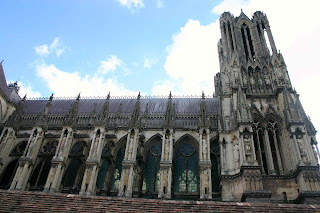
The cathedral of Reims was heavily damaged in World War I, with the vaulting taken out as well as the roof. It was restored over a twenty year period, just in time for World War II, when fortunately it was not bombed again. Today it looks a lot like it did in the thirteenth century, or the early twentieth century anyway (they had plenty of photos to work from). They reused as many of the fallen stones as they could. So Notre Dame may well soon be looking like itself again, again welcoming 50 or more times as many tourists as people attending Mass.
The February 2022 National Geographic has a good article on the people doing the restoration work.
© C. Dale Brittain 2022


