Showing posts with label relics in the Middle Ages. Show all posts

Saturday, December 26, 2020

Saint Stephen

 It's the day after Christmas, Saint Stephen's day, so I will blog about Saint Stephen.

Most people probably only think about him in relation to the King Wensceslas song, which is always treated as a Christmas song, even though it doesn't mention Christmas, just "the feast of Stephen."  Since his feast day is the day after Christmas, it all makes sense.  The song is all about how the rich should remember and help the poor, which is a repeated motif in many old Christmas songs, although there seem to be a lot of people who lose track of that.

The day after Christmas is called Boxing Day in Britain and much of the old British empire.  This has nothing to do with hitting each other with puffy gloves.  Rather, it has to do with boxes, service people going around with boxes hoping for tips from folks they've served all year.  Maybe in the spirit of Wensceslas?

But I digress.  The original Stephen is in the New Testament.  Stephen may not even actually have been a name then (though it quickly became one), as in Greek stephanos meant honor or glory.  He is often called "protomartyr," meaning first martyr, because he is the first person recorded as being put to death for his Christian faith.  In the Book of Acts he is one of the followers of Peter and the rest of the original Apostles and is stoned to death by the Jews for following this disruptive set of ideas.  Saul of Tarsus, who later became Saint Paul and one of the leaders of the early church, was said to have witnessed the stoning and been disturbed by it.

(In the Middle Ages there were even earlier martyrs celebrated, the Holy Innocents, all the baby boys Herod was supposed to have killed in trying to kill Jesus.  But Stephen still got to be a protomartyr.  The Innocents were celebrated on December 28.)

Though Stephen was killed long before the New Testament was composed, he was often depicted holding the Gospels, as in the image below.  Also note the stones.
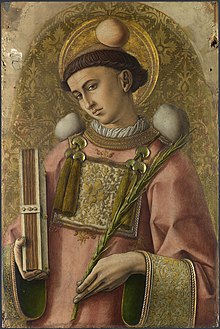
St-stephen.jpg

As well as being the first martyr, Stephen was one of the first saints to have his bones discovered, treated as relics, and have churches named for him.  This happened at the beginning of the fifth century, nearly 400 years after his death.  After his relics, buried outside Jerusalem, were revealed in a vision, they were moved into a church on December 26, which is why today is his feast day.

Bits of his bones were sent to various other parts of the Roman Empire (which, you'll recall, was officially Christian at this time).  Saint Augustine of Hippo, a bishop in North Africa and one of the main theologians of the early western church, had originally been skeptical about relics, but he was impressed with the miracles these relics performed.

In the following decades, a great many churches were named for Stephen.  Originally churches had not been named for saints, but now they started to be.  In France St.-Etienne (Saint Stephen) is a very common designation for a cathedral church.  An old baptistry church, originally separate from the cathedral, would be named for Saint John the Baptist (St.-Jean) for obvious reasons, but the other French churches of the fifth and sixth centuries were generally named for local saints.


© C. Dale Brittain 2020

For more on the medieval way of thinking about saints, see my new ebook, Positively Medieval: Life and Society in the Middle Ages.  Also available in paperback.

Thursday, December 12, 2019

The Shroud of Turin

The Shroud of Turin is a remarkable object, a piece of linen with an image of a dead man depicted with dark red stains that might (maybe) be blood.  The man is shown as a photographic negative, light for the parts that would have been dark and vice versa.  Since the Middle Ages the linen has been thought by many to have been a burial shroud for Jesus after the Crucifixion.

Turin shroud positive and negative displaying original color information 708 x 465 pixels 94 KB.jpg

 On the left is a modern photograph of the face on the Shroud, the way it appears if you just looked at it now.  On the right is a photographic negative, showing how the image comes alive when one photographs it using black and white film and then looks at the film (the negative) rather than printing it.  Understandably, this has raised major questions, because this couldn't have been seen before the invention of photography in the nineteenth century (it wasn't indeed noted until around 1900).

The Shroud first showed up in the fourteenth century in France.  It was in the possession of a man known as a notorious relic-monger.  Indeed, the bishop of Troyes declared it a fraud in 1390, saying it was designed to mislead the gullible, tricking them into visiting the church that had it and making offerings.  The bishop also announced that the artist who created it had confessed.  Medieval people believed in relics but also made clear that one should not believe everything presented as such.

Nonetheless, the Shroud has continued to attract attention and belief over the centuries.  In the sixteenth century it was acquired by the cathedral of Turin, where it has been ever since.  It has become a major tourist attraction there, even though one cannot actually see it, instead just seeing the chapel where it lies.  Actual viewings are very rare but also very popular. 

There are enough odd things about it that many still assert its authenticity, even though it's hard to explain where it could have been for 1300 years and why no one knew about it.  The strange "negative" effect has been discussed as the product of rays (?) emanating from the dead man, which of course would make more sense if the dead man were supernatural.  Some people however have claimed to have reproduced something that looks a whole lot like the Shroud using medieval techniques.

Some have said (though it's been disputed) that the plant pollen found on the fibers are more typical of the Middle East than medieval France, though even if this is the case, it might only show the Shroud to be a fourteenth-century Middle Eastern creation.  The carbon-dating of the fibers indicates a medieval date, though some have asserted that those who did the carbon-dating were misled by skin cells and the like left behind by people who touched and kissed the Shroud in the medieval period.

The modern Catholic church does not consider the Shroud a relic.  A relic, as I've noted before, is either a body part of a saint or something a saint touched and used (the latter being so-called second-class relics).  Rather, Pope Francis has called it an "icon."  Like paintings or other depictions of Christ (including Byzantine icons) it is considered to have value in orienting the thinking of the faithful toward divine subjects, even if the object is not divine itself.  The Holy Hanky of Cadouin, once thought to be stained with Jesus's sweat until its "decorative border" was revealed to be a statement of Muslim faith in Arabic, is similarly revered today as something to make the faithful ponder the life and death of Christ.

The Shroud thus indicates that people in the Middle Ages and the twenty-first century have reacted very similarly to relics:  some want to believe, some are dismissive, some say there's a deeper meaning regardless of historical accuracy.

© C. Dale Brittain 2019

For more on medieval religion, see my ebook Positively Medieval, available on Amazon and other ebook platforms.


Monday, January 30, 2017

The Holy Hanky of Cadouin

The monastery of Cadouin, founded in the twelfth century in southwestern France, had and still has the Holy Hanky.  (Its official name is the Saint-Suaire.  It means Holy Hanky.)  Discredited as a genuine relic since the 1930s, it is a very interesting example of how relics were seen and used in the Middle Ages.


Here's a picture of it.  The story is that it was a handkerchief used to wipe the sweat from Christ's brow as he carried the cross on the way to his crucifixion.  Shortly after the year 1100, when the French had just conquered Jerusalem during the First Crusade, the pope's representative on the crusade, the bishop of Le Puy, picked it up in Mustafa's House O' Relics.

(Okay, there wasn't really a Mustafa's House O' Relics, with a certificate of authenticity bearing the genuine facsimile signature of Jesus H. Christ.  But close.  The rest of it's real.)

The bishop sent the precious relic, which he said had protected him in battle, home to his cathedral of Le Puy.  But the cathedral canons frankly didn't believe the story of the priest whom the bishop had commissioned to take it there.  Medieval people were by no means ready to believe in every relic someone presented to them.  The priest ended up in the newly-founded monastery of Cadouin instead, along with the Holy Hanky.  (It's not clear what the bishop's reaction was when he found out what had happened to his relic.)

This small, out of the way monastery quickly became a place of pilgrimage.  People flocked to see something so holy, a physical connection to the redemptive suffering of Christ.  It was widely considered to perform miracles.  Its authenticity was considered proven by the miracles it worked.  And why should we say it didn't?  We weren't there.  It inspired gifts to the monastery from such notable people as Eleanor of Aquitaine.

Over the centuries it continued to be revered.  When France went officially atheistic during the French Revolution and both monks and relics were tossed out in the street, the mayor of the village of Cadouin took the Holy Hanky and hid it under his floorboards, until Catholicism was reestablished.

It continued to receive attention and have miracles attributed to it until the priests of Cadouin unwisely decided in 1934 to prove scientifically that it was authentically from the first century AD.  The first thing to turn up was that what they had always assumed to be a decorative border was actually Arabic writing, saying, "Allah akbar!  There is no God but Allah and Mohammed is his prophet."  Oops.

Things went downhill from there.  It's now been determined to have been woven in Egypt shortly before the pope's representative got it.  On the up side, it is one of very few surviving pieces of Egyptian cloth from that period in such nice condition.

Today in Cadouin there is a chain hanging above the altar, where the reliquary with the Holy Hanky used to hang.  There is a display comparing it to the Shroud of Turin (also now known not to be from the time of the crucifixion), discussing how the true source of miracles is not a piece of cloth but God's response to piety and prayer, which may be inspired by almost anything, including an Egyptian handkerchief.

© C. Dale Brittain 2017

For more on medieval religion, see my ebook Positively Medieval, available on Amazon and other ebook platforms.


Friday, April 22, 2016

Relics and reliquaries

As I discussed in an earlier post, saints acted as mediators between humans and the divine in medieval Christianity--as indeed they still do in modern Catholicism.  Saints were not distant figures, because medieval churches would still have a piece of them, their relics.

The early church was slightly leery of the idea of preserving body parts of the holy dead.  Certainly they buried them reverently, but the first time that a bishop put bits of the bones of a saint into an altar was at the end of the fourth century.  Saint Augustine, initially uncertain about the practice, became an enthusiastic supporter in the fifth century.

He was convinced because he believed they could work miracles.  The bones of Saint Stephen, who is mentioned in the New Testament as the first martyr (someone killed for his faith), gained a great deal of attention at this time, and churches all over Europe were dedicated in his honor.  Stephen was soon joined by other saints, both "universal" saints like Mary and local holy men and women, who would be revered where they were buried and who would be considered likely to listen to the prayers of their neighbors.

A relic trade quickly grew up, bringing bones especially from the Roman catacombs to churches that needed relics.  Medieval people did not automatically believe every bone was a relic.  If there was any doubt, they would test it, for example by throwing it into a fire and seeing if it hopped out, or trying to see if it would work a miracle.  Scientific method in action.  (Click here for more on medieval miracles.)

Similarly, medieval people were suspicious of people willing to sell relics--who would want to get rid of a real relic?  So if a church did buy a relic, they would usually do so from someone who claimed to have stolen it.  These "holy thefts" were considered only to be possible if the saint was willing to leave--probably because the church where their relics were located was not treating them right.  If someone wanted to steal relics which did not want to go, they would become enormously heavy, or the thief would find it impossible to leave town.

Relics could be classified as first-class or second-class.  First-class relics were actual pieces of the dead saint.  Second-class relics were things the saint had touched or used, like items of clothing.  Some of the  best-known second-class relics were the (supposed) Crown of Thorns, brought from the Holy Land to Paris in the thirteenth century (it is still preserved at the Ste.-Chapelle), and the "chemise" of the Virgin, kept at Chartres, supposedly the nightgown Mary was wearing when she gave birth to Jesus.


Relics were generally kept in reliquaries.  These boxes were beautifully decorated, often inset with jewels.  Sometimes the reliquary would be in the shape of the body part--for example, an arm bone might be kept in a reliquary shaped like an arm.  Sometimes the reliquary portrayed the saint herself.

For important festivals and councils, the reliquaries would be taken out of the church and become part of the procession.  A conference between the abbots and bishops of a number of different churches would also be considered a conference between the saints who had been brought along.  Although saints (like God) could be accessed anywhere, they were considered to be most present with their relics.  Just because they were dead didn't mean that they weren't still alive and part of the community.

A late medieval French king (Louis XI) wouldn't go out without a certain number of relics pinned to his clothes.  This sort of thing strikes many moderns as "superstition," but it is important not to be so dismissive.  As I discussed earlier, superstition is an action unrelated to the desired outcome (like wearing lucky socks), whereas the saints helped protect the king.

One may think of saints and their relics as something for days of long ago.  But during World War II, when American fighters were bombing the French city of Amiens (held by the Germans), the priests of the cathedral took out their saint's reliquary and showed the saint the danger.  The last bombing run stopped just short of the gorgeous fourteenth-century cathedral.  Hard to argue with success!

© C. Dale Brittain 2016

For more on medieval religion, see my new ebook, Positively Medieval: Life and Society in the Middle Ages.