Showing posts with label A Bad Spell in Yurt. Show all posts

Monday, September 30, 2024

Kindle Unlimited

 As I have discussed earlier on this blog, self-publishing ("indie" publishing) is a complicated process.  The author has to not only write the book, but themselves do (or hire) the editing, the formatting, the procuring of covers, and the actual publishing, to say nothing of keeping track of royalties.  And of course there's then advertising to make sure anyone knows your book exists.  Indie books almost never show up in stores, so no one is going to stumble across it wandering around Fred's Corner Bookstore.

The publishing platforms on which indie authors publish their books have issues of their own to deal with.  (Amazon's KDP has come to dominate the market, but Apple, B&N, and Kobo still have a decent share of e-readers.)  The whole idea is that there are "no gatekeepers," so they aren't going to check for quality of prose or story line or even basic sentence structure, but they don't want plagiarism or raw pornography or words sliding off the page of a paperback.  The platforms want to keep the best authors, those whose books are selling thousands of copies, and figure out how to maximize their own profits (harder when a number of indie books are, shall we say, a bit on the weak side).

Amazon has hit upon "Kindle Unlimited."  Indie authors can decide to enroll their ebooks in the program, in return for a promise to make sure their ebooks are exclusively on Amazon, no other ebook platform.  Voracious readers can then sign up for Kindle Unlimited, pay their $12 a month fee, and read as many ebooks from the program as they want.

These ebooks are officially borrowed, not bought, and the readers can only have ten of them "checked out" at once (and if they stop paying their $12 a month they all disappear from their Kindle).  The authors get paid, not the royalties they'd get from an outright sale, but a fee based on how many pages the KU borrower read.  (How do the bots know?  They know things.)

Romance readers especially, those who may read four or five books a week, love KU.  Why spend $3 or $4 to buy an ebook when for only $12 a month they can read a new book every day - or even more!  Find an author you like, and blast through their entire list.  Readers of other genres of fiction are often the same.

I've recently started an experiment, making my whole "Royal Wizard of Yurt" series available through Kindle Unlimited.  The series (6 novels, 3 novellas, 3 omnibus volumes) has been out for a while, so at this point my faithful fans have pretty much read them all.  So this is an experiment to see if I can get some new fans.  "A Bad Spell in Yurt," the first book in the series, is the gateway drug to all my fiction.


So far the experiment has been working well.  Even though I've done zero promotion, a number of KU members have found and read their way through the whole series.  An additional, unexpected but welcome result has been a number of people who have bought the whole series outright.  Can't tell if these are people who borrowed and read the books, then decided they wanted to have copies to keep forever, or if they're friends, ones who don't have KU memberships, and were told the books were Really Good by their KU friends (fine friends, there).  Either works for me!

So if you're a KU member who's been reading my blog for years but never got around to reading "Bad Spell," give it a try!  Here's the US link (also available in other countries).

https://www.amazon.com/dp/B004S2CPM2

The story is about a young wizard, fresh out of wizards' school, who becomes Royal Wizard in the tiny kingdom of Yurt. He has no idea what he's doing, being just glad to have graduated after all that embarrassment with the frogs, but he cheerfully rises to the challenges.  After all, he's not a very good wizard, but Yurt isn't a very big kingdom.


© C. Dale Brittain 2024

Saturday, May 6, 2023

Indie Book Covers

 There's an old saying, "You can't judge a book from its cover."  It means that glancing at something's exterior won't necessarily tell you all the complicated and interesting things within, and many an excellent book (among other things for which the book is a metaphor) may have a nondescript exterior.

But this saying does not apply to indie book publishing.  In a bookstore full of traditionally published books, someone may wander around, be intrigued by a title or a cover, or go to their favorite part of the store and see (for example) a new book on the US Civil War they haven't seen before, and pick it up.  Some of the titles they see will jog a memory of seeing that book reviewed favorably by (for example) the New York Times, or seeing it on a best-seller list.  The cover image isn't all that important.

This is why you will often see these days a traditionally published book that doesn't even have a cover image, just the title in interesting script on a solid cover background, or at most maybe a tree or an abstract shape.

Things are different for indie books.  There is no physical bookstore where someone may wander, looking at a finite number of books, selected by the staff as worthy of buying and reading.  Instead one is on an on-line bookstore, along with literally millions and millions of other books (including traditionally published ones), knowing perfectly well that a lot of the books are not worth buying.  (The advantage of indie publishing is anyone can publish. The disadvantage of indie publishing....)

So the cover becomes very important.  A well done cover serves a lot of purposes.  If interesting and intriguing, it can catch the potential buyer's eye.  If professionally done, it is a marker that the author cared enough about her book to try to do everything right, including (one hopes), story, editing, and formatting.  The style and content of the cover tell the genre:  a passionate-looking couple for romance, rockets or planets for science fiction, a pastoral scene with a church for a book of religious musings, and so on.

The cover's whole purpose in life is to make the potential reader look at the book's description and read the first few pages, then, one hopes, push the Buy button.  The cover is not strictly an illustration of any particular scene in the book, but it should convey something of the flavor of the book.

For example, A Bad Spell in Yurt, my first published novel, has a great cover by Tom Kidd.  It indicates without a doubt that this is fantasy, but the wizard hero's rueful expression, pile of books, and lack of swords indicates that this is not epic fantasy and has a good touch of humor (the title helps).


Tom Kidd read the whole book before he started painting the cover, but often the artists whom indie authors get to do their covers will just take suggestions from the author as to what the cover might show, in a simpler illustration.  Dane of EBook Launch did a very nice cover for me of The Starlight Raven without actually reading the book.  A young woman suggests the book is for and about teens (which it is), and in the front there's a raven with stars in its feathers.


In other cases, I've bought covers from graphic artists who put interesting covers together from stock photos, then I added my own title and author name to this "pre-made" cover.  Such was the case with Shadow of the Wanderers.  This one, the potential reader should be able to tell at once, is epic fantasy with a strong Norse component.


And sometimes I've used my own photographs. A picture of a staircase in the ruined castle of Fleckenstein, in Alsace, is on the cover of my (non-fiction) Positively Medieval.  I like it because it is very clearly authentically medieval, old and worn by many feet over the centuries, and because it seems to draw the reader into the book.

Self-publishing is free, but the serious indie author has got to assume that she'll be paying for a good cover at some point.  Without that almost subliminal hint that the right cover can give the potential reader, the book may never be bought and read.

© C. Dale Brittain 2023


Saturday, December 17, 2022

The Starlight Raven

 A lot of readers like series.  They get to know and like the characters, they enjoy the world in which the characters function, and they are eager to see what happens next.  This is why some authors keep a series going for dozens of books (mysteries are especially wont to do this), and why both TV shows and movies keep bringing out the same people to have new adventures.

I like a good series myself!  And I write them.  When I first wrote and published A Bad Spell in Yurt, I assumed it was a stand-alone.  At first I resisted suggestions that it become a series.  I'd seen too many series in which the problem solved in the first book turns out not to have been solved after all in the second book, thus undercutting what had been the first book's happy ending, or the same problems being presented repeatedly and unoriginally (as in the classic, Defeat the Dark Lord in book 1, defeat the Purple Lord in book 2, and in book 3, look, there's the Plaid Lord), or the author becoming so fond of his characters that he won't let anything exciting or dangerous happen to them.  But my husband persuaded me that my characters could mature and grow and face entirely different challenges, so "Yurt" ended up being a series, with 6 novels (and 3 shorter novellas).

But the series wrapped up well in the sixth novel, all the long-term plot lines resolved, our hero in a very different place than he had been at the beginning.  I didn't want to continue the series with lame adventures.

So instead I went with "Yurt, the Next Generation."  This series focuses on the hero's daughter, offspring of a witch and a wizard with the skills of both.  The Starlight Raven, the title of the first book about Antonia, has become a series in itself, with three books published and a fourth on the way.  It will probably be five or maybe six books in all.

These are quite different, I've found, than the original Yurt series, even if set in the same world.  A teenage girl (Antonia) is quite different from a perhaps overly-confident young adult male (her father when his series begins).  She has to worry about sex discrimination and unwanted attention from the opposite sex, things which never bothered him in the slightest.  I've added the dimension that witchcraft, female magic, is quite different from male wizardry, and Antonia has to try to find her way in both, while still being a girl.  Although the wizards' school gets mentioned a lot in the original Yurt series, Antonia's stories are actually set there, at least in part.  I've also done a lot more with inter-generational issues.

The result of introducing real teen-girl issues into fantasy is that a lot of people think of "The Starlight Raven" series as darker and for more mature audiences than the original Yurt, even though Antonia begins the series at age 14, whereas her father began his own series in his late 20s and has been killed at least once, although she's never been killed a bit.


Anyway, I hope that both "Yurt" fans and people who just enjoy teen fantasy will like "The Starlight Raven."  A sample is given below to whet your appetite.  Here's the link to the book on Amazon.

+++++++++++++++++++++++++++++++++++++++++++++++++++++++++++++++++++++++

Of course I knew my mother was a witch.
She never needed a match to light the fire.  She knew immediately if someone new had come to town, even if she had spent the entire day at home, sewing.  Sometimes in the evening, after she had finished tailoring a new ballgown for the mayor’s daughter or embroidering a new altar-cloth for the church, women would knock quietly on our door, giving quick glances up and down the cobbled street, and Mother would tell them if they were going to have a baby boy or a girl.
But I had no intention of living an uneventful life as a small-town witch.  I was going to study to be a real wizard.
That would be easy, I thought.  My father was head of the wizards’ school in the great City, a much more interesting place than our little town of Caelrhon.  He’d said himself that I could come and study there when I became fourteen, the first girl the wizards’ school had ever admitted.  Already I knew how to turn someone into a frog, something even my mother couldn’t do.
But on my fourteenth birthday it all became much less easy.

It started two weeks earlier.  A gentle hand on my shoulder interrupted my dreams.  “Antonia, wake up.”
“It’s too early to get up for school,” I mumbled into the pillow.
The hand remained on my shoulder.  “It’s not a school day.”
Then I remembered.  “We’re going to the City!”
I was out of bed with a bound, and then, with another bound, right back under the covers.  The air from my casement window was cold.  “It’s not even morning yet!”
Mother flicked a flame into life on my candlestick.  She was already dressed, her brown braids neatly wrapped around her head.  I loved her hair, smooth where mine was always tangled, darker than mine but showing golden highlights in the glow of the candle.
“I want to go there and be home again before it gets late,” she said firmly.  “After all, tomorrow is a school day.  In fact I hear,” she added with a smile, tugging the quilt off me, “that at the wizards’ school they give the new students only one warning.  Then, if they aren’t on time for the first early-morning class, they set the dragons on them.”
I swung my legs out of bed and kept them out.  “Sometimes I think everyone’s seen dragons except for me.  Father even killed one once when he was young, even though he won’t talk about it.  And there was the time we arrived in the City just too late to see a whole flock of them.”
“I’ve never seen a dragon either,” said Mother.  She had the brush and was working the snarls out of my hair.  “I think it would be more terrifying than exciting.  And I’m not at all sure they come in ‘flocks.’”
I let her work on my braids, thinking that once I was a wizard I would go visit dragons myself, rather than waiting for them to come to me.  A herd of dragons?  A pack?  A clutch?  I was fairly certain it wouldn’t be a gaggle.
“Besides,” I said after a minute, “I know they don’t punish students for sleeping late.  Father told me that when he was a student at the wizards’ school, he hardly ever made any of his morning classes.”
There was a chuckle behind me.  “Antonia, your father is an admirable man in many ways, and he’s made himself an excellent wizard over the years, but I would not recommend using him as your model when you become a wizardry student.”
I shrugged and laughed myself.  Having my hair braided was very pleasant.  I glanced toward my window, still nearly dark, and was hit by a sudden memory.  “I had the strangest dream,” I said slowly.  “It was about a bat.  He tapped at my window and squeaked this really high squeak, but when I sat up he flew off.  And for some reason I wasn’t frightened at all.”
“Of course not,” Mother muttered through hairpins.  “Bats won’t hurt you.  I’m glad you knew that, even in a dream.”
“And the strangest thing of all,” I went on, “was that he had a little cylinder tied to his leg—you know, like the carrier pigeons wear.”
“Who would send messages by a bat?” said Mother abruptly.  The last pin went sharply into my hair.  “Really, Antonia, you’re old enough to know that nobody finds someone else’s dreams very interesting.  Get dressed and come downstairs.”
She slammed my door behind her, leaving me wondering why she could possibly be so irritated by a dream.
No time to worry about it.  I splashed cold water on my face from the washbasin, pulled on a school dress, and laced up my boots.  In front of the mirror I smoothed out the hairs disarranged in getting dressed.  I grinned at my reflection and blew out the candle.  I was the daughter of a witch and a wizard, almost fourteen years old, and I didn’t think there was anything I couldn’t do.
When I clattered down the stairs into the kitchen, Mother was frying bacon and smiling again.
But then I saw it, lying on the table amid dressmaking scraps:  a tiny piece of parchment, half unrolled.  It looked like the kind of message usually brought by a carrier pigeon.

© C. Dale Brittain 2015, 2022

Friday, February 21, 2020

The 19th century and the Middle Ages

Okay, historians generally put the close of the Middle Ages at the end of the fifteenth century, somewhere in the decades surrounding the year 1500, when Columbus, the Protestant Reformation, and the printing press changed a whole lot of things.  Today however I suggest that in many ways the Middle Ages lasted until the "long" nineteenth century.

Historians like to use the term "long" when discussing a century.  That way we aren't locked into a strict hundred year period where the first two digits are all the same (if after 1000).  Here I discuss the period from roughly the 1770s to the outbreak of World War I (1914), arguing that the many upheavals and developments during this period changed many aspects of everyday life that had been unchanged since the Middle Ages.

Three of the big developments of the late eighteenth century in Europe and North America (where European culture predominated) were the Industrial Revolution, the beginnings of universal education, and the end of the assumption that countries would naturally be ruled by kings.

The Industrial Revolution, which appeared first in England, was based on a turn from human/animal power, plus a good amount of wind/water power, to power from fossil fuels, primarily coal. Machines powered by coal (or steam generated by coal fires) could work very fast without tiring.  Manufactured products became much more accessible and affordable, starting with cloth and steel.  Factories (and the resulting air and water pollution from burning coal) spread rapidly.

The Enlightenment, which began in France, believed in the basic rationality of humans and thought that people would make wise decisions and be able to make good lives for themselves if they just had a better education.  Although it took a while, this idea resulted in the next generation or two of schools being established for everybody, not just the well-to-do.

Small entities (like cities, or the Swiss cantons) had long been ruled by elected leaders.  But the American colonies, which after freeing themselves from England had started as a confederation of small entities/states, with elected governors (that's why the name of the country is the United States), decided in the Constitution (1789) that there would be an elected central government for the whole country.  George Washington rejected being called king, which would have been the default title, and settled on the innocuous title of president, he-who-presides.  The French, whose Revolution also began in 1789, originally wanted a limited monarchy (as England already had) rather than the absolute monarchs they'd been having, but they eventually also settled on presidents (after various adventures, including Napoleon as emperor, which I won't discuss now).

Now we get into the real nineteenth century.  Peoples' lives were radically altered by improvements in transportation and communication.  Trains, which were everywhere by the 1860s and 1870s, meant you could now travel in an hour a distance that would have taken all day on horseback.  By the first decade of the twentieth century cars were appearing, allowing individualized travel.  Telegraphs came in with the railroads (you had to let the next station down the line know a train was coming, so there wouldn't be two trains on the same tracks going opposite directions), and then by the final decades of the nineteenth century telephones appeared, allowing people to speak across town or even across the country without having to be in the same room.  Photography developed rapidly, allowing  people to see scenes (like the aftermath of Civil War battles) far away.  We now take all these things for granted (plus being able to get restaurant recommendations or play games on our phones), but they would have drastically changed how people lived.

In many ways the Napoleonic wars (wrapped up in 1812) were very similar to fifteenth-century wars, with big cannons, horses, foot soldiers dragged into the fighting.  But the soldiers had uniforms, and there were individual firearms as well as cannons.  The American Civil War of the 1860s was the first modern war, with rifles and trains playing serious roles, and it really bore little resemblance to fifteenth-century wars, except that of course a lot of people died.  By the time of WW I, medieval warfare was clearly far in the past.

In the second half of the nineteenth century, first gas and then electricity spread to private homes, replacing candles and lamps for illumination (although even in the US not all areas were electrified until the 1920s or even 1930s).  Coal replaced wood for heating at the same time.  Movies first appeared at the very end of the century.  We're looking less medieval all the time.

Curiously, just as the Industrial Revolution spread pollution and separated the worker from the work of his or her hands, and made a whole lot of manufactured goods more easily available, people became nostalgic for a golden past and decided this past was the Middle Ages, as I have discussed earlier.
My own fantasy series that begins with "A Bad Spell in Yurt" (available on Amazon and other online bookstores) is set in a version of the 19th century, where magic made the Industrial Revolution unnecessary, and where such Middle-Ages-ending events as the discovery of the New World, the Protestant Reformation, and the French Revolution never took place (though they are still Enlightened in the world of Yurt and have limited monarchies).

© C. Dale Brittain 2020

For more on medieval and modern history, see my ebook, Positively Medieval:  Life and Society in the Middle Ages.


Friday, March 1, 2019

The Wood Nymph and the Cranky Saint

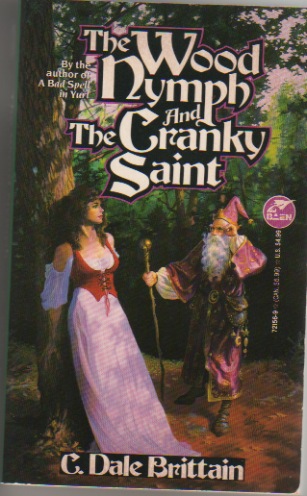
The second book in a series never gets the love or attention of the first book.  So today I want to talk a little about The Wood Nymph and the Cranky Saint, the second of my Yurt fantasy series.  (Available both as an ebook and as part of the print omnibus, My First Kingdom.  Here's the link on Amazon.)

Here our young wizard hero, who realized in the first book that if he was going to be a competent wizard it might have helped to pay attention in the wizards' school, has been a Royal Wizard for two years and has actually become sort of good at magic.  But then he has to deal with two extremes of renegade magic--the old retired wizard, who learned his magic back before the wizards' school even existed, and a newly-graduated young wizard who is just as feckless as our hero was a few years ago.

Plus cranky religion!  I'm a medievalist, so I've put into my medieval-themed fantasy genuine medieval stories about relics, saints who appear in visions, saints who blast their enemies with lightning, and other exciting tidbits.

For any book, catching the reader's eye is important, and the cover is a big part of that.  The book was originally published over 25 years ago, with the cover below.  I guess it's eye-catching, but the wood nymph of the title here looks sort of like Disney's Snow White, which she certainly shouldn't, and my young wizard hero looks like an old geezer, which he also shouldn't.


So when I made this into an ebook, I did my own cover, as seen below.  It is meant to suggest an old hermit in the woods.  (Did I mention there are hermits in the woods?)


The book is also now an audiobook.  This requires a separate, square cover.  I used an image of a mossy stream, because a lot of the book's action takes place in the woods (the hermits' woods) where there's a mossy stream that comes out of a cave in the side of a cliff.  (The actual stream is in Burgundy, if anyone is interested.)


Now I like this cover just fine, but my narrator finds it unexciting.  So I've created a new cover that now appears on Audible.  This is a reliquary from the Middle Ages and evokes the reliquary of the Holy Toe in the book.  (I told you there were relics in it.)


So if you're interested in listening to audiobooks, you'll get the above cover.  My narrator does a great job, so I highly recommend the audiobooks.  Audible, where they are to be found, is so eager to get new listeners that they're usually running a free trial, so give it a whirl!

Here's the link to the first audiobook in the series, A Bad Spell in Yurt, where you might as well start, for US and for UK listeners.  Enjoy!

© C. Dale Brittain 2019

Saturday, October 20, 2018

The Witch and her Daughter

I've got a new paperback!


It's an omnibus edition of the fourth and fifth books in the Yurt series, The Witch and the Cathedral and Daughter of Magic.  It's for sale on Amazon (link here) and coming soon to other bookstores.  (It's also available as an ebook, offered through Amazon at a discount price compared to buying the two novels separately.)

It's a companion volume to My First Kingdom, which was an omnibus of the first three Yurt novels.  These five books were originally all published by Baen as mass-market (small size) paperbacks twenty-five years ago, and if you bought them then they're probably falling apart by now.  These are trade (large size) paperbacks on sturdier paper.


If of course you've never read any of the Yurt books, what are you waiting for?  A Bad Spell in Yurt (the first one) can also be bought as a free-standing trade paperback or as an ebook on Amazon and all other major ebook platforms.  All five of these books are available both as ebooks and audiobooks.

And then there's the series' boffo finale, Is This Apocalypse Necessary? available both as its own trade paperback or as an ebook, and Third Time's a Charm, a collection of three novellas (short novels) that take place in between the main books (available ditto).

So refresh your shelves with new editions, or get started on your holiday shopping!  (If a girl can't promote her own books, whose books can she promote?)

The two novels in The Witch and Her Daughter are all about female magic-workers, confounding (or confusing) the male wizards, especially the wizardly narrator.  The books are surprisingly intense.  When I was formatting the paperback, I had to keep stopping to take a breath.  On the other hand, there are also some very funny parts, like the comment, "I've noticed this before. The Earth never opens up and swallows you when you need it to."

Here's the opening to give you a taste:

PART ONE - THE CATHEDRAL

That morning I thought my main problem was the three drunk newts.  But that was before I got the telephone call from the chaplain.  He was not in fact the chaplain any more, but then a minute ago the newts had been three drunk students.

I had been sitting in on Zahlfast's class at the wizards' school.  He paused in his description of the basic transformation spell to explain the dangers inherent in its use.  Any magic spell, even illusions, can have repercussions far beyond the expected, and advanced spells if not done properly can lead to loss of identity or even life.

The three drunk wizardry students, sitting together and laughing quietly in the back, had apparently decided to test for themselves what these dangers might be.

We dived for the newts before they had a chance to disappear into cracks in the floor.  "Hold onto those two, Daimbert," said Zahlfast.  "I'll start on this one."

The newts wiggled in my hands as I tried to hold their smooth bodies gently.  The loss of a tail or a leg as a newt would mean permanent damage to the student as a human, and if they escaped as newts we might never be able to return them to themselves.  They were quite attractive, light green with bright red spots, but their tiny newt eyes looked up at me with human fear.

The rest of the class had retreated to the back of the room.  Zahlfast glared at them.  "What are you waiting for?  This is all the demonstration you'll get today."  The students left in some confusion, and he returned to his spell.

It is harder to undo someone else's spell than one of your own.  As I started on one of the newts I was holding, Zahlfast finished with his, and suddenly a student stood before him, or rather slumped.  He was slightly green, but I think that was from feeling ill rather than the after-effects of being a newt.
I finished with mine and handed the third to Zahlfast.  "How can they be drunk so early in the day?  I didn't think the taverns down in the City were even open yet."

Zahlfast spoke the final words in the Hidden Language to break the spell.  "Bottles in their rooms," he said as the last dazed and frightened newt became a dazed and frightened wizardry student.

"We never had bottles in our rooms when I was a student here," I said self-righteously.

Zahlfast looked at me sideways, a smile twitching the corner of his mouth.  "As I recall, you had plenty of trouble at the transformations practical exam, even perfectly sober."

I preferred not to recall all my embarrassment with those frogs, even twenty years afterwards, so I loftily ignored this comment.  I had, after all, become a perfectly competent wizard in the meantime—or at least had managed to persuade the wizards' school of my abilities enough that they had invited me back for a few months as an outside lecturer.

"Now," said Zahlfast to the students.  "Are you sober enough to listen to reason?"

"Spill a spell, spoil a spell," blurted one and collapsed on his face.  I was interested to see that they still excused themselves for magical mixups with the same catch-phrase we had used years ago.

© C. Dale Brittain 2018

Saturday, October 1, 2016

A Bad Spell in Yurt

I've been writing stories since I was five years old.  Being a published author is a more recent development, however.  It's been just twenty-five years since my first book came out from Baen Books, a New York publisher specializing in fantasy and science fiction.  (Cover below.)


In honor of the twenty-fifth anniversary of A Bad Spell in Yurt, it has just been reissued in large format (trade) paperback, with the same great Tom Kidd art on the cover (see below).  Tom did a terrific job making Daimbert, my young wizard hero, look like himself.  Daimbert is not nearly as competent a wizard as he would like to be, but he has still managed to become Royal Wizard of Yurt.  On the cover, Daimbert is trying to work out how to work a magic glass telephone.


The new paperback is available directly from the publisher, CreateSpace, as well as from Amazon and Barnes & Noble--or from your own favorite bookstore.

The characters and situations came to me quite literally in a dream, along with the opening lines:  "I was not a very good wizard.  But it was not a very big kingdom."  (I should have more dreams like that....)  I wrote it in about four months, decided it was the best thing I'd ever written, and Baen accepted it with remarkably little fuss.

It was not of course the first thing I'd ever written, or the first time I'd tried to get a book published.  In elementary school I would fold sheets of manila paper so they looked (sort of) like a book and write and illustrate my own children's stories.  By junior high, I was writing chapter-books (as they are now called) on lined paper.  At a certain point I started typing on an old WWI era typewriter.  It was very exciting when, in high school, my parents bought me a (used) electric typewriter and I learned touch-typing.  By then I was reading "how to write" books from the library (something I'd recommend to any would-be writer), and figuring out things like avoiding clichés, ways to develop characterization, description versus action, how to get in background material, and the like.

In high school and college and graduate school I continued writing for fun, in many different genres, though fantasy was probably the most common (I read Lord of the Rings at an impressionable stage).  I had a whole series of 8 or 10 books that now look (sort of) like what George Martin started doing years later, high adventure in an imagined medieval-style world with fairly minimal magic.  The first was about Airnthal Silverblade, daughter of the king, on a secret mission into the enemy's capital.  I tried it on several publishers; it's probably just as well none took it.

So it was extremely exciting to get Daimbert out in the world.  It became a fantasy/science fiction best-seller and went through three printings in mass-market (small size) paperback.  In some ways, however, that early success has defined me.  Bad Spell was followed by five more novels and three novellas about Daimbert.  I've tried publishing other types of fantasy, but my fans just become distraught, feeling I'm wasting my time writing about anything but Daimbert.  I've recently started a new "Yurt, the Next Generation" series, and some fans can't even deal with that.

So for any die-hard Daimbert fans with a disintegrating twenty-five-year-old Baen paperback, now's your chance to get the new edition.  And now that book reading has branched out, you can also get Bad Spell as an ebook from Amazon and other e-tailers, or as an audiobook from Audible.  (The rest of the Daimbert books are also available as ebooks, and most of them as audiobooks.)  Enjoy!

© C. Dale Brittain 2016

Wednesday, June 15, 2016

Indie book promotion

As I discussed in an earlier post, one of the big challenges of publishing as an independent (rather than through one of the Big Six New York publishers) is getting noticed.  No one can buy a book if they don't know it exists.  Standing on the corner with a wheelbarrow full of books, like a stereotypical old-fashioned oyster seller, might work, but only for print (physical) books.  It's not going to work at all for an ebook.

So the first question after a new author publishes an ebook (typically through Amazon, B&N/Nook, iTunes, or Kobo) is, "How can I promote/market my book?"  No one likes to hear, "It's a ton of work and probably will have minimal results."  "There must be a secret!" they insist.  No, if there was a secret, either we'd all be doing it (in which case it wouldn't be secret), or else the few who had figured out the Secret would guard it with their lives, not wanting to dilute its effect.

It's actually simple and not secret all.  First, write a book that's as good as you can make it, including editing, cover, and description, as well of course as excellent content.  Make sure it's in a popular genre (tip, romance, SF/fantasy, and mystery/thriller usually do OK, poetry and children's books do not).  Then let everyone you know (especially on social media) know about it.  Then hope the Sales Fairies drop a big load of fairy dust on you.  Then write more books, even better than the first.  ("Your results may vary.")

Social media promoting can be difficult because, if your Facebook is nothing but "Buy my book!" no one will bother checking it out.  Same goes for Twitter.  I blog (well, duh, you say as you read my blog), but I doubt I get many sales of my books as a result.  Most people who come to the blog just seem to want to know about medieval farm animals (or, as one person recently asked, "Why were chickens sacred in the Middle Ages?"--hard to know how to answer that one….)

This is why promotion companies have sprung up.  Authors give them money, and they send out an announcement of a Special Sale on an ebook to a mailing list made up of people who have specifically asked to be notified of books on sale in their favorite genre.  This is targeted selling at its best, much better than randomly tweeting "Buy my book!" to anyone left on your Twitter feed.

The biggest and best (and most expensive) is Bookbub.  In the fantasy genre, they have roughly 1.8 million folks on their mailing list, and they anticipate that, on average, about 1800 of these will buy a particular book as a result of their mailing.  This is 1/10 of 1%, even though the recipients of the promotion email specifically asked to be notified, and indicates why most authors' own random mass blasts don't have much effect.

But 1800 sales in a couple days is good.  It is believed that a decent proportion of all Amazon ebook sales are due to a Bookbub promotion.  Sale of a first book in a series will, if the book's any good, lead to follow-on sales for the rest of the series, at full price.  This is why authors line up to give Bookbub lots of money.  There are other, less expensive promoters of this sort, but BB has by far the biggest mailing list.  They can afford to be very picky about which books they promote, which in fact helps, because the recipients of the emails know the books have been pre-screened for decent writing.  (Though some good books never get picked!)

I had a Bookbub promotion this weekend, A Bad Spell in Yurt on sale as an ebook for only 99 cents, on Amazon and other e-tailers.  As the first in the Royal Wizard of Yurt series, it's the gateway drug to the rest of my books.  I managed to sell over 2500 copies at the sale price, so I'm hoping that readers will want to continue with the whole series.

© C. Dale Brittain 2016

Sunday, July 19, 2015

Fantasy and Science Fiction

Modern fantasy and science fiction are now considered more-or-less the same genre.  Although they are shelved together in bookstores, they are quite different in origin and orientation.

Fantasy, as I discussed earlier, is the world's oldest literature, larger-than-life people racing across the landscape, having adventures that include a major element of marvel and the supernatural, adventures that the authors use to make moral points and to critique their society.  Think of Gilgamesh (a Babylonian epic) or, for that matter, the Old Testament.  Modern fantasy is a re-imagining of the twelfth-century epics and romances--but in the twelfth century these stories were not considered "fantasy" but simply literature.

Fantasy became a major genre in the twentieth century.  But when J. R. R. Tolkien's Lord of the Rings essentially started it in the 1950s, no one knew what to call it.  (There were some earlier examples, but not enough for a genre.)  The terms "fairy tales for grownups" and "super science fiction" were used in reviews of Lord of the Rings.  Fairly quickly people settled on "fantasy" (a term popularized by Ballantine Books in the 1970s), although the word "fantasy" still is used widely to use something completely imaginary, or something like a guy being surrounded by a bevy of lovely and willing wenches.


Today "fantasy" novels are expected to have dragons, wizards, and a more-or-less medieval setting.  This is true of my own novels, Tolkien's, George Martin's, and thousands more.  Some authors start with real medieval history and add magic, which can be considered historical fantasy.  Some authors try to defy the stereotype, putting magic (and sometimes elves or vampires) into the modern world, which can be either considered urban fantasy or magic realism (depending on the number of elves and vampires).  You know it's a popular genre when it spawns a lot of sub-genres.

Science fiction has much more recent roots, yet was established as a genre in popular literature before fantasy.  It began as a genre in the early twentieth century in the wake of the industrial revolution, as people began speculating on where our technology could take us--and whether that would be good.  While fantasy is set in an imaginary past, science fiction is set in an imaginary future.  Most commonly it has spaceships.

Although there has always been an element of "Aiyee! Here comes the tentacled space monster!" in science fiction, true fans prefer what they call "hard" science fiction, which is based on real science and which tries to have a rational explanation if something seems to defy what we would consider the laws of the universe.  Along with the adventures, there will be a lot of "world-building," speculating on what life on other planets or for alien species would be like, and how humans would react.

In spite of being set in an imaginary past or imaginary future, both fantasy and science fiction are really commentaries on our our society--as fantasy has been since the beginning.  This is clearly evident in science fiction.  When modern American society is booming, novels show an optimistic future, with poverty and crime overcome and lots of flying cars and pet robots.  When the American economy stagnates, novels give us dystopian futures, full of evil repressive overlords.  You can learn a lot about the 1950s and 1960s by reading the science fiction written then.

© C. Dale Brittain 2015

Tuesday, March 10, 2015

The author as wizard

Authors have enormous power.  We can create whole new worlds without the muss and fuss of hiring Industrial Light & Magic or Weta Workshop to do our special effects.  We can terrify.  We can make people laugh.  We can make people get angry or become sad.

We are wizards.


What readers remember most about any good book is the characters.  Here is where the power of the author seems to diminish, because when the characters start to have as much reality to the author as they may (one hopes) to the reader, then they start having a mind of their own and paying no attention to whatever the author wants them to do.

Daimbert, the wizard hero of "A Bad Spell in Yurt," is not me, but he likes to sit in my brain and comment on events.  I myself like to think of the book as "searing," although the most common reviews say "charming" or "gave me a few chuckles."  Daimbert reminds me that that should be expected of a book whose title is a pun.  A sneak preview is below.


PART ONE - YURT

I was not a very good wizard.  But it was not a very big kingdom.  I assumed I was the only person to answer their ad, for in a short time I had a letter back from the king's constable, saying the job was mine if I still wanted it, and that I should report to take up the post of Royal Wizard in six weeks.
It took most of the six weeks to grow in my beard, and then I dyed it grey to make myself look older.  Two days before leaving for my kingdom, I went down to the emporium to buy a suitable wardrobe.
Of course at the emporium they knew all about us young wizards from the wizards' school.  They looked at us dubiously, took our money into the next room to make sure it stayed money even when we weren't there, and tended to count the items on the display racks in a rather conspicuous way.  But I knew the manager of the clothing department—he'd even helped me once pick out a Christmas present for my grandmother, which I think endeared me to him as much as to her.
He was on the phone when I came in.  "What do you mean, you won't take it back?  But our buyer never ordered it!"  While waiting for him, I picked out some black velvet trousers, just the thing, I thought, to give me a wizardly flair.
The manager slammed down the phone.  "So what am I supposed to do with this?" he demanded of no one in particular.  "This" was a shapeless red velvet pullover, with some rather tattered white fur at the neck.  It might have been intended to be part of a Father Noel costume.
I was entranced.  "I'll take it!"
"Are you sure?  But what will you do with it?"
"I'm going to be a Royal Wizard.  It will help me strike the right note of authority and mystery."
"Speaking of mystery, what's all the fuzzy stuff on your chin?"
I was proud of my beard, but since he gave me the pullover for almost nothing, I couldn't be irritated.  When I left for my kingdom, I felt resplendent in velvet, red for blood and black for the powers of darkness.
It was only two hundred miles, and probably most of the young wizards would have flown themselves, but I insisted on the air cart.  "I need to make the proper impression of grandeur when I arrive," I said.  Besides—and they all knew it even though I didn't say it—I wasn't sure I could fly that far.
The air cart was the skin of a purple beast that had been born flying.  Long after the beast was dead, its skin continued to fly, and it could be guided by magic commands.  It brought me steeply up from the wizards' complex at the center of the City, and I looked back as the white city spires fell away.  It had been a good eight years, but I felt ready for new challenges.  We soared across plains, forests, and hills all the long afternoon, before finally banking steeply over what I had been calling "my" kingdom for the last six weeks.
From above there scarcely seemed to be more to the kingdom than a castle, for beyond the castle walls there was barely room for the royal fields and pastures before thick green woods closed in.  A bright garden lay just outside the castle walls, and pennants snapped from all the turrets.  The air cart dipped, folded its wings, and set me down with a bump in the courtyard.
I looked around and loved it at once.  It was a perfect child's toy of a castle, the stone walls freshly whitewashed and the green shutters newly painted.  The courtyard was a combination of clean-swept cobbles, manicured flower beds, and tidy gravel paths.  On the far side of the courtyard, a well-groomed horse put his head over a white half-door and whinnied at me.
A man and woman came toward me, both dressed in starched blue and white. "Welcome to the Kingdom of Yurt.  I am the king's constable, and this is my wife."  They both bowed deeply, which flustered me, but I covered it by striking a pose of dignity.
"Thank you," I said in my deepest voice.  "I'm sure I will find much here to interest me." The air cart was twitching, eager to be flying again.  "If you could just help me with my luggage—"
The constable helped me unload the boxes, while his wife ran to open the door to my chambers.  The door opened directly onto the courtyard.  I had somehow expected either a tower or a dungeon and wondered if this was suitably dignified, but at least it meant we didn't have far to carry the boxes.  They were heavy, too, and I had not had enough practice with the spell for lifting more than one heavy thing at a time to want to try in front of an audience.
The air cart took off again as soon as it was empty.  I watched it soar away, my last direct link with the City, then turned to start unpacking.  Both the constable and his wife stayed with me, eager to talk.  I was just as eager to have them, because I wanted to find out more about Yurt.
"The kingdom's never had a wizard from the wizards' school before," said the constable. I was unpacking my certificate for completing the eight years' program.  Although, naturally, it didn't say anything about honors or special merit or even areas of distinction, it really was impressive.  That was why I had packed it on top.  It was a magic certificate, of course, nearly six feet long when unrolled.  My name, Daimbert, was written in letters of fire that flickered as you watched.  Stars twinkled around the edges, and the deep blue and maroon flourishes turned to gold when you touched them.  It came with its own spell to adhere to walls, so I hung it up in the outer of my two chambers, the one I would use as my study.
"Our old wizard's just retired," the constable continued.  "He must be well past two hundred years old, and when he was young you had to serve an apprenticeship to become a wizard.  They didn't have all the training you have now."
I ostentatiously opened my first box of books.
"He's moved down to a little house at the edge of the forest.  That's why we had to hire a new wizard.  I'm sure he'd be delighted to meet you if you ever had time to visit him."
"Oh, good," I thought with more relief than was easy to admit, even to myself. "Someone who may actually know some magic if I get into trouble."
I took my books out one by one and arranged them on the shelves:  the Ancient and Modern Necromancy, all five volumes of Thaumaturgy A to Z, the Index to Spell Key Words,and the rest, most barely thumbed.  As I tried to decide whether to put the Elements of Transmogrification next to Basic Metamorphosis, which would make sense thematically but not aesthetically, since they were such different sizes, I thought I should have plenty of quiet evenings here, away from the distractions of the City, and might even get a chance to read them.  If I had done more than skim those two volumes, I might have avoided all that embarrassment with the frogs in the practical exam.
"You'll meet the king this evening, but he's authorized me to tell you some of our hopes.  We've never had a telephone system, but now that you're here we're sure we'll be able to get one."
I was flabbergasted.  In the City telephones were so common that you tended to forget how complicated was the magic by which they ran.  It was new magic, too, not more than forty years old, something that Yurt's old wizard would never have learned but which was indeed taught at the wizards' school.  How was I going to explain I had managed to avoid that whole sequence of courses?
He saw my hesitation.  "We realize we're rather remote, and that the magic is not easy.  No one is expecting anything for at least a few weeks.  But everyone was so excited when you answered our ad!  We'd been afraid we might have to settle for a magician, but instead we have a fully-trained and qualified wizard!"
"Don't worry the boy with his duties so soon," the constable's wife said to him, but smiling as she scolded.  "He'll have plenty of time to get started tomorrow."
"Tomorrow!  A few weeks!" I thought but had the sense not to say anything.  I didn't even have the right books.  If I did nothing else, I might be able to derive the proper magic from basic principles in four or five years.  I was too upset even to resent being called "the boy"—so much for the grey beard!
"We'll leave you alone now," said the constable.  "But dinner's in an hour, and then you can meet some of the rest."
I had seen faces peeping out of windows as we went back and forth with the luggage, but no one else had come to meet me.  While I unpacked my clothes, I tried gloomily to think of plausible excuses why Yurt could not possibly have a telephone system.  Nearby antitelephonic demonic influences and the importance of maintaining a rustic, unspoiled lifestyle seemed the most promising.


© C. Dale Brittain 2015

Tuesday, November 4, 2014

A Bad Spell in Yurt

I've always enjoyed fantasy as well as real medieval history.  So when the characters for what became my first published novel, "A Bad Spell in Yurt," showed up quite literally in a dream, I set the story in something that would at least remind people of the real Middle Ages.

Some of it, as I've discussed before, is more nineteenth century than medieval.  But there is no New World in the story, just an outer ocean that reaches west from Europe all the way around to Asia (as medieval people, including Columbus, assumed).  There are thus no New World foods like chocolate or turkeys or tomatoes or potatoes (on which see here).  The hunting scenes and the weapons and the castles are all authentically medieval (except that the castles have figured out how to have plenty of hot water).

The saints in the "Yurt" stories are all based on real medieval stories about saints, including the Cranky Saint of the shrine of the Holy Toe, though I may have gone a bit over the top on that one.  When my heroes go through Hell (quite literally) in the finale of the series, the Hell they encounter is based on pre-Dante visionary literature.  (And here I bet you didn't even know there was pre-Dante visionary literature.)


For those of you who haven't read "A Bad Spell," or who have friends who haven't, here's a special sneak preview (the image is from Amazon).  (If you have read it, be sure to continue the series with "The Wood Nymph and the Cranky Saint.")


PART ONE - YURT

I was not a very good wizard.  But it was not a very big kingdom.  I assumed I was the only person to answer their ad, for in a short time I had a letter back from the king's constable, saying the job was mine if I still wanted it, and that I should report to take up the post of Royal Wizard in six weeks.
It took most of the six weeks to grow in my beard, and then I dyed it grey to make myself look older.  Two days before leaving for my kingdom, I went down to the emporium to buy a suitable wardrobe.
Of course at the emporium they knew all about us young wizards from the wizards' school.  They looked at us dubiously, took our money into the next room to make sure it stayed money even when we weren't there, and tended to count the items on the display racks in a rather conspicuous way.  But I knew the manager of the clothing department—he'd even helped me once pick out a Christmas present for my grandmother, which I think endeared me to him as much as to her.
He was on the phone when I came in.  "What do you mean, you won't take it back?  But our buyer never ordered it!"  While waiting for him, I picked out some black velvet trousers, just the thing, I thought, to give me a wizardly flair.
The manager slammed down the phone.  "So what am I supposed to do with this?" he demanded of no one in particular.  "This" was a shapeless red velvet pullover, with some rather tattered white fur at the neck.  It might have been intended to be part of a Father Noel costume.
I was entranced.  "I'll take it!"
"Are you sure?  But what will you do with it?"
"I'm going to be a Royal Wizard.  It will help me strike the right note of authority and mystery."
"Speaking of mystery, what's all the fuzzy stuff on your chin?"
I was proud of my beard, but since he gave me the pullover for almost nothing, I couldn't be irritated.  When I left for my kingdom, I felt resplendent in velvet, red for blood and black for the powers of darkness.
It was only two hundred miles, and probably most of the young wizards would have flown themselves, but I insisted on the air cart.  "I need to make the proper impression of grandeur when I arrive," I said.  Besides—and they all knew it even though I didn't say it—I wasn't sure I could fly that far.
The air cart was the skin of a purple beast that had been born flying.  Long after the beast was dead, its skin continued to fly, and it could be guided by magic commands.  It brought me steeply up from the wizards' complex at the center of the City, and I looked back as the white city spires fell away.  It had been a good eight years, but I felt ready for new challenges.  We soared across plains, forests, and hills all the long afternoon, before finally banking steeply over what I had been calling "my" kingdom for the last six weeks.
From above there scarcely seemed to be more to the kingdom than a castle, for beyond the castle walls there was barely room for the royal fields and pastures before thick green woods closed in.  A bright garden lay just outside the castle walls, and pennants snapped from all the turrets.  The air cart dipped, folded its wings, and set me down with a bump in the courtyard.
I looked around and loved it at once.  It was a perfect child's toy of a castle, the stone walls freshly whitewashed and the green shutters newly painted.  The courtyard was a combination of clean-swept cobbles, manicured flower beds, and tidy gravel paths.  On the far side of the courtyard, a well-groomed horse put his head over a white half-door and whinnied at me.
A man and woman came toward me, both dressed in starched blue and white.  "Welcome to the Kingdom of Yurt.  I am the king's constable, and this is my wife."  They both bowed deeply, which flustered me, but I covered it by striking a pose of dignity.
"Thank you," I said in my deepest voice.  "I'm sure I will find much here to interest me."  The air cart was twitching, eager to be flying again.  "If you could just help me with my luggage—"
The constable helped me unload the boxes, while his wife ran to open the door to my chambers.  The door opened directly onto the courtyard.  I had somehow expected either a tower or a dungeon and wondered if this was suitably dignified, but at least it meant we didn't have far to carry the boxes.  They were heavy, too, and I had not had enough practice with the spell for lifting more than one heavy thing at a time to want to try in front of an audience.
The air cart took off again as soon as it was empty.  I watched it soar away, my last direct link with the City, then turned to start unpacking.  Both the constable and his wife stayed with me, eager to talk.  I was just as eager to have them, because I wanted to find out more about Yurt.
"The kingdom's never had a wizard from the wizards' school before," said the constable.  I was unpacking my certificate for completing the eight years' program.  Although, naturally, it didn't say anything about honors or special merit or even areas of distinction, it really was impressive.  That was why I had packed it on top.  It was a magic certificate, of course, nearly six feet long when unrolled.  My name, Daimbert, was written in letters of fire that flickered as you watched.  Stars twinkled around the edges, and the deep blue and maroon flourishes turned to gold when you touched them.  It came with its own spell to adhere to walls, so I hung it up in the outer of my two chambers, the one I would use as my study.
"Our old wizard's just retired," the constable continued.  "He must be well past two hundred years old, and when he was young you had to serve an apprenticeship to become a wizard.  They didn't have all the training you have now."
I ostentatiously opened my first box of books.
"He's moved down to a little house at the edge of the forest.  That's why we had to hire a new wizard.  I'm sure he'd be delighted to meet you if you ever had time to visit him."
"Oh, good," I thought with more relief than was easy to admit, even to myself.  "Someone who may actually know some magic if I get into trouble."
I took my books out one by one and arranged them on the shelves:  the Ancient and Modern Necromancy, all five volumes of Thaumaturgy A to Z, the Index to Spell Key Words, and the rest, most barely thumbed.  As I tried to decide whether to put the Elements of Transmogrification next to Basic Metamorphosis, which would make sense thematically but not aesthetically, since they were such different sizes, I thought I should have plenty of quiet evenings here, away from the distractions of the City, and might even get a chance to read them.  If I had done more than skim those two volumes, I might have avoided all that embarrassment with the frogs in the practical exam.
"You'll meet the king this evening, but he's authorized me to tell you some of our hopes.  We've never had a telephone system, but now that you're here we're sure we'll be able to get one."
I was flabbergasted.  In the City telephones were so common that you tended to forget how complicated was the magic by which they ran.  It was new magic, too, not more than forty years old, something that Yurt's old wizard would never have learned but which was indeed taught at the wizards' school.  How was I going to explain I had managed to avoid that whole sequence of courses?
He saw my hesitation.  "We realize we're rather remote, and that the magic is not easy.  No one is expecting anything for at least a few weeks.  But everyone was so excited when you answered our ad!  We'd been afraid we might have to settle for a magician, but instead we have a fully-trained and qualified wizard!"
"Don't worry the boy with his duties so soon," the constable's wife said to him, but smiling as she scolded.  "He'll have plenty of time to get started tomorrow."
"Tomorrow!  A few weeks!" I thought but had the sense not to say anything.  I didn't even have the right books.  If I did nothing else, I might be able to derive the proper magic from basic principles in four or five years.  I was too upset even to resent being called "the boy"—so much for the grey beard!
"We'll leave you alone now," said the constable.  "But dinner's in an hour, and then you can meet some of the rest."

I had seen faces peeping out of windows as we went back and forth with the luggage, but no one else had come to meet me.  While I unpacked my clothes, I tried gloomily to think of plausible excuses why Yurt could not possibly have a telephone system.  Nearby antitelephonic demonic influences and the importance of maintaining a rustic, unspoiled lifestyle seemed the most promising.


© C. Dale Brittain 2014