The Bayeux Tapestry is one of our best sources of information about what the 1066 Norman Conquest looked like, that is, what kind of weapons, what kind of ships, what kind of clothes were considered normal in the eleventh century. It's not really a tapestry, but rather a series of seventy embroidered linen squares, sewn together in a long series, some 230 feet long and not quite 2 feet tall. It is probably missing a square or two at the end. (Officially a tapestry's design is woven in, rather than embroidered.)
The Tapestry (as we might as well call it anyway) is an unabashed effort to tell the history of how Duke William of Normandy conquered England, becoming king (he's now known as William the Conqueror), and how it was totally appropriate that Harold Godwinson, who had thought that he was rightful king of England, was killed in battle.
The story is told in a series of scenes, almost like a comic strip, where in each scene people are doing something. A few words of Latin identify what they are doing or name the different figures. Along the border are various small images like someone dismembered, someone pulling the armor off a dead person, a nude man flashing his stuff, and the like. So although the Tapestry glorifies the Battle of Hastings that William won, it also is very aware of the brutal nature of war.
There are a lot of questions about the Tapestry that remain unanswered, starting with who made it. For a long time the assumption was that Mathilda, William the Conqueror's wife, embroidered it with her ladies. The French indeed call it la tapisserie de la reine Mathilde. This seems based on nothing more than thinking embroidery is "women's work."
n fact it seems most likely that Odo, bishop of Bayeux (which is in Normandy), had it made. The Tapestry has been in Bayeux almost its entire life. Odo accompanied the Conquest, but because he was a bishop he did not shed blood, using a club rather than a sword. "Internal injuries only." Odo was probably hoping to be named archbishop of Canterbury (in England) after the Conquest, but if so he was bitterly disappointed, because William instead chose Anselm, abbot of the Norman monastery of Bec. Given that Odo was William's half-brother, this must really have rankled.
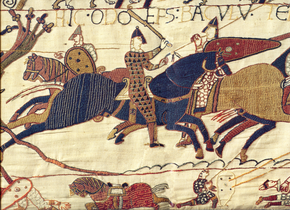
Here's an image from the Tapestry. It shows Bishop Odo, identified over his head as ODO EPS (the EPS standing for episcopus, bishop.) You note that although he's wearing chain mail and a helmet, he has a club, not a sword.
The Tapestry is now in its own museum in Bayeux. It is very nicely displayed, in a long glass case that snakes around the room so that you can follow it and see all the images (I recommend the headphones with a recording explaining what each scene shows, available in English or French).
© C. Dale Brittain 2021
For more on medieval political and social history, see my ebook Positively Medieval, available on Amazon and other ebook platforms. Also available in paperback.


