Showing posts with label medieval armor. Show all posts

Monday, February 26, 2024

The Armourer

 As I have discussed previously, knights in the twelfth century normally wore chain mail, made of iron rings riveted or welded together to provide protection against swords and other weapons.  Although we have plenty of illustrations from the period of chain mail, actual chain mail from the twelfth century is now essentially non-existent.  It would be used until it disintegrated, and it was especially subject to rust.

When we think of armor we usually think instead of plate armor.  Here we have lots of surviving examples, the earliest from the thirteenth century but continuing up through the seventeenth century.  England's Tower of London long collected helmets and swords from the late medieval and early modern periods.  Recently these have been moved to their own museum in Leeds (Yorkshire), called (appropriately enough) the Armouries.  The entryway is seen below.


The person responsible for making all the pre-modern armor was known (again appropriately) as an armourer.  It was a highly skilled occupation, and armourers had their own late medieval guilds.  A royal court would have several armourers on staff, and they were kept busy.

Plate armor was made from steel, not iron, produced by working the charcoal from the great furnaces (used to melt iron) into the metal.  Because most medieval iron came out of mines in Germany, that region also became the center of steel making.  Armor made by German armourers might be sold all over Europe.  Plates of steel, ready to be made into armor, would also be sold, or a powerful lord might buy raw iron to be worked up locally.

The armourer was in many ways like a blacksmith, using metal, a furnace, and hammer and anvil to shape metal into protective gear.  The advantage of plate armor over chain mail was that it was designed to deflect the blow of a sword or lance, even to turn aside a bullet unless it came in on a perfectly direct course.  Late medieval helmets often took on fanciful shapes, which while certainly embracing fashion, were ultimately based on theories of the best shapes to send an incoming shot or blow skittering away.

Realistically plate armor will not do a lot against musket fire, and it's useless against cannon fire, but it was highly effective against the footsoldiers increasingly pressed into service in late medieval warfare.  A heavily armored knight on a heavily armored horse could ride down footsoldiers with impunity.


But plate armor achieved its great flourishing in post-medieval tournaments.  When the cavalry charges, for which tournaments had originally been designed to train knights, no longer served in wars fought with cannons and pikemen on foot, tournaments became very popular games for the powerful.  The above mounted knight is clearly a tournament fighter.

The heavy plate armor used for tournaments of the early modern period would have been awkward and confining in a regular battle.  But it didn't matter.  Knights would be hoisted into the saddle with cranes and aimed at each other.  Armourers really came into their own, shaping the armor to fit each individual, decorating it with scenes from epics or tales of antiuity, inventing new styles.  King Henry VIII of England loved such tournaments.  Several of his suits of armor survive, getting larger and larger around over the years as he did.


© C. Dale Brittain 2024

For more on medieval knights, see my new ebook, Positively Medieval: Life and Society in the Middle Ages.  Also available in paperback.


Sunday, May 30, 2021

Bayeux Tapestry


 The Bayeux Tapestry is one of our best sources of information about what the 1066 Norman Conquest looked like, that is, what kind of weapons, what kind of ships, what kind of clothes were considered normal in the eleventh century.  It's not really a tapestry, but rather a series of seventy embroidered linen squares, sewn together in a long series, some 230 feet long and not quite 2 feet tall.  It is probably missing a square or two at the end.  (Officially a tapestry's design is woven in, rather than embroidered.)

The Tapestry (as we might as well call it anyway) is an unabashed effort to tell the history of how Duke William of Normandy conquered England, becoming king (he's now known as William the Conqueror), and how it was totally appropriate that Harold Godwinson, who had thought that he was rightful king of England, was killed in battle.

The story is told in a series of scenes, almost like a comic strip, where in each scene people are doing something.  A few words of Latin identify what they are doing or name the different figures.  Along the border are various small images like someone dismembered, someone pulling the armor off a dead person, a nude man flashing his stuff, and the like.  So although the Tapestry glorifies the Battle of Hastings that William won, it also is very aware of the brutal nature of war.

There are a lot of questions about the Tapestry that remain unanswered, starting with who made it.  For a long time the assumption was that Mathilda, William the Conqueror's wife, embroidered it with her ladies.  The French indeed call it la tapisserie de la reine Mathilde.  This seems based on nothing more than thinking embroidery is "women's work."

n fact it seems most likely that Odo, bishop of Bayeux (which is in Normandy), had it made.  The Tapestry has been in Bayeux almost its entire life.  Odo accompanied the Conquest, but because he was a bishop he did not shed blood, using a club rather than a sword.  "Internal injuries only."  Odo was probably hoping to be named archbishop of Canterbury (in England) after the Conquest, but if so he was bitterly disappointed, because William instead chose Anselm, abbot of the Norman monastery of Bec.  Given that Odo was William's half-brother, this must really have rankled.


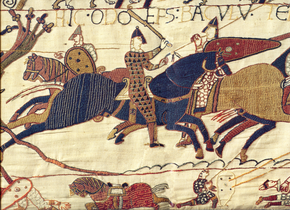
Here's an image from the Tapestry.  It shows Bishop Odo, identified over his head as ODO EPS (the EPS standing for episcopus, bishop.)  You note that although he's wearing chain mail and a helmet, he has a club, not a sword.

The Tapestry is now in its own museum in Bayeux.  It is very nicely displayed, in a long glass case that snakes around the room so that you can follow it and see all the images (I recommend the headphones with a recording explaining what each scene shows, available in English or French).

 © C. Dale Brittain 2021


For more on medieval political and social history, see my ebook Positively Medieval, available on Amazon and other ebook platforms.  Also available in paperback.


Sunday, January 10, 2021

Medieval Armies

 We think of armies as professional bodies, thoroughly trained, wearing uniforms, following discipline, able (in the US) to get their tuition paid to go to college.  Since the era of the Vietnam War, the US has gone from a draft to a volunteer army.

Medieval armies were very different, starting with the lack of uniforms, training, and discipline.  The Roman army had been more like what we think of as an army, young men recruited into a paid professional military force for 20 year hitches, marching together in disciplined phalanxes.  Medieval generals had read about Roman armies (especially the treatise by Vegetius, "the Art of War"), but good luck having anything like that after the economic and social collapse of the Empire in the sixth century.

The Germanic armies that were commanded by early medieval kings and counts were foot-soldier armies, supposedly made up of all able-bodied free men.  Some had originally been hired by the Romans as "barbarian legions," but by the time one gets to the seventh and eighth centuries there was no sense of anyone getting paid.  They were expected to turn out and fight to defend their people.  Their chief weapon was a long sword, and they carried round shields—meant to protect the individual in a fight, rather than the tall, rectangular shields of the Romans, with which one could form a shield wall.  They had helmets but not much in the way of armor.

In the ninth and tenth centuries, once stirrups began to be in use (apparently they began in Persia), and there was enough iron to shoe horses, horses began to appear more and more in armies.  Knights started appearing attached to all armies in the eleventh century, and by the twelfth century knights made up the bulk of most armies, although they always had a significant foot-soldier component.  Great lords, especially in England, were expected to show up for battles accompanied by a certain number of knights.  If you think it would have been hard keeping a foot-soldier army disciplined when they were just young men told they needed to come defend the county, think about a lot of proud knights who were intensely proud of their ability and touchy about their honor.

These armies were still formidable.  Knights and the accompanying foot soldiers went on Crusade, conquering the Holy Land in the First Crusade and establishing the Kingdom of Jerusalem.  They lost it again within three generations, but that was probably inevitable for an occupying army surrounded by an awful lot of people who didn't want them there.

Mercenaries appeared in local wars in the eleventh and twelfth centuries, soldiers who would (at least theoretically) do what they were ordered to do, because otherwise they wouldn't be paid.  They could also (theoretically) be counted on for a long war, whereas knights usually went home from regional wars after a while.  The problem with mercenaries of course is if you stop paying, they will stop fighting for you, even switch sides.

Twelfth- and thirteenth-century knights had chain mail, helmets, lances, swords, and either round or tall, kite-shaped shields (as seen below).  Plate mail, such as you see in Hollywood movies, did not appear until the late Middle Ages.


A lot changed for armies in the Late Middle Ages.  Once gun powder became a weapon of war in the fourteenth century, during the Hundred Years War between France and England, cavalry charges became much less effective, as they could be brought down by cannon fire.  More and more armies were made up of foot soldiers armed with pikes.  Archers, both longbow men and those armed with crossbows, continued to play a major role, because there was nothing like a personal firearm.

The mass of foot soldiers of a late medieval army were treated with supreme disdain by their commanders, who called them cannon fodder, as they might be ordered to march against a bank of cannons and get killed, so the better trained soldiers could rush in before the cannons were reloaded.  These soldiers were "recruited" by officers going around to villages and ordering a certain number of young men to join the army.  They would end up with the poor who didn't have the money to buy their way out, the obnoxious and violent who were pushed to go by their neighbors, and the foolish, who actually believed the promises of military pay.

Yet these armies were tough.  For the Hundred Years War, from which we have fairly good records, soldiers would march 20 miles in a day and then fight a battle.

© C. Dale Brittain 2021

For more on medieval knights and so much more, see my ebook, Positively Medieval: Life and Society in the Middle Ages.  Also available in paperback.

Thursday, October 23, 2014

Medieval (?) Movies

I have problems with movies supposedly set in the Middle Ages.  They get so many things wrong.

For example, almost invariably a movie set in the early Middle Ages will have knights wearing plate armor.  Plate really only came into style in the fourteenth century.  It required great advances in metallurgy, and, because it was heavy and expensive, even then was usually reserved for the most powerful.  The full tournament armor one sometimes sees in museums dates from after the Middle Ages and was meant solely for tournaments, where one would be winched up onto one's horse, not for battle.

And then there's the movie version of the King Arthur story made maybe a dozen years ago, supposedly set in the late Roman Empire, where the "knights" (knights of course not coming into existence for another five centuries) wore both medieval chain mail and Roman protective gear.  They also rode around using modern western saddles and had stirrups (not invented for another four centuries).  The movie claimed to be based on true archaeological finds.

It's just a story! you say.  Yes, and for that reason I have no trouble whatsoever with things labeled fantasy, even if they are set in an essentially medieval world.  The "Lord of the Rings" movies are among my favorite movies, and I'm a fan of the "Game of Thrones" TV series (as well of course of the books).  Here one can enjoy the slightly larger-than-life aspect of powerful individuals and the opportunity to be truly distinctive that actually were part of medieval elite culture.

But I continue to have problems with any movie that claims historical accuracy.  If they want to be accurate, they had better be accurate.  There were a few old movies that did this just fine (I'm thinking of "Lion in Winter" and "Becket"), where the emphasis was all on the characters' emotional interactions, not on the armor or siege weapons.  (Peter O'Toole starred as Henry II in both these movies, once as young Henry and once as old Henry.  The movies are still good.)

Now if one wants to retell the King Arthur story to make it "a story about today," that's fine.  That's what medieval authors did.  The twelfth-century stories made Arthur a glorified version of a twelfth-century king, and in the fourteenth century he had become a fourteenth-century monarch.  All historical fiction, after all, is really a story about the author's "today," as much as about the time period in which the story is set (and medieval authors made no efforts for historical accuracy).  But make it clear that that's what you're doing.

Sometimes this works, sometimes it doesn't.  In the 90s there was a Richard Gere movie, called, I believe, "Lancelot First Knight."  Aside from the fact that Lancelot looks nothing like Richard Gere, it was mildly amusing in a very 90s way.  Guinevere was a tomboy and she and Lancelot practiced safe-sex in a 90s way, never getting past a kiss.  Lancelot was a rugged individual, from a poor background who rose due to his skills (including scrambling through some weird and anachronistic machine).  Malory rolled in his grave.

© C. Dale Brittain 2014