Showing posts with label council of Nicaea. Show all posts

Thursday, April 16, 2026

Sylvester I

 With the American president now feuding (verbally) with the pope, and people in his orbit even threatening to pull an "Avignon papacy" on Pope Leo, it seems appropriate to dip back into early Christian history for some context on church and state and a glimpse of the ways that secular and religious rulers interacted.

Popes are first and foremost bishops of Rome, the head Christian in their city. Bishops as rulers of their flock go back to the early days of Christianity.  Most Christian denominations have bishops, including the Amish.  In the first thousand years or so AD, bishops were locally elected (as they still are in Amish communities), and they ran the Church between them.  The sense gradually increased that the bishop of Rome should be over all other bishops, just as the Roman emperors were over all kings and governors.  It helped that the bishop of Rome was supposed to be heir of Saint Peter, who was the leader of the apostles.

(The Bible makes Peter the leader of the apostles, but it doesn't put him in Rome.  Rather, he preached in Antioch. Let's not worry about that now.  After all, the basilica of Saint Peter's has his bones.  Shouldn't that be good enough?)


This idea of the supremacy of the Roman pontiff really started with Sylvester I (pope 314-335 AD, pictured above in a later medieval image).  He was bishop of Rome at the time of Constantine, first Roman emperor to be baptized.  His feast day is December 31, so as you celebrate New Year's Eve, be sure to dedicate a glass of champagne to Saint Sylvester, as he is now known. (Germans sometimes refer to New Year's Eve as "Silvester" in his honor.)

Pope Sylvester presided over the Council of Nicaea, called in 325 to debate the true nature of the Trinity, resulting in the Nicene Creed, still the basis of Catholic teaching (and a lot of Protestant teaching as well).  Once Constantine made it acceptable to be Christian in the Roman Empire (formerly officially pagan, in spite of including a lot of Jews, Christians, and those with various other beliefs), Sylvester started the construction of the great church now known as Old Saint Peter's, which stood until the sixteenth century, when the current Saint Peter's basilica was built in its place.

Once Christianity was tolerated out in the open, and indeed soon became the official religion of the Empire, there began to be hints of a debate that was never fully resolved:  in a Christian empire, who is the ultimate authority? the primary Christian (the pope) or the emperor?  As I've discussed before, popes really only became the effective heads of organized Christendom in the eleventh century and promptly became involved in a knock-down drag-out battle with emperors and kings which lasted on and off for four centuries.  ("Oh yeah? I depose you!" "You can't! I excommunicate you!" "So what! You're a heretic!" "No, you're the heretic!" "Oh yeah?" etc.) The squabbles between president and pope going on now have a long historical background.

Efforts by the popes to establish supremacy within the Empire did not wait for the eleventh century (much less the twenty-first).  When Constantine moved his political capitol to Constantinople in the fourth century, Pope Sylvester stayed behind in Rome.  He was probably just as glad not to have the emperor there.  Constantine after all had ordered that the Council of Nicaea be held to settle questions of the Trinity, even though he himself was not yet baptized (that happened only as he was dying). Although he didn't influence the council's outcome, he sat right there observing.

With no emperor on hand, Sylvester and his successors became the effective rulers of the city of Rome and surrounding territory, including defending against Goths, Huns, and the like.  But that wasn't enough.  By the sixth century, an elaborate story had grown up in which Constantine contacted leprosy but was healed by Pope Sylvester.  In gratitude the emperor gave Sylvester his own crown and other imperial insignia, led the pope's horse by the bridle (acting as groom), and declared that the bishop of Rome was above all other bishops.  Sylvester, not to be outdone in generosity and humility, gave the crown back -- but note the implication, the pope is the one who gets to decide if a man deserves to be crowned.

In the eighth century this story was improved further by the "discovery" of the Donation of Constantine, a supposed letter in which Constantine, on his way out the door to Constantinople, gave rule of the whole western half of the Empire to the pope.  Both popes and emperors believed this document to real, not a forgery, until the Renaissance, but the emperors always had some good reason to argue it didn't apply.  ("At least not now. Besides, the pope was a heretic.")


© C. Dale Brittain 2026

For more on medieval Christianity, see my new ebook, Positively Medieval: Life and Society in the Middle Ages.  Also available in paperback.

Thursday, May 1, 2025

Christian Ethiopians in Rome

 As I discussed in an earlier post, Ethiopia was predominantly Christian during the Middle Ages, with its own stories, for example, of miracles of the Virgin, stories that like their counterparts in Europe were intended to show that no matter how big a sinner you were, there was always hope for salvation.

Ethiopia had been Christian since at least the fourth century, when priests from Egypt became established there. (You'll recall that Egypt was a major center of Christianity in the first centuries AD.)  The Ethiopians indeed considered their attachment to the Judeo-Christian tradition to go back even further, to the days of King Solomon.  The "Song of Songs," a book in the Old Testament, has the king address his beloved, "You are black but you are comely."  Both Ethiopians and Europeans interpreted this as meaning the queen of Sheba, black as were the people of the Horn of Africa (Ethiopia).

Okay, the Song of Songs is supposed to be about Christ's love for His church, according to medieval theologians, not some king crooning to his mistress, but they would have been the first to tell you that a Bible text had meaning on more than one level.  At any rate, the kings of Ethiopia, from at least the thirteenth century, asserted descent both from the Solomon-Sheba alliance and from those who had brought Christianity to the Horn of Africa in the fourth century.  They also said that Sheba's son had brought the Ark of the Covenant to Ethiopia from Jerusalem, but we aren't going to talk about that now.

In the early days of the church, before the rise of Islam, Ethiopia had sent bishops to ecumenical councils.  They attended the Council of Chalcedon in 451, which addressed some of the issues of the nature of Christ that seemed still to be up in the air after the Council of Nicaea over a century earlier.  Christ was both human and divine, but was He both fully, or half and half?  The council settled on "one person, two natures," fully human and fully divine at the same time, accepted by both the Latin west and Greek orthodoxy.  The Ethiopians, along with some other Christian churches, held out for one person, one (blended) nature.  (Yes, most of us today would be scratching our heads over why this was a big deal, but trust me, it was.) Other differences also persisted, such as whether to celebrate the Sabbath on Saturday or Sunday. Also the Chalcedonian version of the church finished dropping any thought that Christians needed to follow Old Testament requirements of circumcision, which the non-Chalcedonian churches continued to follow.

Throughout the Middle Ages, although there wasn't much contact between western (Latin) Christendom and Ethiopia, once the Mediterranean basin became predominantly Muslim, they knew each other were there.  Pilgrims from Ethiopia periodically visited sites holy to early Christianity, even if in areas (like Egypt or the Sinai) now predominantly Muslim.  There were plenty of stories in Europe about "Prester John," a black priest (prester) who was sort-of-like-a-pope of some fabulous African land.

At the end of the Middle Ages, pilgrims from Ethiopia showed up in Rome.  They wanted to visit the tombs of Saints Peter and Paul who, being in the New Testament, were as important to them as they were to western Christendom.  They settled in the church of San Stefano Maggiore, an old church, located near Saint Peter's basilica, that had been in some disrepair for centuries and had most recently been used to house priests.  San Stefano became the Ethiopian guest house.

Ethiopian pilgrims continued to visit Rome and stay in San Stefano for the next two centuries, through the late Middle Ages, Renaissance, and Reformation.  Some stayed only a short time.  Others lived there their entire lives.  They learned about the Latin version of Christianity, and a few converted to it.  They explained their version to the Roman priests.  These priests thought to draw these strange people they thought of as "Indians" (that is from some distant marvelous land) into their version of Catholicism, and simultaneously became disturbed at what they considered heretical beliefs and practices.  The pope, facing the split in western Christendom from the Reformation, tried to figure out how these Ethiopians could be on his side.

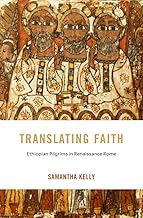
The Ethiopians' extensive writings on their experiences in Rome ended up in the library of the Vatican.  Samantha Kelly, who (unlike most of us) can read their language, has very recently published a book on these Ethiopian pilgrims, called Translating Faith, Harvard University Press 2025.


Translating Faith: Ethiopian Pilgrims in Renaissance Rome (I Tatti Studies in Italian Renaissance History)


© C. Dale Brittain 2025

Wednesday, June 12, 2024

Nicene Creed

 The "Nicene Creed" is trending today, so I thought I'd blog about it, given its importance for medieval Christianity.

The word creed means something that one believes, coming from the Latin "credo," meaning "I believe."  The first words of the Nicene Creed are "I believe," so that makes sense, even though the Creed was originally written in Greek.  The whole creed is a list of things a Christian believes.  Although I've seen some discussions where people on-line are saying, "I don't need a creed! I have the Bible!" they are fundamentally misunderstanding it.  The Nicene Creed is the short version of what you need to believe in order to call yourself a Christian.

The Nicene Creed is named that because it came out of the 325 Council of Nicaea.  By the early fourth century the main wave of persecution of Christians was over, but that just meant that Christians were free to disagree with each other.  There had been a lot of debate and discussion in the first three centuries of Christianity about exactly what were the fundamental tenets of Christianity, especially what was the nature of the Trinity.  All the different people with different views naturally declared that everyone else was a heretic.

For example, was Jesus just a man, divinely-inspired but not divine himself?  Was he in fact God who just put on a facade of looking human in order to fool people?  Had he started as straight human but become divine at some point, either before or after the Crucifixion?  The Gospels had him calling himself both "son of Man" and "son of God" and even saying "I and the Father are one," so that didn't help.  And where did the Holy Spirit fit into this?  If you've got Father, Son, and Holy Spirit, does that mean three Gods?  Since the Christian Bible didn't settle on (more or less) the form it has now for another century or two, and was itself a topic of heated discussion, that wasn't going to help.

The emperor Constantine, who had recently decided to become a Christian, believed this arguing was unseemly.  (He was not baptized yet, but Christian women in his family were persuasive, as was a burning cross he saw in the sky over a battle field, which would certainly have gotten my attention.)  Roman emperors had always been the heads of Roman state paganism, so he found it appropriate to call a council to decide.  The council was presided over by the emperor, but he didn't make the decisions, rather encouraging all the assembled bishops, from all over the Empire, to resolve their differences and vote.

What they came up with is essentially the Nicene Creed of today, though some editing was done at the 381 Council of Constantinople, and the precise wording depends on the translation used.  It defined the Trinity as one God in three persons and Jesus as both wholly divine and wholly human.  There.  No multiple gods, no Jesus as just an ordinary human, no Jesus as a divine being in disguise as a human.  It was a compromise to which the majority of the attending bishops agreed.

Of course it didn't stop those people who left the Council convinced that all those bishops were heretics, or those who heard about the Council and disagreed with what they heard or thought they heard.  Heresies concerning the humanity of Jesus and the nature of the Trinity swirled around the Mediterranean for three more centuries, until the rise of Islam essentially ended them.

But mainstream Christianity had settled on a basic definition, supported by all the bishops of the major cities of the Empire.  It began, "I believe in one God, the Father almighty, maker of heaven and earth."  So far it could also be a statement of basic Judaism.  But then it immediately adds, "And in one Lord Jesus Christ, the only-begotten son of God ... co-substantial with the Father."  There's the just-one-substance, more-than-one-person part.

The Creed continues to give a brief summary of Jesus coming to earth to save everyone, being crucified and rising again, ascending to Heaven from which He will come again to judge us all.  Then finally the Creed gets to the Holy Spirit, who always gets overlooked, "And in the Holy Spirit ... who proceeds from the Father."

Somewhere between the sixth and ninth century western (Latin) Christendom added what's known as "filioque" clause to "from the Father."  The term means, "and the son," so the Holy Spirit was said to proceed both from the Father and from the Son.  Greek orthodoxy declared this was a total heresy.  Eastern and Western versions of Christianity have still not resolved this one, twelve hundred years later.

The 381 Council of Constantinople added a final wrap-up to the Nicene Creed, adopted as part of it, saying that one believed in "one holy, catholic, and apostolic church" and in "one baptism for the remission of sins."  Here the stress was on the idea of a universal church, all Christians being one body (the word catholic means universal, though it's been adopted by one version of Latin Christendom as meaning specifically them).  Stress was also put on the church's origins with Jesus's apostles, not just some people somewhere having some ideas.  Christianity (like Judaism) has always emphasized historical continuity.

The wording seems to suggest that you only get one chance to wipe out sins with baptism, so for a while people would wait until they were dying to be baptized, once they were pretty sure they weren't going to sin any more.  Constantine himself was baptized on his death bed.  However, in another century or so infant baptism came in, as wiping away Original Sin, so that infants and children wouldn't go straight to Hell if they died.  This requires bonus actions to wipe away subsequent sins.  Original Sin assumes everyone since Adam and Eve is born already laden with sin, but Nicaea didn't worry about that, and that's a different story.

Today the Nicene Creed is taught to all Catholics and is sort-of part of the doctrine of most western Protestant churches (not the Unitarians obviously).  The Southern Baptists are currently trying to decide about it, worried over the word "catholic," and feeling that the purpose of baptism isn't stated correctly.  (Some have even questioned whether modern Catholics are even really Christians.  I'm not getting into that discussion.)

As a medieval historian, I'm always sort of bemused by how many modern Christians in the West don't realize that you can't jump straight from the first century to the twentieth or twenty-first.  All versions of western Christendom are the products of medieval Christianity, even if there were conscious efforts to reject big parts of it.


© C. Dale Brittain 2024

For more on medieval Christianity, see my new ebook, Positively Medieval: Life and Society in the Middle Ages.  Also available in paperback.


Wednesday, June 5, 2019

Heresy and Orthodoxy

The word "orthodox" makes one think of Greek Orthodoxy or Russian Orthodoxy (and there are other versions of Christianity with Orthodoxy in their names), but the word actually means correct religion, as opposed to heresy.  Heresy is incorrect religion.  How do you tell the difference?

There is and can be no absolute guide.  You can tell which was the true religion by who won.  Obviously God wouldn't let the wrong guys win, everyone said (and says).  Alternately, however, the Bible talks about "when two or three are gathered in my name...." so maybe the tiny minority is right and the self-styled winners are wrong and going to hell.  Guess we'll find out!

Heretics are specifically people who should know the true religion but have gone seriously astray.  So different versions of Christianity can (and often do) label each other as heresy.  Latin Christendom and Greek Orthodoxy excommunicated each other in 1054 and have only recently started getting back together.  (Protestants and Catholics have also decided that the other side isn't really a bunch of heretics.  Or not too heretical.)  So Christianity considers Islam not a heresy but a different religion, and Muslims aren't heretics but infidels.  Pagans, those who believe in multiple gods, are also not technically heretics.  This has never stopped the word "heretic" being tossed around a lot for anyone someone disagrees with.

Early Christianity had a lot of heresies.  Some of the most serious were so-called Christological heresies, arguments over the nature of Christ.  Was he just an inspired human?  Was he God in disguise?  Did he really die on the Cross or, if he was God the whole time, was it just a big charade?  If he was an inspired human who did rise again from death, should we pray to him rather than directly to God or is that a big mistake?  Are God and Jesus both gods, separate ones--and what about the Holy Spirit?  The efforts of the Council of Nicaea (325) to define the Trinity, one God in three persons, Jesus both fully human and fully divine, tried to settle the matter and just led to a lot of new heresies.  Most only ended with the rise of Islam in the seventh century, when a lot of territories that had been Christian under the Roman empire instead had Islam as their dominant religion, making a lot of the arguing irrelevant.

Other early Christian heresies included pelagianism, the idea that you could save yourself by being as good as you possibly could without needing grace (via the sacraments), and donatism, the belief that sacraments (which you needed) could only be validly administered by a pure priest, so if the priest had secretly sinned they didn't count.  These were also more or less wiped out once Islam gave people more things to think about than theological niceties.  Pelagianism had been especially strong in Roman Britain, until the arrival of the pagan Angles and Saxons ended that issue.

Another serious heresy was manichaeism, the idea that the universe was locked in a battle between absolute good and absolute evil, which neither would ever win, and that the spiritual world was good and the physical world evil.  There is a fair amount of dualism (the idea of two equal powers fighting it out) in orthodox Christianity, but this is heresy.

A lot of early Christian doctrine was worked out in response to heresy.  Someone would announce a new insight into religious issues no one had really thought about much, a church council would meet, discuss, decide it was wrong, and settle on an official doctrine of the opposite.  (This is how for example it was decided that the Christian Bible would include the Old Testament, the Jewish Bible, even though Christians felt they had "moved beyond" a lot of it.)  Thus heresy (and the reaction to it) helped define orthodoxy.

A version of Manichaeism took root in southern France in the twelfth century, among people who thought they were good Christians and that God's true message had finally been revealed to them.  This version is often called Catharism (from catharsis, a freeing or purging of oneself from troublesome things), and the Albigensian Crusade was launched against it in 1209 (on which see more here).

My husband and I have written a novel, Count Scar, set in a fictional version of southern France in the aftermath of the Albigensian Crusade--except with magic.  We've moved the geography around some, and all the people are fictional; the single biggest change we made was not getting into northern France's invasion of southern France in this crusade.  (The book is available on Amazon and other ebook platforms.)

We're finishing a sequel, Heretic Wind, for anyone who enjoys the first one.  Coming soon!


© C. Dale Brittain 2019

For more on real medieval heresy, see my new ebook, Positively Medieval: Life and Society in the Middle Ages.