Showing posts with label Norman Conquest. Show all posts

Friday, December 15, 2023

Brother is the Enemy

 We tend to think of families as all getting along and supporting and protecting each other.  For most families in the Middle Ages, that was probably the norm as well.  But just as today siblings can become very competitive over such things as "who gets Grandma's gold coin collection," so among the medieval aristocracy there was often fierce competition between brothers.

This is to be anticipated, because even though there were no strict rules of primogeniture (that is, of the oldest son getting everything), oldest sons did tend to inherit more, and the younger sons thought this was Totally Unfair.  Throughout the medieval and early modern period there were plenty of tales about three brothers, where the oldest gets the big inheritance, the middle one gets some small thing, and the third is told, "Good luck, kid."  Of course in these stories the youngest heads off and finds something worth far more than the original inheritance, and even a princess to marry.  Take that, older brother!

The Merovingian kings of what is now France (fifth to eighth centuries) were described by contemporaries as ready to slay their brothers and cousins.  The various small kingdoms, into which what is now France and the Low Countries were divided, were parceled out between heirs, who then decided the best way to add to their holdings was to kill their rivals.  Gregory of Tours, chief historian of the Merovingian era, said that Clovis, first of the kings, complained loudly that he was alone in the world without any relatives, in the hopes of luring some relatives out of hiding so he could kill them.

The Carolingian kings were not much better (eighth to tenth centuries).  Charlemagne had a younger brother, named Carloman, whom Charlemagne's biographer Einhard said died of "some disease."  Einhard went on to say that he couldn't imagine why Carloman's widow then fled with her children.  (One can imagine just fine.)

Charlemagne's grandsons were each given a kingdom of their own, Germany for Louis, France for Charles, and the "Middle Kingdom" (including Italy) for Lothair.  Louis and Charles immediately ganged up on their brother, as perhaps should be expected.  In the confusion and disagreements over the next two generations, a kingdom of Burgundy was established within what Lothair had thought was his kingdom, and Boso declared himself king, only to be opposed by his brother Richard, who told the Carolingian kings that he was their little friend.

In England after the 1066 Norman Conquest, William the Conqueror designated Normandy, the family inheritance, for his oldest son, Robert Curthose, designated newly conquered England for his second son, William Rufus, and told Henry, the third son, "Sorry, kid."  When William Rufus died without heirs in 1100, Henry immediately took his brother's throne.  Robert Curthose was off on Crusade and was understandably shocked when he got home.  Extensive fighting then took place, and Henry eventually won, taking Normandy as well as England and locking up his brother for the rest of his life.

In France, it was often remarked in the thirteenth century, with some wonderment, that the younger brothers of the king didn't try to kill him, not even a little.  In part this was due to the kings parceling out large chunks of territory (appanages) to their younger brothers.

These examples are all of the most powerful (and there are plenty more examples of fraternal warfare).  Peasant families in contrast tended to act in solidarity.  After all, they could not call up armies or faithful followers (like Boso's brother Richard) to fight against their relatives.  Landlords were more likely than brothers to be seen as the enemy.


© C. Dale Brittain 2023


For more on medieval political and social history, see my ebook Positively Medieval, available on Amazon and other ebook platforms.  Also available in paperback.


Sunday, December 3, 2023

Old French

 Old French, like the medieval versions of Spanish, Portuguese, Italian, and Romanian, plus other variants (like Provençal), derived ultimately from Latin.  They are called Romance languages because they derive from the language of ancient Rome.  But Old French is much closer to modern French than what is called Old English is to modern English.

This is because what we call Old English is Anglo-Saxon, the Germanic language that was spoken in England before the Norman Conquest.  English had to incorporate a lot of French in the centuries after 1066, including going through the Middle English phase, before it became sort of what we think of as modern English in the seventeenth century.  Old French in contrast never had to incorporate an entirely different language.  (The number of words in modern English is roughly the same as the vocabularies of modern French and German put together.)

The first examples of Romance languages becoming distinct from Latin date to the ninth century.  At this point it was recognized that the pronunciation of a lot of words didn't exactly match the Latin spelling and that the grammar was increasingly different.  We should not of course be surprised at early medieval people accepting that spelling and pronunciation didn't match.  Look how English speakers pronounce though, through, tough, cough, and bough.

Written Old French came into its own in the twelfth century, primarily for stories, epics and romances.  Songs were also written in Old French.  A lot of stories had doubtless been told in the vernacular (that is, the everyday spoken language) for a long time, and songs sung in it, but now they were written down in it.

Most twelfth-century education was in Latin, and monks and bishops could converse and write fluently in correct classical Latin.  But as the century went on, more and more Old French was added to the educational mix.

During the middle years of the thirteenth century, some legal documents started being drawn up in Old French.  The spelling was subject to a great deal of variation, so that "I," ego in Latin, was spelled both je (as in modern French) and ge.  It seems clear that it was pronounced with the J sound, no matter how it was spelled.  But thirteenth-century French is close enough to modern French that a modern French speaker can read it relatively easily, with no more difficulty than a modern English speaker has in reading Shakespeare's sixteenth-century English.

Not everybody went over to using Old French.  For an especially important document, Latin was still preferred.  Stories might be told in Old French, but theological and political treatises were written in Latin.  Popes and bishops issued their documents in Latin, not the vernacular (popes still use Latin for official pronouncements).  For that matter, English scholars (like Isaac Newton) were still writing serious works in Latin in the seventeenth and eighteenth century.

But the spread of Old French made it easier for more people to become literate, especially once paper started replacing the much more expensive parchment at the end of the thirteenth century.  Then one just needed to learn to read and write, not pick up a foreign language in the process.


© C. Dale Brittain 2023

For more on medieval language and social history, see my ebook Positively Medieval, available on Amazon and other ebook platforms.  Also available in paperback.


Sunday, November 12, 2023

Ethnic Identity

 Because the US is a melting pot, an awful lot of us have a distinct ethnic identity related to our ancestry.  African-Americans of course refer back to their ancestors who were captured in Africa and brought to the Americas as slaves (though there are certainly some, like President Obama, who have very recent African heritage, but no ancestors who were slaves in the Americas).  Irish-Americans celebrate Saint Patrick's day, Mexican Americans (and those who like tequila) celebrate Cinco de Maio, and so on.

You can now get your DNA analyzed for further details on your ancestry.  I, not to my surprise, tested out at close to 3/4 English, with the rest a mix of German, French, Dutch, Irish, and Scandinavian.  Interestingly, I am not considered "English-American."  Although those who might be called English-Americans are not the majority in this country, they were the majority among our founders, and are still considered the default. ("We're real Americans, and everybody else is a modified-American!" Yeah. Right. Not in my view.)

But ethnic identity is more than one's DNA.  A big part of it is language and religion and food and customs.  People in the Middle Ages also had ethnic identity, though because they were exposed to other sorts of folks less than we are the topic came up less often.

The French in the Middle Ages liked to say that the French were best (big surprise) and mocked the Germans for not being as good knights or fighters as they considered themselves to be.  England after the Norman Conquest had clear demarcations between the French and the English (some of these "French" were genetically half Scandinavian, but that didn't count).  Italians always knew they were not German, and asserted Germans were bad.  Heretics, non-Christians (especially Muslims), and Greek Orthodox Christians were considered the Other by the Latin Christian majority.  Jewish communities focused on their religion and their family customs to maintain themselves among a sea of non-Jews, as they indeed have for three thousand years.

Language was one of the big markers of identity, as indeed it still is now.  The Norman French may have had a lot of Scandinavian DNA, but they were French because they spoke French.  Each region of medieval Europe had its own language.  Portuguese was like (but unlike) Spanish, which had similarities to Catalan, which was related to the Occitan of southwest France, which had similarities both to the French around Paris and to Provençal, spoken in southeastern France, which was similar to northern Italian.

Italian itself had (and has) many variants.  Sicilian is still almost its own language.  Latin, the language of the area around Rome (Latium), was the language spread by the Roman legions, but other parts of the long Italian peninsula had been speaking their own version of proto-Italian for centuries.  Hence Portuguese, Provençal, and the rest grew out of Latin in different ways, but the various regions of Italy had a long head start in diversification.

Then there's German.  The Rhine was and is the theoretic dividing line between Romance languages and Germanic languages, as it was the theoretic boundary of the Roman Empire of antiquity, but in practice the line was anything but sharp.  Alsace, now part of France and on the French side of the Rhine, went back and forth between school children being taught in French or in German in the late nineteenth and early twentieth centuries, as control of the region shifted back and forth.  Now Alsatian kids go to school in French but usually hang out with their friends in Alsatian, a German dialect.

Although the French of France today is derived ultimately from Latin, those who live in the modern French republic (and have ancestors going way, way back there) have Celtic ancestors from pre-Roman and Gallo-Roman times, and Germanic ancestors in the Franks who became the rulers of the region in  late antiquity.  The Franks gave their name to the country but dropped their German language like a hot potato once they settled in the Roman Empire.

Medieval Germany, like modern Germany, had dialects of its own.  Dutch (and Letzburg, still spoken on the streets of Luxembourg) and Anglo-Saxon are Germanic languages, as are all the Scandinavian languages except for Finnish.  Friend or foe could be determined in part by whether one was fluent in the right language.

Regional dialects are strongest if people don't move around much.  The "My Fair Lady" story is predicated on even different regions of London having distinctive accents.  Even now in Britain some regional dialects are considered low-class. In the US regional dialects are rapidly disappearing, due both to population movement and to people all watching the same movies, TV shows, and Tik-Tok videos in different parts of the country.

If the regional dialects are fading, there is still an assertion that one's heritage and food and way of life are the best.  One can get Maine lobster in Alabama and southern fried chicken in Maine, but everyone will tell you that those who "appropriated" their cuisine did a bad job with it.  This doesn't keep people from enjoying the ethnic dishes of other countries.  Pizza demonstrates that Anglo-Americans may have been instrumental in the US's founding, but Italian-Americans are keeping it going.

And I haven't even mentioned the indigenous Americans.

© C. Dale Brittain 2023


For more on medieval language and social structures, see my ebook Positively Medieval, available on Amazon and other ebook platforms.  Also available in paperback.

Sunday, May 30, 2021

Bayeux Tapestry


 The Bayeux Tapestry is one of our best sources of information about what the 1066 Norman Conquest looked like, that is, what kind of weapons, what kind of ships, what kind of clothes were considered normal in the eleventh century.  It's not really a tapestry, but rather a series of seventy embroidered linen squares, sewn together in a long series, some 230 feet long and not quite 2 feet tall.  It is probably missing a square or two at the end.  (Officially a tapestry's design is woven in, rather than embroidered.)

The Tapestry (as we might as well call it anyway) is an unabashed effort to tell the history of how Duke William of Normandy conquered England, becoming king (he's now known as William the Conqueror), and how it was totally appropriate that Harold Godwinson, who had thought that he was rightful king of England, was killed in battle.

The story is told in a series of scenes, almost like a comic strip, where in each scene people are doing something.  A few words of Latin identify what they are doing or name the different figures.  Along the border are various small images like someone dismembered, someone pulling the armor off a dead person, a nude man flashing his stuff, and the like.  So although the Tapestry glorifies the Battle of Hastings that William won, it also is very aware of the brutal nature of war.

There are a lot of questions about the Tapestry that remain unanswered, starting with who made it.  For a long time the assumption was that Mathilda, William the Conqueror's wife, embroidered it with her ladies.  The French indeed call it la tapisserie de la reine Mathilde.  This seems based on nothing more than thinking embroidery is "women's work."

n fact it seems most likely that Odo, bishop of Bayeux (which is in Normandy), had it made.  The Tapestry has been in Bayeux almost its entire life.  Odo accompanied the Conquest, but because he was a bishop he did not shed blood, using a club rather than a sword.  "Internal injuries only."  Odo was probably hoping to be named archbishop of Canterbury (in England) after the Conquest, but if so he was bitterly disappointed, because William instead chose Anselm, abbot of the Norman monastery of Bec.  Given that Odo was William's half-brother, this must really have rankled.


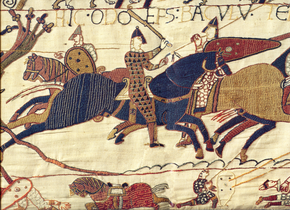
Here's an image from the Tapestry.  It shows Bishop Odo, identified over his head as ODO EPS (the EPS standing for episcopus, bishop.)  You note that although he's wearing chain mail and a helmet, he has a club, not a sword.

The Tapestry is now in its own museum in Bayeux.  It is very nicely displayed, in a long glass case that snakes around the room so that you can follow it and see all the images (I recommend the headphones with a recording explaining what each scene shows, available in English or French).

 © C. Dale Brittain 2021


For more on medieval political and social history, see my ebook Positively Medieval, available on Amazon and other ebook platforms.  Also available in paperback.


Friday, February 7, 2020

Getting rid of a monarch

In the US this week an ultimately unsuccessful effort was made to convict and remove the president. It thus seems like a good time to talk about getting rid of a medieval monarch.  After all, you can't just drag a king (or a president for that matter) to the curb on Blue Box day (or Major Appliance Disposal day).

As I have discussed earlier, medieval kings were not absolute rulers (that developed only in the post-medieval period with kings like Louis XIV of France).  But they were still hard to get rid of if those around them didn't like what they were doing.  One possibility was always assassination, as Julius Caesar had been murdered by his sometime-friends in 44 BC, because they were hoping (erroneously) that with him gone, Rome would go back to being a Republic rather than being ruled by emperors.

Once Europe became Christian, the option of murdering people, even kings thought to be on the wrong path, seemed less viable.  Other ways were often sought.  The most famous example is probably the replacement of the Merovingian dynasty on the Frankish throne by Pippin "the Short," father of Charlemagne, in 751.  The official story was that Pippin, the mayor of the palace for the last Merovingian king (sort of like chief of staff or secretary of state), who had actually been running the kingdom, asked the pope if it was right for an incompetent to have the name of king, and the pope said no (25th amendment!).  Pippin deposed the king and had himself elected by the Franks, anointed and crowned by the bishops, and blessed by the pope.

(This official story appears for the first time 40 years later and seems dubious.  I'll discuss it properly another time.)

Deposing incompetents continued.  Among Charlemagne's descendants, Charles the Simple was deposed and locked up when he didn't seem to be doing his job protecting France from the Vikings.  In England in 1066, Harold Godwinson was declared king, but Duke William of Normandy claimed that Harold was an oath-breaker, that he (William) had been promised the English throne, and he took the throne by force.  This didn't count (maybe) as assassination because Harold was an oath-breaker and died in battle.

Sometimes kings were just threatened with deposition.  In England in 1215, the great barons forced King John to sign the Magna Carta, a document spelling out the rights of the great lords and churches of England, if he didn't want to be deposed.  John grumbled and complained and tried to get out of it, but he died the next year (natural causes), which certainly solved the barons' immediate problem.

At the end of the fourteenth century in England, King Richard II again seriously displeased the barons, who thought he was acting as if he were above the law.  The final straw was when he seized the duchy of Lancaster, held by his first cousin Henry.  Henry raised an armed rebellion and captured Richard.  Parliament, coming into its own in the late Middle Ages, declared that Richard had broken England's laws and forced him to abdicate in 1399.  Henry became King Henry IV, claiming his right to the throne by inheritance, by conquest, and by act of Parliament.

Parliament entered the picture again in 1461, when Henry IV's grandson Henry VI, who came to the throne as a baby and had serious mental health issues as an adult.  During his periods of incompetence, England was ruled by various relatives, with Parliament's support, but this was complicated by the relatives' fights with each other and Henry's efforts to regain control.  We're here plunging into the War of the Roses, which I won't discuss here, but Henry was finally conquered and deposed in 1461, with the combination of conquest and Parliamentary support leading to the reign of his third cousin, Richard III.  The same set of circumstances that had led to Henry IV becoming king led, two generations later, to his grandson Henry VI being kicked off the throne (but at least left alive).

In late medieval France meanwhile, during the Hundred Years' War, during the phase when the English were winning, they were able to get the "dauphin," the heir to the French throne, declared illegitimate, by having his mother attest that the boy's father was someone other than the late king.  This got him out of the way, but only until Joan of Arc's angel voices told her he really was legitimate the whole time and got him crowned as Charles VII (see more on Joan here).

You will note that medieval people rarely just tossed (or killed) a king.  There was always an effort to justify, usually on the basis of abuse of power by the king, sometimes on the basis of his legitimacy.  Getting the great lords on board was usually Step One.

© C. Dale Brittain 2020

For more on medieval kings, see my new ebook, Positively Medieval: Life and Society in the Middle Ages.  Also available in print!