Showing posts with label medieval castles. Show all posts

Monday, March 7, 2022

Countries and dynasties

 It's easy to think of countries as self-evident units.  After all, England was a country in the Middle Ages, with its borders pretty much the same as they are now (well, that's cheating, most of its borders are ocean).  France was a country, and although big parts of what's now Belgium were part of France in the Middle Ages, and the medieval kingdom didn't include much along its eastern edge that's now firmly part of France (Alsace, the Jura region, Provence), most of what's France now was France then.

But a lot of borders and even countries are due to dynastic events in the Middle Ages (or early modern period).  For example, we think of Spain as a country, with a little western bit being Portugal, but if Ferdinand of Aragon and Isabelle of Castile had not married in the fifteenth century (and for that matter driven the Muslims out of Grenada), the Iberian peninsula might have a lot more countries on it than it does now.

Even the division between France and Germany is due to family dynamics.  Charlemagne's grandsons, Lothar, Louis, and Charles, decided to divide up what had been a single Frankish territory, rather than continuing to slug it out as to who got to be the heir.  Lothar got to call himself emperor and got a slice down the middle of Frankish territory, including what are now parts of Belgium, Alsace and Lorraine, much of Switzerland, Provence, and a claim to Italy, including Rome, where emperors had to be crowned (the Italians had different ideas, but that's another story).  This lasted for a little while, long enough for the name "Lothar's land" (Lotharingia) to become attached to, and give its name to, Lorraine (Alsace had long had its own name).

Louis and Charles went along with this division at the 843 Treaty of Verdun, but before too long they decided it was Not Fair for Lothar and his son Lothar II to hog both Aachen (Charlemagne's capital) and Rome, to say nothing of the imperial title.  So they ganged up on him and divided Frankish territory between just the two of them, more or less along the Rhône-Saône river system, meaning Provence stayed under the German kings, even though it was culturally more French than anything, and even though Alsace and Lorraine continued to be a major source of contention for the next thousand years, as the Rhine (east side of Alsace) seemed more like a natural boundary than the line drawn on the map.

Then there are the countries that never quite made it, due to dynasties dying out.  An excellent example is Sedan, in northern France, in the Ardennes near the Belgian border, more or less where the Champagne and Lorraine regions meet.  You probably never heard of it, but in slightly different circumstances it could have been a much bigger and more powerful principality than Monaco or even Luxembourg.

Sedan is now noted for its castle, described as the biggest in Europe by the local tourist bureau, which may indeed be true (though Stirling in Scotland is also extremely large, as are some other royal castles).  Sedan's castle is certainly enormous.  It was begun in the late Middle Ages and added to and modified right up to the nineteenth century.  This model will give you an idea of its size.


The interior courtyard will also give you some idea of the scale of the place.  The multistory building was intended both as a garrison for troops and as a place to store weapons and munitions.  It is now a luxury hotel.
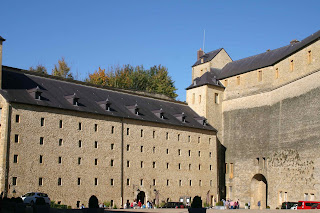


It is not only huge but built with enormously thick walls.  Succeeding generations of lords kept making them thicker and thicker.  Cannon balls didn't stand a chance.


For a while the powerful lords of Sedan flourished.  In the sixteenth century they converted to Protestantism and established a college for Protestants.  The town had a profitable textile industry and book publishing industry.  But then, in the seventeenth century, they ran out of heirs, and the principality was eventually absorbed into the French kingdom.  If the family dynamic had been slightly different, they might have become their own country in the early nineteenth century, when western Europe's boundaries were (sort of) settled in the aftermath of the Napoleonic wars.

But Sedan was now firmly part of France.  The French appreciated those heavy walls.  But even medieval walls, maintained and added to over the generations, cannot by themselves win all battles, even though the castle was never actually taken.  In the battle of Sedan in 1870, during the Franco-Prussian war, the outnumbered French army was in the city streets, being fired on from the surrounding hills by the superior German forces.  The castle never fell, but emperor Napoleon III surrendered, rather than see all his troops slaughtered.

Sedan is worth visiting.  Spend the day.  There's a lot to see, and not many tourists.

An interesting book about how medieval dynasties shaped their countries' histories is by Robert Bartlett, Blood Royal (Cambridge University Press, 2020).  (He talks about Charlemagne's grandsons, and a great many other royal dynasties, but not Sedan's lords, because they never actually called themselves royal.)

© C. Dale Brittain 2022
For more on medieval castles and nations, see my new ebook, Positively Medieval: Life and Society in the Middle Ages.  Also available in paperback.


Tuesday, October 8, 2019

Castles in TV/movies

A challenge for American film makers and TV producers is getting good backdrops for costume dramas.  They can manage a story set in the 1950s or even 1930s.  There are plenty of small towns (and even neighborhoods in large cities) with streets where all the buildings were built before WW II, and thus all the producers really need to do is get the modern cars off the streets and make sure the people in the background aren't wearing jeans and hoodies.

But for pretty much any story set before the twentieth century, finding a good location is a challenge.  For a long time movies avoided the challenge by having everything take place on sets constructed for the purpose.  Need a trackless forest?  Paint a picture of it and stick it behind the actors.  Need a scene inside a castle's great hall?  Easy.  Build a plywood wall and paint a stone wall on it.  A little grey paint, and there you are.

This works for live drama.  People going to a play are perfectly aware that they are sitting in a theatre, watching people on a stage.  They can deal with painted plywood passed off as a stone wall.  But those watching movies or, these days, a lot of TV shows want things to look realistic.

European producers have it a lot easier because they have a lot of old buildings on hand already.  American producers will travel to Europe to find good locations.  Now, there's a lot of mix-and-match that producers use with their locations.  The hero may walk down a street in one village, walk up the front steps of a house not actually in that village, and go into an interior of still a different house.  The scenes are stitched together so it looks like the scene is all the same place, but the clever locations manager has found the best exteriors and interiors for the story, even if they aren't all actually together.

Dramatization of  Jane Austen novels, set in the early nineteenth century, can use real places like the city of Bath (a spa town then and now) and have a choice of British country houses for the homes of the heroines, either exterior or interior or both.  If one looks closely one may see the plastic plates on interior doors that are put on to keep a swinging door from being worn down by constant hands, or a sign by the front door that tells you the hours the house is open to tours, but they still do a good job of looking authentic.

Shows like "Downton Abbey" have the advantage that they can use both the exterior and the interior of Highclere castle (not actually a castle, a late eighteenth-century manor house that is in the south of England, not in Yorkshire where "Downton Abbey" is set).  But the old servants' quarters no longer exist, so those scenes at least are shot in a studio.  Highclere itself has benefited mightily from the show, and tours now go there, and you can have tours, enjoy a high tea, and buy souvenirs.


Some of the settings for the "Game of Thrones" show are hoping for a comparable tourist surge.  An example is the castle of Doune in Scotland (shown above), whose great hall was used for the great hall of the castle of Winterfell in the show.  It's smaller than the great, sprawling Winterfell of the story, and it's partly ruined, but it's still a very nice castle.

© C. Dale Brittain 2019

For more on castles and other aspects of medieval history, see my ebook Positively Medieval, available on Amazon and other ebook platforms.


Sunday, September 8, 2019

Iron-age hill forts

Back when iron started becoming widely used in Europe, say roughly 500 or 1000 BC give or take a few centuries, people started building hill forts.  Because they didn't write down what they were doing, clearly having no consideration for their descendants a few millennia later, we aren't quite sure if these were places from which lords looked down in fierce disdain at other people, or if they were villages that felt they needed some sort of protection against wild animals or people from the next village, or if perhaps they were sacred sites where people would assemble for rituals at certain times of the year.  They were at any rate big, with at least a few acres inside their outer walls.

They did in any event take an awful lot of work to construct, which might go on for generations.  Some had earthen walls, with a few openings.  The Mound Builders in what is now the US built similar structures for equally obscure purposes.  (The ancestors of the American Indians did not have iron, however.)  Or an iron-age hill fort might have stone walls.


The image above is a hill fort in Scotland.  It was built with stone walls that are still there, even though they are now stone humps rather than walls.  There are millions of stones up on top of this hill, every one of which had to be carried up there.  Interestingly, there are no loose stones evident anywhere on the hill's lower slopes.  The following image will give you an idea of how high up this spot is.


Now this hill fort is still there, essentially untouched, except by the elements.  But a lot of hill forts have been found under Europe's cities when excavations have been done (for sewer lines and the like).  A good commanding spot with a river or stream at the bottom of the hill remains a good commanding spot over the centuries.

Under the Roman Empire hill forts were found all over Europe (though now used for different purposes), and a lot of them had castles built on top of them in the Middle Ages.  Castles went up a whole lot faster than cathedrals, and my guess is that there's a simple reason:  if there was a good hilltop spot with a lot of stones already collected, that would strike everyone involved as a perfect place for a castle.  Why spend a lot of effort collecting stones when they were already there?

© C. Dale Brittain 2019

For more on medieval castles, see my ebook, Positively Medieval:  Life and Society in the Middle Ages.


Tuesday, July 23, 2019

Castles through the Ages

Castles, as I've noted in previous posts, really only first appeared around the year 1000, as a combination of palace and fortress.  There had of course been palaces and fortresses going back to prehistoric times, but their combination in a single defensible structure was new in the eleventh century.

We have very few eleventh-century castles.  The occasional grim eleventh-century square tower is about all that we have, or perhaps an outer wall such as the eleventh-century shell-keep of Gisors in Normandy, seen below.


The reason we have such few remains of eleventh-century castles is because castles were rebuilt a lot.  Siege technology was constantly improving (think trebuchets), and castles had to stay one step ahead.  Besides, castles had to make a Statement, and the bigger, the stronger, and more elegant they were, the better statement they made.  Any castle lord who could afford it would renovate and rebuild his castle every generation or so.

In some ways gunpowder did in castles.  In France, where under Louis XIV his war minister, Vauban, systematically went around the countryside with cannons destroying castles (or at least knocking big holes in them), castles were pretty much given up in the early modern period.

But the castles were still there.  They were built of literally millions of stones and were not going anywhere.  And all that stonework could be made defensible again with some effort.  In some places, like Scotland, where it was harder to get cannons across the lochs and highland hills, new castles were being built in the early modern period, designed pretty much the same as medieval castles.  After all, that's what a castle was supposed to be like.

The image below is of Blackness Castle in Scotland, on the Firth of Forth.  It was used for its original military purpose up through the nineteenth century, when soldiers were quartered there.


For the most part, however, most medieval (and early modern) castles had become ruins by the nineteenth century, with a lot of the best stone carried off by enterprising locals to use in their own building projects.  With the development of the Romantic movement (think Ivanhoe) as a reaction against the industrial age, people decided they liked ruined castles.  Castles were romantic.

Some castles were renovated once again in the twentieth century, becoming elegant homes (by twentieth-century standards) as they had once been elegant homes (by twelfth-century standards) in the Middle Ages.  These aren't ruined anymore, but they sure are romantic.


The image above is the Scottish castle Eilean Donan, on an arm of the Irish Sea.  It's now a house as well as a castle that has been voted "most romantic" by various entities.  It really is a romantic site.


© C. Dale Brittain 2019

For more on castles and other aspects of life in the Middle Ages, see my ebook, Positively Medieval, available from Amazon and other ebook sellers.  Also available in paperback!


Tuesday, August 14, 2018

Scottish castles

Recently I posted about medieval Scotland.  Today I would like to continue the Scottish motif by discussing some Scottish castles.

On the Continent the era of defensible castles was mostly over in the fifteenth century due to the development of gunpowder and cannons (and many a castle was replaced with an elegant château).  But in Scotland castles continued to be used for their original military purpose until the seventeenth century.  Sure, they were shot at with cannons, but they shot back.

In some cases this was because the castles were so well positioned for defense that it was almost too hard even to try to attack them.  An example is Dunnottar Castle, perched high above the North Sea.


(See more here on inaccessible castle sites.)


The castle of Dunnottar is on a headland reachable only by a narrow isthmus.  One has to climb a long way down, almost to sea level (160 steps, we counted), climb partway up the headland, and go into a tunnel, with a few holes in the ceiling where things can be dropped on you, before finally emerging in the castle.

During wars between England and Scotland (the Scots call these wars of independence) the so-called "Honours" of Scotland (the official sword, sceptre, and crown used in the coronation of a Scottish king) were hidden at Donnottar.  When it looked like the English would get in (the castle's problem is a shortage of fresh water, making it harder to resist a siege) the Honours were let down the cliff to the sea and smuggled away, being hidden, buried, in a graveyard until things were safe again.

Later, in a very dark chapter in the castle's history, "covenanters" (a group of people opposing the Church of England) were held prison there, packed in so tight they had to stand, but no one wanted to sit down anyway, because there were no "facilities" and the prisoners were standing in their own filth.  Christianity has been used as an excuse to do horrible things to other people, which seems (shall we say) misguided, given that the religion is based on a pacifist's preachings about love.   Today the castle is clean and wind-swept, with lots of gulls and fulmars and even puffins.

The castle of Urquhart, on Loch Ness, has both a citadel (on the right), probably an Iron Age hill fort in origin and defended throughout the Middle Ages, and the castle proper (on the left).  During the seventeenth century, the defenders held out against the Jacobites (let's just say Scottish history is complicated) because the Jacobites had failed to bring cannons with them.


But they promised to come back Very Soon, better equipped.  The defenders, not wanting the Jacobites to take the castle and hold it against them, blew up the gatehouse, making the castle far less defensible, and fled.  If you look closely, you will see the gatehouse (just past the bridge) is a slightly different color than the rest of the castle, because it has had to be patched back up so tourists can visit.

Children (and me!) love running around castles, but they were not built as happy, fairy-tale places.


 © C. Dale Brittain 2018

For more on Britain during the Middle Ages, see my ebook, Positively Medieval:  Life and Society in the Middle Ages.


Wednesday, January 3, 2018

Arrow slits

"My old grandpaw always said, You can't have too many arrow slits."  One imagines many a medieval castellan saying something like this as he added to and remodeled his castle.

Before the fourteenth-century invention of gunpowder and the resulting cannon ports, a castle would have numerous holes and slits from which the defenders could fight back against attackers.  These openings were small, virtually impossible to target from the outside.  A gatehouse would typically have holes in the ceiling, through which any enemy who broke down the gate and got into the gatehouse could be shot--or have stones dropped on him.  But arrow slits were the principal defense openings.


An arrow slit, as can be seen in this picture (Brancion castle in Burgundy), was very narrow on the outside, but wide on the inside, so that the archer could stand to the left or right, wherever he got the best shot at the attackers.  Even if an excellent archer among the attackers (who, remember, would be shooting upward) was able to hit the arrow slit, he might miss the defender unless the latter was standing right in the middle.

An arrow slit does not let in very much light, yet they would be the only openings in the lower storeys of a castle.  There wouldn't even be a door at ground level for the big central tower (donjon).  Rather, there would be a wooden staircase on the outside of the tower that could be fired or cut if attackers got through the outer wall.

As a result, castles were dark for the most part.  However, the people who lived there liked having light as much as anybody.  Thus, upper stories had window seats, where one could sit by a large window, reading, sewing, talking, or just enjoying getting some rays.  The windows did not have glass until the late Middle Ages; before then they would either be closed by shutters or be covered with greased parchment.


Above are some very elegant window seats which would have had fancy late medieval glass windows (also from Brancion castle).

© C. Dale Brittain 2018

For more on medieval castles, see my ebook, Positively Medieval:  Life and Society in the Middle Ages, available from Amazon and other e-tailers.

Monday, March 30, 2015

Motte-and-bailey castles

Earlier I discussed the development of castles.  Here I want to discuss one of the earliest versions from the eleventh century, the motte-and-bailey castle.  (They were not called this in the eleventh century when they were invented.  They were just called castles.  But modern historians of architecture like the term because it's descriptive and because it distinguishes this type of castle from other, later types.)

Let's start with the motte.  The term means a mound.  (It does not mean a moat, and in fact most real castles did not have the circle of water with swans swimming in it that one sees in modern fairy-tale books--not even a moat without the swans.)

A castle was of course most defensible if built on a high place, and an artificial mound increased the height.  There is some discussion whether a mound was built first and the keep that was the heart of a castle built on top of that, or, as seems more likely, the keep (tower) was built first, grounded on bedrock, and then a mound was built up around it.  A wall was often built all the way around the base of the motte, providing additional protection for the tower.

In any event, the lower, underground levels of the tower were used for storage, the ground level had no windows or doors, and the first door was one level up.  This required a wooden staircase on the outside, which could easily be taken in or fired in case of attack.  Only the upper levels had decent windows.


In the above image, the tower dates from the twelfth century, not the eleventh, but you can see the typical position of the one door, well above ground level.

The bailey was an open area, inside a wall, where buildings were run up to serve the needs of the castle:  barracks, kitchens, more storerooms, weapons shops, mews (for the hawks), stables, and the like.  Originally the wall encircling the bailey would have been built of wooden posts, more like a stockade than anything, but soon the wood was replaced with stone.

What architectural historians consider the "normal" motte-and-bailey arrangement consisted of two sets of circular walls, essentially looking from above like a figure-8, with the motte in one and the bailey in the other, the two joined in the center.  But as already noted, every castle was different, and the typical arrangement was soon to have a wide, open area at the base of the motte, where all the incidental buildings were built, and a high stone wall encircling it all.


The castle of Gisors seen above, built at the end of the eleventh century, has its central keep on top of a very large mound, a wall around it, and more walls at the base of the mound and beyond it.

© C. Dale Brittain 2015
For more on medieval castles, see my new ebook, Positively Medieval: Life and Society in the Middle Ages.


Sunday, October 19, 2014

Fiefs

In an earlier post, I discussed "feudalism" and why medievalists no longer use the term.  (Short version:  It has taken on so many disparate and indeed contradictory meanings as to have become meaningless.)  Today, as I promised then, I want to discuss fiefs.

Fiefs were in fact real, even though much less tidy than textbooks would like you to believe, and even though really limited to the eleventh through thirteenth centuries.  In brief, a fief was a piece of land belonging to one lord but granted to be held by another person, also a noble or knight (not a peasant).  The person receiving it promised fidelity but did not pay rent.  It was a lifetime grant, needing to be renewed in every generation.

In medieval Latin, a fief was most commonly referred to as a feudum, which is where the word "feudalism" came from before it acquired all its additional meanings.  Fiefs, knights, and castles all first appeared in France together, around the year 1000.  This is not accidental.


Once the counts (heads of counties) started building castles, defended by knights, they needed to be sure that the men they put in charge of these castles (castellans) would continue to be loyal to them.  It would be too easy for someone safely behind high walls to "forget" what he owed the lord who had put him there.  The counts therefore demanded mighty oaths of loyalty from the castellans.  The castellans in turn demanded oaths of loyalty from their knights.

Fief-holding was initially extremely ad hoc. Someone might hold in fief from multiple lords.  Two powerful men might even settle a quarrel by agreeing that each would hold in fief from the other.  There was no tidy pyramid, and the kings were not even initially involved.

When William the Conqueror, duke of Normandy, took over England in 1066, he declared that the great lords who had accompanied him must hold from him in fief, and granted them land scattered all over Britain (so that they could not consolidate power).  In the middle of the twelfth century, both the French and German kings announced that their dukes and counts had really held from them in fief the whole time and had gotten centuries behind in their oaths of loyalty.  For the most part, the counts and dukes took a deep breath and accepted this version.  (It became highly problematic when the French kings began loudly pointing out that the kings of England, in their role as dukes of Normandy and Aquitaine, owed them fidelity.)

By the late twelfth century, fief-holding became a little more systematic.  The person receiving the fief, the vassal as he was called, did a ceremony called homage, in which he promised to be the faithful man (homo) of the lord granting the fief.  He went down on his knees and held up clasped hands.  The lord put his hands around the vassal's hands, drew him up, and kissed him.  The ceremony thus symbolized both the vassal's subject position and the fundamental social equality between lord and vassal.

Interestingly, it was at this point that the modern "attitude of prayer" began, on one's knees with clasped hands, indicating that one was God's vassal (although probably not expecting to be drawn up and kissed).  Before then, one prayed lying on one's face, or else standing with head bowed and arms extended.

Normally a vassal was expected to fight on his lord's behalf for forty days a year.  In England, vassals promised to help pay for the knighting ceremony of the lord's oldest son and wedding of his oldest daughter.  Vassals were also expected to help ransom a captive lord.  Because a noble might end up doing homage to several different lords for different fiefs, lords often insisted on "liege homage," where homage to them took precedence over homage to anyone else.

In the thirteenth century, Italian lawyers at the University of Bologna, irritated at the messy, ad hoc nature of fief-holding, tried to create laws and regulations, using various events that had involved fiefs as the basis of precedent law (most medieval law was based on precedent, as was Roman imperial law).  But by the fourteenth century fief-holding became much less common, just as it became more rigid.  The Italian lawyers' version was what was discovered in the seventeenth century and labeled "feudalism."

© C. Dale Brittain 2014
For more on the medieval aristocracy, see my new ebook, Positively Medieval: Life and Society in the Middle Ages.


Saturday, September 20, 2014

Development of Castles

Most people, including me, identify castles with the Middle Ages, even though, as I discussed earlier, castles were really only a feature of the period of the eleventh through fourteenth centuries.

The earliest castles were largely wooden, but very quickly they began to be built instead in stone.  A wooden castle could be set on fire, but with a stone castle, all that would burn were the various stables, kitchens, barracks and the like inside the walls--and even those were soon being built of stone.

Originally castle towers were square and built of field stone, that is stone picked up and brought to the site.  They still look grim and forbidding, and they certainly did at the time.  Early castles were generally built by the very wealthy and powerful, such as the counts of Anjou, who built dozens of castles in the early eleventh century.  (These were however plastered and whitewashed, which might have made them look less forbidding, though rooms were still dark inside.)

The keep, the original big square tower with the great hall on its main floor, remained as castles were rebuilt in subsequent generations.  Both advances in military technology and changes in fashion meant that any castellan lord with any sense of self-esteem (or self-preservation) was always rebuilding.  New towers were often round rather than square in the twelfth and thirteenth centuries, both because they thus would not have a corner that could be undermined, and because it was easier to see in all directions.  These towers were pierced with numerous arrow-slits, narrow on the outside to present a small target, but wide on the inside, so an archer could shoot in either direction.

By the middle of the twelfth century, castles were being built of quarried stone rather than field stone.  Limestone and sandstone were preferred as relatively easy to quarry.  Walls were built very thick, and passages and stairways were often built into the walls.


No two castles were alike.  Each one was suited to its site.  Natural rock outcroppings were incorporated if possible.  A sharp bend in a river was often chosen, as providing a natural moat.  A steep hill looked to medieval lords like the obvious place to put a castle.  The Auvergne region of central France still has a certain number of castles built (somewhat precariously) on the sharp cones of extinct volcanos.

Once gunpowder came in, toward the end of the Middle Ages, the dynamics of castle building changed, because castles no longer were the impregnable fortresses they had been earlier.  As long as walls could be taken down with cannons anyway, those rebuilding decided they might as well have nice windows and let in some light.

Most medieval castles are now in ruins.  They have been done in not just by time but also by deliberate efforts in the early modern period.  Louis XIV in the seventeenth century did not want castles where rebellious nobles might try to defy him, so he sent his minister, Vauban, around France with a number of cannons to systematically break down castle walls.  The English Civil War of roughly the same period had the same result.

Some European towns and villages now have a big empty plaza where a castle used to be.  In other cases, the castle is still there and has been incorporated into the local architecture.

© C. Dale Brittain 2014