Showing posts with label medieval clothing. Show all posts

Sunday, January 11, 2026

Buttons

 We take buttons for granted.  They fasten our shirts, our coats, our waistbands.  They're now most commonly made of plastic, but they can also be made of metal or bone or wood or shell.  The image below shows buttons made of shell on a sweater.  

 Buttons can also be a fashion statement; the buttons on a suit jacket sleeve really have no practical purpose, and a double-breasted jacket has lots of buttons that don't do anything.

 For much of the Middle Ages, clothes were not fastened with buttons.  Whereas the modern standard for buttoned openings is to overlap two pieces of cloth, with the lower level having a button that goes through a buttonhole on the upper one, medieval clothing typically butted two pieces of cloth together, side by side  They were held together by stitches, by toggles, or by a clasp.

Interestingly, early medieval people did have buttons, or things that look like buttons, little knobs sewn onto clothes as decorative features, the way today we might put souvenir pins on a hat or campaign "buttons" on a jacket.  Some buttons were even jeweled. They just weren't used to fasten the clothes together. 

The basic item of clothing then for both men and women was a tunic, basically a long T-shirt.  It would have to be loose enough to wiggle one's way into without zippers or buttons or any sort of opening, though fancy women's dresses were cut on the bias, giving the fabric enough stretch that it could be cut closer to the body.  Fancy tight sleeves would have to be stitched on once someone pulled on their sleeveless tunic; at night the stitches would be cut and the sleeves removed.  One sleeveless tunic could be paired with several sets of sleeves for different looks.

This changed in the thirteenth century. It's not clear if other parts of the hemisphere (which too had long had decorative buttons) had earlier invented closing openings with buttons paired with loops or buttonholes, or if Europeans invented the idea. But at any rate this use of buttons reached Europe. The aristocracy loved them.

A tight fitting jacket or vest (known as a doublet) could be cut to follow your upper body's shape without worrying about how you'd wiggle into something so tight.  Instead, it was open down the front until buttoned right up with a couple dozen buttons. Funerary carvings of the deceased often showed them with all their buttons.

The military of the post-medieval period adopted buttons with a vengeance, lots of brass buttons, both for buttoning and for show.  As a result, when the Amish appeared in the seventeenth century, with one their central tenets non-violence, they rejected the use of buttons as too associated with the military.

As I have discussed previously, the modern Amish are not living in some version of the Middle Ages, but like medieval people before the thirteenth century they do not use buttons. Small children may, but adults use hooks and eyes (Velcro counts as hooks and eyes) and pins.  It is apparently quite a move toward adulthood when an Amish girl can graduate to the use of all straight pins, rather than buttons, to hold her outfit together.

© C. Dale Brittain 2026

For more on clothing and other aspects of life in the Middle Ages, see my ebook, Positively Medieval, available from Amazon and other major ebook platforms.  Also available in paperback! 


Sunday, January 4, 2026

Linen

Linen was the standard cloth for any medieval clothing not made of wool.  Linen is still in use today but has become far less popular, mostly because it wrinkles easily (unlike most cotton-polyester blends).   It's still found in handkerchiefs, bedding, and some shirts, but many people may own no linen clothing at all (interestingly, underwear, now universally made from cotton and maybe nylon, is often referred to collectively as "linen").

But when silk was extremely expensive, polyester and nylon and rayon were unknown, and cotton was rare (it really only reached western Europe in the thirteenth century), linen was the cloth you wanted next to your skin.  (It was also the cloth from which sails were made.)

Linen even now has advantages over a lot of other kinds of cloth.  It is never itchy, as wool can be if not processed properly.  It is strong, stronger than cotton, and is never munched on by clothes moths, as is wool. It is cool and thus good to wear in hot weather.  It also takes up dye readily. 

Linen is made from flax, a kind of grass that can, when treated, be spun as one spins wool and then woven.   It has been in use since ancient times; the semi-diaphanous outfits people were wearing in Egyptian wall paintings were made of linen.  Scraps of linen fabric have been found in central Asia that are believed to be tens of thousands of years old.  Below is an image of the flax plant's details; note that blue flowers.

 Going from the grass-like linen plant to fibers ready to be spun and woven into cloth was a complicated process.  First the plants were "retted," soaked in pond water, where both the water and the bacteria in it would loosen the fibers from each other (medieval people didn't know about bacteria eating pectin, but they knew soaking in the right water got rid of the sticky stuff holding the fibers together).  Then the plants were "scutched," crushed to break down the stalks so that the fibers were freed of them.  Then the fibers were "heckled," combed to get rid of short bits, leaving only the longer fibers, ready for spinning.

In the Middle Ages, linen production, like wool production, could take place anywhere but was especially common in northern Germany and what are now the Benelux countries.  One might call it an industry, but there were no factories, rather villages in which a number of the houses contained spinning and weaving operations.  Women especially produced the cloth on small-scale hand looms.

Linen's natural color is a creamy white, but medieval people liked it even whiter and would bleach it in the sun. A sign of refinement was to wear very lightweight, very white linen.  All the heroines in the stories wore white linen.  It would of course need to be ironed, with a flat iron heated up in the fire.


© C. Dale Brittain 2026

For more on clothing and other aspects of life in the Middle Ages, see my ebook, Positively Medieval, available from Amazon and other major ebook platforms.  Also available in paperback! 


Sunday, December 7, 2025

Too Many Clothes

 Pretty much all of us have too many clothes.  (Yes, I'm looking at me here.). It's hard to avoid. We needed something for a special event and got it.  We have a favorite outfit that's gotten stained and threadbare, but we can't bear to get rid of it.  We saw something really nice on sale.  We have work responsibilities where it seems appropriate not to wear the same outfit too many times close together.

We have some perfectly good clothes we might wear again if we ever lost a few pounds or they came back into style.  We have clothes we would certainly wear if we ever went to a dude ranch/went on a fancy cruise/took up tennis/needed to clear brush (gotta be prepared!).  We have clothes that we don't really like, but they were a gift, so it seems we ought to wear them sometime.  We have clothes we forgot we have.

 Needless to say, this was not a problem in the Middle Ages.  The only people who had what might be considered "too many" clothes were the extremely wealthy, and even they would be put to shame by the number of outfits in a modern teenager's closet.  Party this was because clothes were a lot more expensive and slow to produce than the "fast fashion" one sees today.

(Fast fashion is called that both because it's like "fast food," relatively inexpensive and ultimately unsatisfying, and because new styles are constantly being introduced to keep customers constantly buying the latest fashion.)

Today clothes are sewn by machine, usually in the southern hemisphere, rather than sewn by hand (even home sewers use sewing machines—even the Amish use foot-pedal-driven machines).  And the cloth is all machine-woven today, not woven by hand.  All that hand labor drives up the cost and means one cannot pop up to the mall and come home a couple hours later with several new outfits

 Probably the majority of the medieval population had two everyday outfits, one to wear and one to wash. They might also have a third special-occasions outfit.  (The well-to-do might have two special-occasions outfits.)  These clothes would be worn until they were pretty thoroughly worn out, extensively patched and sewn back together.

The wealthy would pass a worn cloak or tunic down to a servant or someone of lower social status, as an act of generosity, so even a poor person might get to wear silk or velvet at some point, even if stained and threadbare.

At some point clothes just couldn't be worn any more.  At this point they would become rags.  Rags were useful.  They were used for scrubbing.  They were used for diapers.  They were used in the latrine.  They were used for feminine hygiene.  They were used to stuff comforters.  They were used for patches to make another outfit last a few months longer. Rags would get dirty, so just wash and use again until they literally fell apart.

As all this suggests, disposing of old clothing was not a concern.  It is however in the modern West.  Some clothing is just tossed into the garbage.  Other unwanted clothing may be dropped off at Goodwill, but Goodwill will toss anything too stained and threadbare to attract a buyer.  In the US something like a quarter of everything in the landfill is clothing that's been thrown away.

Some worn-out clothing can have its fabric recycled, especially pure cotton and pure wool.  It is however difficult to recycle the strands of a cotton-poly mix fabric, because the different kinds of strands require different processes, and it's nearly impossible to separate them.  This is why the amount of used clothing in the landfill continues to grow, in spite of recycling efforts. (Medieval people, with no polyester, did not have this problem.)

© C. Dale Brittain 2025

For more on clothing and other aspects of life in the Middle Ages, see my ebook, Positively Medieval, available from Amazon and other major ebook platforms.  Also available in paperback! 


Saturday, February 11, 2023

Clothes and Clothes Moths

 Clothes moths have been with us for a very long time.  They are mentioned in the Bible.  The New Testament urges readers to store up treasures in heaven rather than on earth, preferring a place where thieves cannot break in and steal, and where moths cannot get in and munch holes in the woolens (I'm paraphrasing here).

It's actually not the moth itself but the worm, the larval form, that eats your woolens.  Moths lay eggs in what seems a good place, on your sweater shelf, and the eggs hatch into worms.  The moths themselves are very adept at eluding being swatted.  A human can chase a moth for quite a while, clapping her hands together where the moth was a second ago, without success.  (Handy household tip:  Use a cat.  A cat's reflexes are faster than yours.  Pick up Tabby and aim her at the moth.)

Medieval people, like biblical and modern people, had trouble with clothes moths.  Whereas probably the majority of our modern clothing is cotton or synthetic (polyester, nylon, etc.), the default fabric for medieval people was wool.  The moths thought that was great (well, moths don't think anything, but you know what I mean).  Since most medieval people only had two outfits at any one time, one to wear and one to wash (assuming they didn't just have one), the moths didn't have many opportunities in everyday wear, but a heavier (or fancier) outfit, or a winter cloak, or blankets, anything stored away in a chest in warm weather, might well be full of holes when brought out.

We have moth balls that can be put among the woolens, heavy-duty chemicals that were unknown in the Middle Ages (and are probably carcinogenic, but we needn't go into that now).  We have cedar chests that the moths really do not like.  There is no evidence one way or the other that medieval people knew (or didn't) of the value of cedar chests.  But for most people in the Middle Ages a storage chest would not be lined with nice pieces of cedar, instead being something fairly rough made of plain wood.  We can (and should) take our woolens outdoors in very cold weather, hang them up, and brush them, getting rid of moth eggs and killing them with cold, but this doesn't help when the woolens are being nibbled in the summer.

One medieval response was to try to find cloth that moths wouldn't eat.  Those who could afford it loved silk (on which see more here).  Clothes moths won't touch silk, plus it takes dye well and is smooth and gentle on your skin, unlike wool (unless very carefully prepared).  It was however outrageously expensive.  Silk worms (look! a worm related to cloth! but good this time! let's not get into that now) only became widely known and raised in the West at the end of the Middle Ages, so silk needed to be imported from China via the long, long land route across central Asia (the Silk Road, of which you may have heard).

Cotton first started appearing in Europe with any regularity in the late twelfth or thirteenth century.  It too was a luxury fabric, but not nearly as expensive, because it could be grown (rather than harvested from cocoons, a long and tedious process) and did not have to travel nearly as far.  Clothes moths won't touch cotton either.  But good old wool, with the issue of moths, remained the standard.

© C. Dale Brittain 2023E

For more on life in the Middle Ages, see my ebook, Positively Medieval, available from Amazon and other ebook retailers.  Also available in paperback!

Saturday, January 22, 2022

Medieval Fashion

Hennin - Pointed Hat

 Fashion has been important throughout human history, at least for those who could afford it.  By wearing clothes that are the latest fashion, one establishes oneself as the leading influencer, the person all others must copy.  The well to do of the Middle Ages were just as eager to dress fashionably as is a modern teenager who would (she claims) rather die than go to school dressed grossly out of fashion.

In the Middle Ages of course, just as now, the latest fashions were often mocked.  (Don't get me started on jeans, bought new, that come with big holes already worn in the front.)  In the English royal court at the end of the eleventh century, long, pointed toes on shoes were fashionable for men.  Churchmen roundly attacked them as being "girlie" and a sign of weakness, which did not keep men from wearing longer and longer points, until one day they were suddenly unfashionable.

(Court jesters are often depicted with toes on their shoes so long they have to be spiraled around.  They wore them after everyone else had given them up, proving they were fools.)

As well as establishing that one is "in the know," fashion can mark your identification with a certain group.  The white wigs of the eighteenth century (think of pictures you've seen of George Washington or Mozart) were supposed to show that one was wise, like an old person.  Jeans came into college students' wardrobes in the 1960s as a way to show solidarity with workers.  (Workers who would have thrown out jeans once they had big holes in the front, but that's a different story.)

And fashion is a way to flaunt one's wealth, to show off that one has enough money to buy new clothes whenever the fashions change, to stop wearing perfectly serviceable clothes just because they're out of style, and to employ servants to keep the delicate white bits clean and free of stains.  In the court of Louis XIV, when the French aristocracy flocked to Versailles, clothing was the single biggest expense for members of the court.

In the late Middle Ages, there was a major fashion trend in women's hats.  The tall, pointed hats that one sees in many images, hats often with trailing veils, were completely impractical, and that was the point.  No one would wear a hat like that to work in the fields or brew beer.  One wore a hat like to prove one was a person of leisure.


And then in the early modern period there was a great fashion in enormous lace collars.  They were expensive, delicate, and extremely hard to keep clean, all the things that marked the wearer as a person of wealth.  (They were also ridiculous, but that's half the point.)


© C. Dale Brittain 2022

For more on medieval clothing and other aspects of medieval history, see my ebook Positively Medieval, available on Amazon and other ebook platforms.  Also available in paperback.


Tuesday, March 16, 2021

Silk

 Medieval people valued silk cloth.  It was smooth next to the skin (unlike homespun wool), it took colors well, it was lustrous due to the structure of its fibers, it didn't fade, it was very strong for its weight, and moths wouldn't eat it.  (Clothes moths have been a perennial issue for people and their clothes--there are clothes moths in the Bible, where heaven is described among other things as a place where moths will not crawl around and chew holes.)

But the early medieval West did not have silk worms.  In fact, the general belief was that silk was spun from some special stone, found in the fabled East.  The Obviously False slur of silk coming from some worm was roundly rejected.

Now in fact silk does come from worms, raised in China for for at least the past four thousand years.  The worms graze on mulberry leaves, then spin cocoons, which can be carefully unwound to produce the filament, after boiling up the cocoons to kill the pupae.  They would emerge as a moth (not a clothes moth! which eats wool, not mulberry leaves) if they lived.  In fact, so-called raw silk or wild silk is made from cocoons where the moth has emerged, breaking through the cocoon and breaking a lot of the filaments, so the result is a less smooth texture.

Silk was extremely valuable in medieval Europe.  One of the things that Charlemagne ordered the overseers of his manors to do each year was count up how many lengths of silk cloth they had, as recorded in his "Capitulare de villis."  The epics and romances showed how luxurious their heroes and heroines were by insisting that they wore silk, slept under silk blankets, and had silk tents.


The above is a nice piece of silk from eleventh-century Egypt, revered for many years at Cadouin as a Holy Hanky (see more on the Hanky here).

A big part of the expense was getting the silk over thousands of miles from China.  The Silk Road (not really a road, a network of routes) led from China across central Asia and ended up eventually at the eastern end of the Mediterranean.  There in the Middle Ages it was picked up by Italian trading ships and taken to Italy.  From there it was sold throughout Europe.

The Near East was also where spices from southeast Asia were bought by Italian merchants.  The spices had not come via the Silk Road, however.  Instead they had come on Arabic dhows, across the Indian Ocean.  But in the medieval mind, silk and spices both came from the mystic East, which was why Columbus was distraught when the "Indians" he encountered seemed to have neither silk nor spices.

Understandably, the medieval West was eager to find the secret of silk production.  Silk worms appear to have reached Byzantium in the sixth century AD, smuggled there probably from India.  By the twelfth century some Italian cities had figured out about the worms and were raising them in secret, while still putting out the story of the special, magical stone.

 © C. Dale Brittain 2021

For more on medieval clothing, see my ebook Positively Medieval, available on Amazon and other ebook platforms.  Also available in paperback.


Monday, January 18, 2021

Medieval Costumes

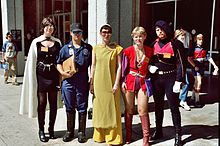
 Creative anachronists and those who enjoy cosplay put great effort into creating more-or-less authentic costumes.  They usually do not weave their own cloth (much less raise the sheep, shear the sheep, and spin the wool), and dying their own cloth is not common, but the more authentically-minded sew by hand rather than by by machine.

Photograph of five people standing together in costume

(Of course a lot of them buy patterns, in their size, and use the pieces of tissue to cut out pieces of cloth in the right shape, but there are limits to how heavy-duty someone wants to be.)


 Medieval Cosplay Armor Patterns | Kinpatsu Cosplay

If one is going to become all authentic about medieval costumes, one of the first decisions is to choose the era one is trying to reproduce.  For both men and women, throughout the Middle Ages, the basic unit of clothing was a tunic, essentially a long-sleeved T-shirt, shorter for the men, longer for the women, as seen in the medieval drawing below.  A long rectangular cloak, generally with a hood, went over this in cooler weather.  But this simple design was greatly varied depending on time and place.

 
Classical antiquity had had very simple clothing, a lot of it basically pieces of cloth just wrapped, tied, and pinned around the body.  Early medieval clothing seems to have been equally simple, although Germanic men adopted trousers, which the Romans initially found both effeminate and hilarious.

As the Middle Ages went on, clothing became more elaborate.  Elegant women wore dresses cut on the bias, which gave their clothing stretch, allowing their clothes to fit more closely to their bodies.  These elegant dresses did not have zippers or other fasteners (zippers are a nineteenth-century invention), so the woman had to wiggle her way in.  Sleeves were basted on separately, every morning.

Even with fairly simple tunics above and socks or stockings below (no tights), an outfit could be accessorized with brooches, bracelets, necklaces, sashes, and fancy belt buckles.  These were worn by both sexes.  The image below is a modern reproduction of a Frankish belt buckle.


A big advance in the thirteenth century was the adoption of buttons.  Originally they were merely decorative, but quickly women realized they could be used with loops as closings for one's clothes, allowing even more tight-fitting outfits.  Lots of buttons (which were expensive, usually mother-of-pearl or ceramic) was a sign of luxury.

Toward the end of the Middle Ages women started wearing elaborate head dresses, again as signs of wealth and luxury.  Keeping one's clothing fresh and unstained, especially if it was white, was also a sign of luxury in an era with neither dry cleaning nor washing machines.

In the post-medieval period, clothing became even more elaborate for those who could afford it.  Those huge white ruffled collars one sees in early modern Dutch paintings were certainly nothing that ordinary working people could afford or manage.

At the court of Louis XIV in France, clothing was by far the biggest expense for the aristocrats at court trying to impress each other.

© C. Dale Brittain 2021

For more on clothing and other aspects of life in the Middle Ages, see my ebook, Positively Medieval, available from Amazon.  Also available in paperback1

Sunday, July 19, 2020

Summer in the Middle Ages

We think of summer as long, lazy days, time to relax and have fun.  That's because we're not farmers.  (And in fact the reason there's summer vacation from school is because, through the early twentieth century, it was assumed that kids would be needed in the summer to work on the farm.)

Medieval people did not think of summer as a time to relax.  It was time to get things done.  Since probably 90% of the population was engaged in agriculture, this was the time to plow and plant and weed and chase away critters and harvest.  It was assumed that during, for example, harvest time (winter wheat, planted at the end of autumn, would be harvested in July) everyone would set to work as soon as it was light enough to see and continue working until it was too dark to see.  This is why initially eighteenth-century factories believed in the 18 hour work day ("They work that long in the fields, they can work that long on the factory floor").

Below is a picture of a plowed field.  Even with a tractor, it's going to take you a while to work it.


Travel was far, far easier in the summer, in spite of the heat and muddy roads, than it was during the winter, when one was battling cold and snow and ice (and short days).  So the kings and great lords who traveled around to different parts of their realms did so primarily in the summer.  So did popes--and for the popes, getting out of Rome, which was then prone to malaria, made excellent sense in the summer.

Wars were also fought primarily in the summer.  This had always been true--the Bible talks about "May, when kings go to war."  An army needs forage for the horses and mules, which means waiting until the grass is growing, and it also prefers that the people they are going to raid have enough food on hand to make raiding worthwhile.

Even though winter was the time for story telling--there were a lot of long cold dark hours to fill--the stories were almost always set in the summer.  King Arthur stories typically started with the king at his mid-summer feast, hoping that something marvelous would show up.

Because the most common fabric for clothing was wool, one could get very warm in the summer without the lightweight cottons we take for granted (cotton only reached western Europe in the twelfth century and was expensive--the alternative was linen, also expensive).  Men could wear short sleeved tunics that were about knee length, and nothing underneath, but women were expected to wear long skirts, not shorts or mini-skirts.  They did tuck their skirts up when working in the field, but they were still more heavily dressed than the men.

Without electricity, no one before the late nineteenth century could have any kind of fan (other than one a human waved), much less air conditioning.  Northern Europe was still cool enough for most of the summer that it wouldn't become unbearable, but around the Mediterranean things definitely got toasty.

© C. Dale Brittain 2020

For more on medieval life, see my ebook, Positively Medieval:  Life and Society in the Middle Ages.  Also available in paperback.


Tuesday, January 29, 2019

Medieval shoes

We take shoes for granted.  Work shoes, dress shoes, shoes for fancy occasions, beach sandals:  off to the store, try on a few pairs, and there we are.  Shoes come in so many shapes and styles that there is even a museum in Toronto (the Bata museum) dedicated to shoes.  The well-to-do are mocked for owning too many pairs of shoes--Imelda Marcos supposedly had hundreds of pairs.  Most shoes today are assembled in third-world countries, and a great many are made of man-made components.

Medieval shoes, as you will doubtless have guessed if you've been reading this blog, were different.  For starters, one did not pop into the shoe store, decide you liked a style, try on both the 9 and the 9 1/2 to see what fit best, and buy a pair.  Shoes were individually made to fit your feet.  Interestingly, however, there wasn't the left shoe and the right shoe.  Instead there were shoes, that might be tweaked until both left and right feet were accommodated.

Shoes were made of leather because there was no plastic and no rubber (at least no rubber in western Europe--rubber comes from southeast Asia).  Light slippers might be fabric with a leather sole, and sandals could be made of fibers (like vines), but leather was the norm.  If someone wanted a new pair of shoes, he or she would go to the shoemaker, who would measure their feet, discuss the style, and decide which shoe last was closest to the buyer's feet.  The shoes would then be made by hand.

Shoes came in several different styles, depending on time, place, and purpose.  The basic shoe was a piece of leather that was cut the right shape to wrap around the foot and was held in place by wide laces going up the leg.  Warmer regions saw a lot of sandals, often made from plant material; some were slip-ons, others had a thong that went between the toes, like a modern flip-flop.  Knights wore riding boots, generally shorter than the modern riding boot.

Not surprisingly, shoes were expensive by our standards.  Peasants needed shoes for the winter, but during the summer they might go permanently barefoot.   (Very conservative Amish communities follow the same pattern today.)  Note the farmer plowing barefoot in the image below.  They would of course have to be very careful not to step on a nail and potentially get tetanus and die.


Even the wealthy had few different pairs of shoes, both because they were expensive and because it took a while to get a new pair.  Because they were made for one's feet, they generally fit just right, so why get more than you needed?

But shoes then, as now, were influenced by fashion.  Periodically a fashion for very long, pointed toes would seize the aristocracy.  In the extreme version, the points were so long that they were drawn up to the knees and tied.  These shoes were hard to walk in, but that wasn't the point.  The long, curling toes still survive in stereotyped images of court jesters.

© C. Dale Brittain 2019

For more on medieval clothing and other aspects of medieval history, see my ebook Positively Medieval, available on Amazon and other ebook platforms.


Sunday, August 26, 2018

Plastic

There's an iconic scene in the '60s movie "The Graduate," where a family friend is giving career advice to a new college graduate.  "One word.  Plastic."

Plastic is not medieval.  It's a twentieth-century invention, and indeed did not become at all common until the second half of the century.  In fact, you can tell if you come across an old dump if it dates to before or after WW II by whether or not it has plastic in it.  These days, of course, plastic is a major part of what we throw away, and the oceans (and ocean birds) are full of it.  (So are we.  The average modern American has several thousand tiny plastic bits lodged here and there inside.)

The word "plastic" just meant originally something that could be molded or shaped into different shapes, which of course plastic can be, to make lots of different objects.  The term now covers all sorts of different materials, including nylon and polyester as well as the versions of plastic that get official recycle numbers on the bottle.

Plastics (polymers) are made out of petroleum.  When you think about how useful plastic is, it seems a shame that we're using petroleum as a fuel and burning it up.  It's also a shame that we don't recycle more.  But these are not what I'm talking about today.

Here I just want to discuss how different a medieval person's material possessions would have been without plastic.

Let's start with clothing.  The chances are excellent that you're wearing something with polyester or nylon in it.  Look at the label.  (Medieval clothing did not have labels.)  Medieval clothing was made of wool or linen or, by the late Middle Ages, cotton.  Let's just say permapress was not known.

Beach sandals (flip-flops) are plastic.  Medieval sandals were usually leather, maybe with a wooden sole or some incorporation of straw.

What did you drink your coffee out of?  At home probably a ceramic mug, and medieval people had ceramic mugs (though not coffee).  But if you got it as a carry-out, it may well have come in styrofoam, a form of plastic.  If you ate carry-out food, there were likely plastic utensils involved.

When you go  to the supermarket, the food comes wrapped in plastic, and you get bigger plastic bags to carry it home in.  Medieval people had cloth or leather bags to carry things, and food did not come wrapped in anything.

Many people now carry bottled water around with them, water that is encased in plastic.  Medieval people would have kept water in a stone or ceramic vessel, or in a leather skin for transportation.  They had glass bottles, but these were too valuable (and breakable) to carry around.

How about in the kitchen?  Your countertop is likely to be plastic.  The stove knobs are.  The interior of the refrigerator is.  The non-stick lining of your pans is made of polymers (plastic).  You stir as you cook with a plastic spoon or a metal spoon with a plastic handle.  Medieval pots were iron (best) or ceramic (not as good) and stirred with a wooden spoon.

Eyeglasses these days usually have plastic frames, and the lens itself is often plastic as well (as of course are contact lenses).  Medieval eyeglasses  had metal frames and glass lenses.

Many a modern house has vinyl siding.  Medieval houses were wood or stone or plaster (usually a combination of all of these).  The plaster often had "natural" things like used straw from the stable mixed in.

Once you become aware of it, it's shocking how many things you touch on a daily basis are made of a material that went from very rare to ubiquitous in the last seventy-five years:  the computer, the car's dashboard and steering wheel and upholstery, the baby's chew toy, bottles of water, stockings, phones, indoor-outdoor rugs, credit cards, camping equipment, picnic plates....  The list goes on.

These days people often want to get plastic out of their lives--dress in natural linen or cotton, only leather for shoes, house sided in cedar rather than vinyl, counter-tops of wood or stone or metal, metal water bottles, bring your own ceramic mug for coffee, ask for paper bags at the supermarket or bring your own cloth bag.  They are fighting an uphill fight against a material culture that medieval people would have thought was great.

 © C. Dale Brittain 2018

For more on what people used during the Middle Ages, see my ebook, Positively Medieval:  Life and Society in the Middle Ages.


Sunday, February 12, 2017

Medieval color

Medieval people appreciated brightly colored flowers or sunsets or autumn leaves just as much as we do.  But they did not have the option of having those colors on their bathroom wall or on their clothing.


The bright colors we take for granted for manufactured items are products of chemical dyes, first developed in the nineteenth century.  The Middle Ages had to make do with natural dyes.  A few of these could produce very nice colors, but those were luxury items.  For most purposes, one had a choice of off-white, muddy green, subdued red, dark brown, dark blue, and maybe unconvincing yellow.

The white was usually off-white, the color of undyed sheep's wool or linen.  Linen could be bleached in the sun, and elegant ladies in the stories wore shifts of snow-white linen.  Keeping it spotless was an additional challenge.


Black sheep (actually dark brown) produced dark brown wool, which was used for monks' habits (so-called black monks) as well as anything else where you wanted a dark brown/black.  Some of the new monastic orders of the twelfth century, such as the Cistercians, went in for white habits instead, because black sheep were rarer than white and their wool was thus more expensive (and "showier").

Purple came from mollusks from the eastern Mediterranean.  This so-called Tyrian purple (actually closer to maroon) had been reserved in ancient Rome for colored strips on the togas of Senators.  In Byzantium, this purple was so rare that it was supposed to be reserved for the imperial family (hence the expression, "born in the purple" for someone of extremely high birth).

Real red was made from kermes insects, found in Italy.  The secret of this vivid red was closely guarded, so that cloth might be sent from the cloth markets of Champagne to Italy to be dyed and come back with its value more than doubled.

You could get a version of dark red from madder, an herbaceous plant with red roots.  It worked great to dye your hands red while you were trying to get some color on the cloth.  ("No, I don't have blood on my hands!")  Indigo, which came from the sap of certain shrubs, could give you a dark blue.  You could also get blue from woad, a plant in the mustard family.  Yellow was hard, but you could get at least pale yellow from some flowers and especially from pollen (in particular the pollen of crocuses, saffron).  You could get green (sort of) by mixing yellow and blue or by embracing grass stains.

Madder, indigo, and woad were all sold commercially, as was saffron, although the latter was very expensive and mostly used as a spice.

© C. Dale Brittain 2017

Friday, April 8, 2016

"Stuff" in the Middle Ages

Most people reading this blog probably own way too much "stuff," a problem medieval people did not have.  Our many cheap and serviceable possessions are a product of the nineteenth-century Industrial Revolution.

In an earlier post I discussed medieval clothing.  Most people in the Middle Ages (and for that matter up through the eighteenth century) would have had two outfits, one to wear and one to wash.  Washing of course was reserved until something was good and dirty; none of this tossing it into the washer after one wearing.  The overstuffed closets of many of us are only possible because of industrial looms, sewing machines, and cheap overseas labor.

One of the biggest causes of clutter in today's house (looking at my own office as I type) is too much paper.  We buy books, we get magazines and catalogues, we get mail, we print out interesting articles, we keep journals, we make notes, we get receipts.  This of course was not a problem for medieval people.

Paper didn't really exist; it first appears along the Mediterranean in the thirteenth century, but only became at all common in the fourteenth.  Without paper, everything was written on parchment, which requires starting with a sheep and doing a whole lot of processing.  Even medieval paper, being rag-based and made by hand, was far more expensive than modern paper, even if cheaper than parchment.

Everything was written by hand until the invention of the printing press in the fifteenth century, and even then most things were handwritten.  Books as a result were very expensive, plus you had to know how to read, which left out three-quarters of the population (or more).  A good-sized library might have a few dozen books, and this would not be a personal library but one belonging to a church.  A hundred books constituted a truly large library.  Most medieval books that survive look very well-thumbed, because they were read and re-read.  (Click here for more on medieval books.)

Besides clothing and paper, modern "stuff" includes kitchen ware (everything from pots and can openers to plates), furniture, appliances, linens (sheets and towels), decorative objects, cosmetics, window treatments, electronic paraphernalia (computers, phones, etc.), sound recordings, souvenirs, toys, sporting goods, and tools.  All of it is good and useful or at least seems like it should be, or could be again.  Much of it is imbued with happy memories.  We don't realize how much we have until we have to move or otherwise clear out a house.

It's no wonder that one of the biggest selling books right now is about how to make yourself throw away or give away your possessions.  Many wish (at least in the abstract) for a simpler set of possessions.  Medieval people would also give everything away, but normally only if they were going to go off and be a hermit or something.  And they would have had far less to deaccession.

Many a powerful lord's household in the Middle Ages would pack up pretty much everything they owned and take it with them when they traveled.  The bed frames would be disassembled, the trestle tables knocked down, the few chairs and cooking pots put on a wagon along with the bedding and the extra clothing, and off they would go.  In the late Middle Ages, when the well-to-do got glass for their windows, they would even travel with their glass--after all, you wouldn't want to sleep in a drafty room.

© C. Dale Brittain 2016

Thursday, January 8, 2015

Medieval underwear

The ancient world hadn't worried much about underwear.  The Mediterranean summers were hot, and two thousand years before air conditioning, one preferred to have as much of one's body as possible cooled by the breeze.

The normal outfit for a man in ancient Greece was a simple piece of cloth wrapped around the torso, going under one arm and pinned at the other shoulder.  It was held in place with a belt and stopped somewhere in mid-thigh.  Men must thus have flashed their manly manliness with almost every step.  In a society that believed athletic events should be carried out in the nude and that portrayed its gods in the nude, this should not be surprising.

(Greek women wore the same basic outfit, but it was ankle-length and would be pinned or sewed with a few stitches all down the side.  We don't know what they had on underneath--they were discreet.)

The Middle Ages however had underwear.  The Romans had mocked the breeches the Germanic people wore, but they had to admit they made horseback riding more comfortable.  Underwear was however expensive.  You probably didn't want wool tight against your private parts, even though wool was the most common and cheapest fabric, so they had to use linen, until (relatively) less expensive imported cotton reached Europe in the twelfth century (silk had been around longer but was of course even more of a luxury).

If a man was not going to get up on a horse, he typically wore a tunic (knee-length or a little shorter) with nothing to speak of underneath except the arrangement (dare I say garter belt?) that held up his stockings.  (Medieval tunics, unlike those of ancient Greece, had no vents down the side.)  Medieval women always wore a bit more under their skirts, as well as usually a slip or chemise with lace at the neck if they could afford it.

Male monks did not normally wear underwear.  The whole purpose of the monastic life was to remove oneself from the world to a life of austere simplicity, and a long, wrapped habit (basically like a bathrobe) was all that was required.  However, this could create problems if a monk went out on an errand or had to ride somewhere.  Monasteries provided breeches to monks leaving the house (no use causing a scandal if the robe suddenly flew open), but they were supposed to return them once they got back.

Nuns however always had a bit more on under their habits.  Heloise, as abbess, complained bitterly to Abelard that the Benedictine Rule that governed monasteries did not give proper attention to the things that went on with women's private parts (she did not go into detail, but we all know what she meant).

As we all snicker about medieval underwear, let us remember that there is still a lively debate about what Scots are supposed to wear under their kilts.

Click here for more on medieval clothing.

© C. Dale Brittain 2015

For more on medieval life, see my new ebook, Positively Medieval: Life and Society in the Middle Ages.


Wednesday, October 15, 2014

Medieval Clothing

Most of us have far too many items of clothing.  Because these days most clothing for sale in the US is made by cheap labor in the third world, it's fairly inexpensive.  So we buy something for a special occasion that we'll wear once, or buy something and decide we don't like it, but not enough to get rid of it.  Or we do like something, so we buy another one or two just like it.

Medieval people did not have the luxury of the overstuffed closet (and yes, I'm looking at me).  Cloth was woven by hand and sewed by hand (no sewing machines until the later nineteenth century), so making it was labor-intensive.  Town people could have clothing made for them, but country people made their own.  Most people would have two outfits, one to wash and one to wear (no pajamas, they slept naked).  When one outfit got thoroughly worn out, they'd get another.

The basic outfit for both men and women was a tunic, essentially a long-sleeved T-shirt.  For men it would be about knee-length.  For women it would be floor-length.  Elegant women preferred dresses cut on the bias, so they would accentuate their form.  Sleeves could be so tight that it was impossible to get the dress on or off, so they had to be separate, sewn in place each day once the woman had wiggled her way in (this is way before zippers).  For riding, men would wear trousers ("breeches"), but much of the time they were happy to show off their manly legs.

Wool was the most common fabric for clothing, which is why sheep-raising was a major activity, especially in areas like the British Isles where the land wasn't as suitable for crops.  The other major kind of cloth was linen, made from flax, a grass-like plant that could be spun and woven like wool.  Women might wear a linen shift (essentially a slip) under their tunics.

Everyone wore long capes as their outer clothing, with a hood to keep off the rain (the umbrella was centuries in the future).  They also wore stockings, woven rather than knitted, as knitting was not invented until the end of the Middle Ages.  These were held up either with wrapped bands or what was essentially a garter belt (for those who remember garter belts), a belt worn under the clothing with laces hanging down ("points") to tie to the tops of stockings.  Shoes were individually made for each person's feet.

(Click here for information on medieval underwear.)

The cloth trade was a major economic activity.  Raw wool from the British Isles was imported into what are now the Benelux countries, where it was woven into cloth.  This cloth would then be sold at the great trade fairs in Champagne (the region in northern France, after which the drink was named some centuries later).  Some of this wool cloth would be taken to Italy, where it was dyed--the Italians had special secret ways of producing good red-colored cloth.  Once dyed, it would be back at the trade fairs to be sold for substantially more than undyed cloth.

If one did not have Italian reds, one's clothing was either natural (off-white) or else a choice of muddy green, dark blue, or brown, which if dark enough passed for black.  Unconvincing yellow was also possible.  We have no idea how lucky we are to have modern chemical dyes.

The luxury fabrics were cotton and silk.  Cotton first appeared in the west in the late twelfth century and made possible actual underwear, which they'd pretty much done without.  Silk was known throughout the Middle Ages, but because it was imported from the far East, it was always extremely expensive.  It came on the so-called silk road from China, across central Asia, to fetch up in the eastern end of the Mediterranean.  Silk was valued for its color--you could get a brilliant green silk--for its softness, and for its resistance to cloths moths.  No one believed the ridiculous story that silk came from worms.

The wealthy had luxurious clothing that probably cost as much (proportionately) as we'd pay for a car, both because it was good to have more than just a few serviceable outfits and because it was an excellent way to show off.

© C. Dale Brittain 2014
For more on medieval life, see my new ebook, Positively Medieval: Life and Society in the Middle Ages.