Wednesday, May 14, 2025

Stave Churches

 We think of medieval churches as made of stone, as indeed most of them were.  But stone churches always needed wood as well.  The scaffolding that was required when the church was being built, as the rows of stone blocks rose higher and higher, was of course made of wood.  And the rafters of the church, which held up the roof, were wooden.  As the fire at Notre Dame six years ago showed, if those centuries-old timbers caught fire the church itself would suffer serious damage.

Some churches were however made primarily of wood, most notably the Scandinavian stave churches.  There are over two dozen in Norway dating from the Middle Ages and one in Sweden.  The term "stave" refers to the vertical posts, one at each corner of the main, central part of the church, which supported the weight of the rest of the building materials.

These staves were made from entire trunks of an evergreen tree (a special northern species of pine).  An appropriately tall, straight tree would be chosen, its branches cut off, and its bark girdled.  It would now be dead, but it was left standing for several years.  This was believed to make the sap inside set up, making the wood very hard and resistant to rot and insect damage.

The staves were set on horizontal "sills," made from the same hardened wood, and clapboard siding was attached.  The churches were several stories tall, with very steep roofs that would shed Norwegian winter snow.  They were decorated with carvings on the rafter ends, the same way that stone churches might have gargoyles.


The result was something that to the modern eye looks fantastical, like something out of a fairy-tale, but they are treated by the local congregation as just their church (note the cemetery adjoining the church).

Because these churches do not look like the churches built in much of Christian Europe in the Middle Ages, they are now often labeled "pagan."  This seems very unfair, as the earliest examples date from the end of the twelfth century, roughly 200 years after the region adopted Christianity.  (Remember, centuries were just as long in the Middle Ages as they are now.  We're talking about a time span comparable to the distance from us back to Thomas Jefferson as president.)

Movies and TV shows about the Vikings often give them "pagan temples" that look like stave churches, even though there is a grand total of zero evidence that Vikings ever worshiped Odin in anything that looked even vaguely like a stave church.  The carpentry skills that produced excellent long ships for the Vikings, however, carried over into the skills needed to build a stave church, and some of the techniques for the churches' clapboard siding are very similar to those used in ship construction.

© C. Dale Brittain 2025

For more on medieval religion and other aspects of medieval history, see my book Positively Medieval, available on Amazon and other on-line platforms.  Available as an ebook or paperback.

Thursday, May 1, 2025

Christian Ethiopians in Rome

 As I discussed in an earlier post, Ethiopia was predominantly Christian during the Middle Ages, with its own stories, for example, of miracles of the Virgin, stories that like their counterparts in Europe were intended to show that no matter how big a sinner you were, there was always hope for salvation.

Ethiopia had been Christian since at least the fourth century, when priests from Egypt became established there. (You'll recall that Egypt was a major center of Christianity in the first centuries AD.)  The Ethiopians indeed considered their attachment to the Judeo-Christian tradition to go back even further, to the days of King Solomon.  The "Song of Songs," a book in the Old Testament, has the king address his beloved, "You are black but you are comely."  Both Ethiopians and Europeans interpreted this as meaning the queen of Sheba, black as were the people of the Horn of Africa (Ethiopia).

Okay, the Song of Songs is supposed to be about Christ's love for His church, according to medieval theologians, not some king crooning to his mistress, but they would have been the first to tell you that a Bible text had meaning on more than one level.  At any rate, the kings of Ethiopia, from at least the thirteenth century, asserted descent both from the Solomon-Sheba alliance and from those who had brought Christianity to the Horn of Africa in the fourth century.  They also said that Sheba's son had brought the Ark of the Covenant to Ethiopia from Jerusalem, but we aren't going to talk about that now.

In the early days of the church, before the rise of Islam, Ethiopia had sent bishops to ecumenical councils.  They attended the Council of Chalcedon in 451, which addressed some of the issues of the nature of Christ that seemed still to be up in the air after the Council of Nicaea over a century earlier.  Christ was both human and divine, but was He both fully, or half and half?  The council settled on "one person, two natures," fully human and fully divine at the same time, accepted by both the Latin west and Greek orthodoxy.  The Ethiopians, along with some other Christian churches, held out for one person, one (blended) nature.  (Yes, most of us today would be scratching our heads over why this was a big deal, but trust me, it was.) Other differences also persisted, such as whether to celebrate the Sabbath on Saturday or Sunday. Also the Chalcedonian version of the church finished dropping any thought that Christians needed to follow Old Testament requirements of circumcision, which the non-Chalcedonian churches continued to follow.

Throughout the Middle Ages, although there wasn't much contact between western (Latin) Christendom and Ethiopia, once the Mediterranean basin became predominantly Muslim, they knew each other were there.  Pilgrims from Ethiopia periodically visited sites holy to early Christianity, even if in areas (like Egypt or the Sinai) now predominantly Muslim.  There were plenty of stories in Europe about "Prester John," a black priest (prester) who was sort-of-like-a-pope of some fabulous African land.

At the end of the Middle Ages, pilgrims from Ethiopia showed up in Rome.  They wanted to visit the tombs of Saints Peter and Paul who, being in the New Testament, were as important to them as they were to western Christendom.  They settled in the church of San Stefano Maggiore, an old church, located near Saint Peter's basilica, that had been in some disrepair for centuries and had most recently been used to house priests.  San Stefano became the Ethiopian guest house.

Ethiopian pilgrims continued to visit Rome and stay in San Stefano for the next two centuries, through the late Middle Ages, Renaissance, and Reformation.  Some stayed only a short time.  Others lived there their entire lives.  They learned about the Latin version of Christianity, and a few converted to it.  They explained their version to the Roman priests.  These priests thought to draw these strange people they thought of as "Indians" (that is from some distant marvelous land) into their version of Catholicism, and simultaneously became disturbed at what they considered heretical beliefs and practices.  The pope, facing the split in western Christendom from the Reformation, tried to figure out how these Ethiopians could be on his side.

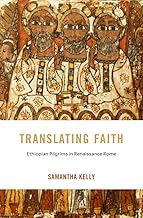
The Ethiopians' extensive writings on their experiences in Rome ended up in the library of the Vatican.  Samantha Kelly, who (unlike most of us) can read their language, has very recently published a book on these Ethiopian pilgrims, called Translating Faith, Harvard University Press 2025.


Translating Faith: Ethiopian Pilgrims in Renaissance Rome (I Tatti Studies in Italian Renaissance History)


© C. Dale Brittain 2025

Sunday, April 13, 2025

Religious Women

 There were many ways for women to show their religiosity in the Middle Ages. The most obvious of course was by becoming a nun, entering a monastery for women.  Although such nunneries became common in the late Middle Ages, when a large proportion of the nuns had entered the cloister as girls, for much of the Middle Ages such houses were far outnumbered by male monasteries.

In the early and high Middle Ages, most of the nuns did not enter as girls but rather as mature women.  Men too did not always enter as boys; the Cistercian order, for example, was made up primarily of monks who had converted as young men, and many an elderly man decided to improve his chances at heaven by spending his final year or two as a monk.  But there were a whole lot of nuns who had entered the house in middle age, not old age, usually because they were widowed--a common event when women tended to marry much older men.

It was these experienced middle-aged women who tended to become abbess.  At the double-monasteries of the early Middle Ages and of twelfth-century houses like Fontevraud, where a male house and a female house had a single head, the head was always a middle-aged woman.

But how else could a woman be religious?  Nunneries usually followed the same Benedictine Rule as male monasteries, but just as there were houses of male canons, who lived more or less like monks but who also served as priests for their community, there were some houses for canonesses.  Although of course they did not serve as priests, they might take care of people at a hospital.  (Even today, nurses in Britain are called Sister, a reminder of this old function.)

Canonesses lived in a cloistered setting, like nuns, but one could still be a religious woman outside the cloister.  In medieval cities, from the thirteenth century onward, there grew up forms of the religious life for women where the women continued to live in their own houses and do their normal activities but still practice a more contemplative life.  They might have a rule formally endorsed by a bishop and practice chastity as well as meeting regularly for prayer.

But some of these lay sisterhoods did not bother with a formal rule.  They followed a life that combined religiosity in both a public and private setting but took no vows.  From their point of view, they were living like the original apostles as described in the Book of Acts in the Bible.  The Beguines, found primarily in cities of Flanders, sought to help their fellow citizens through good works as well as trying to be fair and honest in their own commercial dealings.  They met regularly to encourage each other and to pray together.

The danger was that, without vows or formal oversight from the church hierarchy, they were considered (at least by the church hierarchy) to be in danger of slipping into heresy.  Some of them did, making up their own versions of religious doctrine--which of course they believed was true Christianity (the bishops disagreed).  Some got into serious trouble and ended up shipped off to real nunneries.  Some were allowed to continue as long as they kept quiet about it.

And then there were the recluses, women who set themselves up in a tiny house build on the outside of a church.  They would of course need the approval of the priest or bishop.  This practice was more frequent before nunneries became common.  The woman in essence was a hermit in her cell, except that she was usually in the middle of town or village, not out in the woods, where everyone agreed (even including the women) females ought not to be by themselves.  Most of these recluses had enough food to live on donated by the pious and regularly attended Mass in the adjoining church.  But in an extreme version the recluse might be walled up in her cell and not leave at all.

These recluses are often referred to as "anchorites" by British historians, although no anchor was involved, and there is no medieval cognate for the term.

Some of ways medieval women showed their religiosity must have been very hard on their bodies.  But as Peter Abelard pointed out in the early twelfth century,  because women's bodies were weaker than men's, their virtue was so much greater in enduring physical privation.


© C. Dale Brittain 2025


For more on medieval religion and other aspects of medieval history, see my ebook Positively Medieval, available on Amazon and other ebook platforms.  Also available as a paperback.

Wednesday, April 2, 2025

Ethiopian Miracles of the Virgin

 Ethiopia, in eastern Africa, has been Christian for longer than most of Europe.  The area was never part of the Roman Empire, but missionaries presumably made their way down there from Egypt, which was in the Empire and became Christian early.

Indeed, there has often been assumed to be a long connection between Ethiopia and Judea/Israel.  The Song of Solomon (love poems supposedly written by King Solomon, father of David, now usually interpreted as expressing Christ's love for His church), speak about his beloved as black and comely, and this is often said to indicate that she was from Ethiopia.  Did the queen of Sheba move to the Middle East from Ethiopia?  Hard to say.

Because Ethiopia was predominantly Christian in the Middle Ages, it had saints and miracle stories, just as Europe did.  And, again like Europe, the most common miracle stories involved the Virgin.  She was Mom, the one who would always love you no matter how bad you were.  God would judge you for your crimes, and Jesus was too awe inspiring to approach for everyday issues (he saved your soul and everyone else's, the church said, isn't that enough of a miracle?) but Mary was right there, even edging out the Holy Ghost as the "real" third member of the Trinity.

Ethiopia's stories of the Virgin, like those in Europe, may seem weird to the modern eye, because someone is very bad yet, because they pray to her, they are saved.  In Europe, for example, one of the most common stories was of a knight on his way to a tournament who stopped to pray to the Virgin and prayed so hard he lost track of time, but no problem! the Virgin put on his armor, rode his horse, and won the tournament.  Because she was wearing his armor, everyone thought it was him, and he won the prize.  In another, a monk rowed across the lake every night to visit his mistress, but he always prayed to the Virgin before going, so when his boat sprang a leak and he drowned, she interceded with God to save his soul.  Mom always will love you!

One of the most common Ethiopian stories, retold and illustrated multiple times, involved a rich lord who was also a cannibal.  (A little dig at the powerful there.)  After eating all his friends and family, he set off to find more people to eat, taking a water skin with him.  Soon he met a dying leper, who begged for a drink.  No way, said the cannibal.  The leper begged in the name of God, in the name of Christ.  No luck.  But then he begged in the name of the Virgin, and the cannibal relented and gave the leper a little water as he finished expiring.  Shortly thereafter, the cannibal too died (not clear why, but let's not spoil the story worrying about it, I doubt that he got sick from eating a dead leper).  The devil was all set to seize his soul, but the Virgin intervened, and he was saved.  Better pay attention when someone asks for something in her name!

Since both Ethiopian and European miracle stories can seem weird to us, maybe our role as historians is to stop trying to make the past fit our idea of what religion and society should properly be like and instead try to understand people for their own sake.

Wendy Belcher of Princeton University is leading a team studying Ethiopian miracles of the Virgin.


© C. Dale Brittain 2025


For more on religion, saints, and other aspects of medieval history, see my ebook Positively Medieval, available on Amazon and other ebook platforms.  Also available as a paperback.

Monday, March 17, 2025

Snakes

 It's Saint Patrick's day! One of the most enduring stories about this late-Roman saint is that he drove the snakes out of Ireland.  But as I noted in an earlier post about good old Saint Paddy, there actually were no snakes for him to drive out.  Pretty much all living things in what is now Ireland, including snakes, had been wiped out by the glaciers, back thousands of years ago, and as the glaciers retreated and plants and animals again reached the British Isles the snakes never made it across the Irish Sea.

Of course for medieval people it was good not to have snakes.  Europe doesn't have all the poisonous snakes found in the Americas (and don't get me started on Australia), but they do have the adder, which while not as serious if it bites you as a rattlesnake, is in fact poisonous, and people can die from the bite.  Great Britain (the island with England, Scotland, and Wales on it) does have adders, even if Ireland doesn't.  So does the European continent (I once almost stepped on an adder in France.  It was cool about it.)

The ancient Hebrews weren't fond of snakes either.  The story of Adam and Eve, where they are tempted to eat from the Tree of Knowledge after God told them explicitly not to, has a snake as a tempter.  The book of Genesis describes the snake as the most sneaky and cunning of all the creatures.

It's not quite clear what the snake's purpose was in tempting Eve, but he certainly paid for it.  God cursed all three of them, telling Adam he'd only get food by hard labor in the fields, Eve that she'd bear her children in pain, and the snake that he'd have to go on his belly in the dust.  Interestingly, the implication is that up until then snakes had had feet.  However, medieval and Renaissance depictions of the Adam and Eve story always have the snake with no feet (though sometimes it has a human face).


The line between snakes and dragons in medieval imagery was rather fluid.  Both were a sort of serpent, though dragons would usually have limbs as well as long snaky tails.

Now in fact snakes play an important role in the ecology.  Water snakes eat frogs and small fish, and land snakes eat insects, mice, and rats (depending on the kind of snake and how big it is).  When you have an animal without predators, it can multiply to the point of causing serious harm to the environment.  (Hmm.  Humans don't have natural predators other than each other.  Let's not talk about that right now.)


© C. Dale Brittain 2025

For more on medieval saints and medieval animals, see my new ebook, Positively Medieval: Life and Society in the Middle Ages.  Also available in paperback.


Thursday, March 13, 2025

Performative Acts

 Recently a number of medieval scholars have started examining what are called performative acts, that is not simply that someone did something or other, but that they "performed" it, that is acted in a certain way to underscore what they were doing.  These days a lot of communication is done via text or email or phone call, where you don't see the other person, but medieval communication was more likely to be done face to face.

Now of course we still have performative acts.  People do them instinctively even if they are not thinking through their performance.  Mom coming into the room where she just heard a disturbing crash stands with her arms firmly folded.  The professor steps up to the lectern and gazes sternly out across the students until they stop talking.  The president signs an executive order, waves it back and forth so everyone can see his signature, and hands the signing pen to someone nearby, as (one assumes) a precious souvenir.

Medieval oaths of allegiance were full of performative acts.  One did not simply swear an oath, or (as we do now) raise one's right hand while swearing it.  (Think about it. Why does raising your hand make it more significant? But it does.)  One went down on one's knees and raised one's hands to the person to whom one was swearing allegiance.  This is the basic act of swearing homage, as a knight or noble would do to a lord.  But it doesn't stop there.  The lord would reach down, take the hands, draw the person up, and kiss them on the cheek.  This would be done very publicly.  Everyone would remember it and would understand the symbolism of the person swearing homage both being subservient to and the equal of the lord.

Peasants as well as aristocrats could take part in performances.  In some parts of western France in the eleventh century, a serf was expected to come on hands and knees before his or her lord with a penny balanced on their head.  The value of the penny was trivial.  What was important was the public ceremony.  In some cases the peasant might even have a rope looped the neck, in case the imagery was not clear enough.

Oaths of allegiance among aristocrats were not one-time events.  Chronicles often tell us that, at Easter or other important times, the king might "wear his crown" and have all his men repeat their oaths of allegiance.  Wearing the crown itself was a performative act, as kings did not usually walk around wearing something heavy, valuable, and awkward on their heads.  When they put it on they were signaling their position and authority.

Even property transfers were often performative.  Someone giving land to a monastery would generally place something on the altar, a book, a staff, even a handful of dirt.  Although scholars once considered such acts a sign of a primitive, illiterate society, in fact the public act, which dozens would witness, is only known about today because it was recorded in writing.  The physical action emphasized the spoken and written words and gave the witnesses something striking to remember.

Although the physical act is usually what we think of by a performative act, documents could play a part.  A big piece of parchment with seals dangling from it could be waved around as its own performative act.


© C. Dale Brittain 2025

For more on medieval political acts, see my ebook, Positively Medieval:  Life and Society in the Middle Ages.  Also available in paperback.


Saturday, March 1, 2025

The Donkey Playing a Harp

 The donkey playing a harp.  Or, if you prefer, the ass playing a lyre.  It's an image you'll find carved on Romanesque churches (eleventh-twelfth centuries) all over western Europe.  What could this possibly mean? you ask.


The image above is from Compostela, in northern Spain, but there are plenty of others.

But where did such a curious image come from?  It goes back to someone named Phaedrus. But even before we get to Phaedrus, remember Aesop's Fables?  You must have been exposed to them at some point.  Short little stories, usually involving animals, with a moral to the story.  Well, Phaedrus, who lived in Rome in the first century AD but may have been a Greek slave, translated Aesop from Greek into Latin and added some fables of his own.  Later generations seem to have added a few bonus fables to the collection.

And there in the Phaedrus material is the donkey playing a harp.  It's a pretty minimal fable.  A donkey sees a harp lying in a field, tries to play it with his hoof, and does sound a lovely note though he's incapable of playing a tune.  Too bad, he thinks.  If someone who knew what he was doing had tried to play the harp, I would have enjoyed it.  There follows some lame moral about the right person coming along at the right time.

The fables of Phaedrus became well known in the west, along with the image of the donkey trying to play the harp with his hoof, unsuccessfully I'm sure.  The image became a "marvel," something weird and outside of people's normal experience.  The donkey and his harp always appears around the edges of major carvings, usually along with images of strange creatures such as showed up in medieval travelers' tales, like centaurs, or griffins, or mermaids, or people with the head of a dog, or the people who lived down near the south pole who were upside down, needing strong toes to hang onto the earth and keep from falling off.  (The Compostela carvings include some of these.)

This is an indication that medieval churches were more than just places to contemplate the saints and one's own salvation.  They were educational centers, centers of ideas, places to marvel at all the amazing things in the world.


© C. Dale Brittain 2025

For more on medieval churches, see my ebook, Positively Medieval:  Life and Society in the Middle Ages.  Also available in paperback.