If you live in Florida, you think of Saint Augustine as a city in your state. If you took Western Civ in college, you may have heard of the saint. Wasn't he like an early Christian thinker or something? you say. Yes he was, and the person after whom the city is named. He's actually one of the most important Christian thinkers of the West. The following gives you a few highlights that ought to jog your memory of Western Civ--or fill in a gap if you never took it.
Before beginning, let's clarify, that there are two saints named Augustine. The first one is the one we're talking about today (lived 354-430). He was a bishop in North Africa when North Africa was still part of the Christian Roman Empire, pre-Islam. I pronounce his name AW-gust-teen, like the Florida city. The other one was sent from Rome to Anglo-Saxon England around the year 600 to convert the pagan Anglo-Saxon kings to Christianity, at which he was fairly successful. I pronounce his name Aw-GUST-tin, to keep him separate from the first one. (Note that pronunciation of these names is fairly mix-and-match, depending on who you ask.) (The name Austin is a variation of Augustine. Thought you should know.)
Let's talk about the bishop. He wasn't a bishop at first, of course. He grew up in Roman North Africa, son of a Christian mother, Monica, and a father who didn't seem to worry much about religion one way or the other. (Monica is also a saint now. You go, girl.) Young Augustine's father told him to enjoy his youth, sow some wild oats, and Augustine took him up on it. We know all of this because Augustine was one of the first people to write an autobiography, a story of his own life, which he called "Confessions." But among all the wine, women, and song, he started thinking about philosophical issues.
His big question (and a question that's continued to be big for all philosophers) was, Why is there evil in the world? First he decided Dualism was the answer. This is the philosophy that the universe is caught in an eternal struggle between Good and Evil. They are equally balanced, and neither will ever win. (This is also called Manichaeism. It's officially a heresy. It's also related to the religion of Zoroastrianism.)
Augustine ended up rejecting Dualism, however, after reading the pagan Greek philosopher Plato (lived in fifth century BC). Plato argued for archetypes, absolutes, that we all reflect dimly, saying that there is such a thing as Absolute Good (this was against other Greek philosophers, who said everything was relative). However, there was no Absolute Evil, only an absence of good.
(Think about light versus dark. Dark isn't an absolute. It's just the absence of light. When you go to bed you don't reach for the switch and "turn on the dark.")
Young Augustine really studied Plato and other early Greeks (in translation into Latin, his own native language) and went off to Milan, where there was a famous school of philosophy at the time. Here he encountered Ambrose, who was both bishop of Milan and a noted philosopher in his own right. (Ambrose is also now a saint. The cathedral of Milan is dedicated to Santo Ambrogio. That's him.) Ambrose converted Augustine to Christianity, and Augustine soon went home to North Africa to become bishop of the city of Hippo Regius (which was not a city of hippopotamuses, it's just its name‚ a city now in Algeria and called Annaba).
Here he started writing, so many books, in fact, that when he died it was said that no one could possibly read them all. And these weren't just any books. These became the most important works defining theology for the Middle Ages--and for that matter, he was also very influential on Martin Luther and the Protestant Reformation.
Augustine settled on original sin and the will to explain evil. Humans, he said, ever since Adam and Eve had wanted to have their own way, rather than do what was right and good. There was no "childhood innocence" for him, but everyone was born a sinner. He pointed out that if a woman were nursing two babies (either twins, or one of hers and another she was fostering) the two would fight over who had the Lucky Breast. Without baptism that wiped out original sin (the sin of our origins, from Adam and Eve), everyone would go straight to hell. Not surprisingly, this idea pushed baptism from something you might undergo in old age back to infancy.
But, as he knew perfectly well, everybody kept on sinning away even after baptism. Augustine stressed that no one can make their own salvation, no one can always be good and pure and earn their way into heaven. (The idea that all it takes is to choose to do good to be saved is another heresy, Pelagianism.) Since everyone's a sinner, we all need grace, he said, God undeservedly choosing to save at least some of us--a possibility because of Christ's sacrifice, grace given to humans via the sacraments.
Because Augustine rejected Dualism (though Christianity still has a lot of dualism in it), he rejected the idea that the body was naturally bad. After all, Genesis is clear that God had created the physical world, including human bodies, and God doesn't create bad things, even if we mess them up. Our problem is a will that tells the body to go for it.
Sex, like the body, was not naturally bad. After all, Adam and Eve were supposed to multiply. (And we're not talking here about the times-tables.) Sex in marriage, for the purpose of having children, was just fine for Augustine. But willfully deciding to have sex just for fun, especially if outside of marriage, was clearly sinful. This is still the official Catholic position. (But one was allowed to enjoy procreation. Whew.)
Perhaps his most famous work is "The City of God," in which he argued that humans cannot create heaven on earth, but that the perfect city will be found only after death, in heaven. This was written partially in response to the Visigoths sacking Rome in 410, which caused some to complain that things had been better in the olden, pagan days, when Rome wasn't sacked a bit, and others to blame God for allowing perfectly good Christians to have their city sacked. You're missing the point, Augustine said. The Vandals (like the Visigoths, a Germanic tribe) sacked his own city of Hippo as he was dying in 430, but they left his cathedral and library untouched.
Click here for more on figuring out philosophically why there is evil in the world.
© C. Dale Brittain 2018
For more on medieval philosophy and religion, see my ebook, Positively Medieval: Life and Society in the Middle Ages, available from Amazon and other ebook platforms.
Tuesday, January 30, 2018
Saturday, January 27, 2018
Life in the Middle Ages
I've been posting on this blog for close to four years and have nearly 300 posts. So I've decided there's enough here for a book! It's just been released, and the title is Positively Medieval.
The book is organized topically, society, food, love and marriage, children, and so on. It's not a textbook that focuses on political events, but there is at least some politics in there. After all, the Anglo-Norman kings have been one of my readers' favorite blog posts. (Farm animals are still far and away the favorite.) But it has much more on how people lived, what they ate, and what they believed than on who won which battle.
I have a feeling that many of the people who end up at my blog are students doing projects for The Medieval Unit. This is fine--for one thing, it means they're getting more accurate information than they would in a lot of places. Hope they'd be interested in a book even after the class moves on to The Reformation Unit or The French Revolution Unit.
I've included a lot of my photos. Almost all the pictures you've been seeing are mine, if they are a photograph of a place. The picture below, which I'm using as the cover, is of Fleckenstein castle, on the French-German border. The stairs are cut right into the bedrock, and part of the castle is also cut into the rock.
If you've been reading this blog for a while, are there topics you'd definitely want to see included? Or is there something about the Middle Ages that you've been waiting eagerly for me to cover, but I strangely have not? If so, let me know! Easiest is probably to comment at the bottom of this page.
The book will eventually be available both as an ebook and a print book--so far it's just an ebook. The ebook has color pictures if you read it on a tablet or computer, the print probably just black and white (color is a lot more expensive in print). Hope some of my faithful readers will be interested in buying it! I won't be shutting down my blog, so people who decide to google "medieval farm animals" will still end up right here, but it will be more convenient to have everything together. (I know, sometimes I'll discuss a topic, then weeks or months later I'll get back to it and add a little more.)
Here's the link to the book on Amazon; it's also available on other ebook platforms.
© C. Dale Brittain 2018
The book is organized topically, society, food, love and marriage, children, and so on. It's not a textbook that focuses on political events, but there is at least some politics in there. After all, the Anglo-Norman kings have been one of my readers' favorite blog posts. (Farm animals are still far and away the favorite.) But it has much more on how people lived, what they ate, and what they believed than on who won which battle.
I have a feeling that many of the people who end up at my blog are students doing projects for The Medieval Unit. This is fine--for one thing, it means they're getting more accurate information than they would in a lot of places. Hope they'd be interested in a book even after the class moves on to The Reformation Unit or The French Revolution Unit.
I've included a lot of my photos. Almost all the pictures you've been seeing are mine, if they are a photograph of a place. The picture below, which I'm using as the cover, is of Fleckenstein castle, on the French-German border. The stairs are cut right into the bedrock, and part of the castle is also cut into the rock.
If you've been reading this blog for a while, are there topics you'd definitely want to see included? Or is there something about the Middle Ages that you've been waiting eagerly for me to cover, but I strangely have not? If so, let me know! Easiest is probably to comment at the bottom of this page.
The book will eventually be available both as an ebook and a print book--so far it's just an ebook. The ebook has color pictures if you read it on a tablet or computer, the print probably just black and white (color is a lot more expensive in print). Hope some of my faithful readers will be interested in buying it! I won't be shutting down my blog, so people who decide to google "medieval farm animals" will still end up right here, but it will be more convenient to have everything together. (I know, sometimes I'll discuss a topic, then weeks or months later I'll get back to it and add a little more.)
Here's the link to the book on Amazon; it's also available on other ebook platforms.
© C. Dale Brittain 2018
Saturday, January 20, 2018
Winter Olympics
It's almost time for the Winter Olympics! Was there something comparable in the Middle Ages? Emphatically NO. As I discussed earlier, the original Greek Olympian games (that don't bear much of any relationship to the modern Olympics, other than the name) were ended at the end of the fourth century AD as too pagan. After all, they had begun as a way to honor Zeus and the rest of the Olympian gods.
But the Middle Ages had some of the same sports that appear in the Winter Olympics, though maybe not as sports. Well, at least they had cross-country skiing.
Skiing was a way to get across country with a lot of snow, and was fully developed as a mode of transportation in late medieval Scandinavia. It was in fact quicker and easier getting between some places in the winter than it was in the summer, when it might be muddy. Because of the glide, one can go faster on skis than on foot over long distances.
Medieval skis were basically long thin boards. No fiberglass skis, no special waxes, no big discussions about how long the ski should be compared to your height and snow conditions. But they got the job done.
The modern Olympics still calls cross-country skiing a Nordic event. But how about down-hill?
Curiously enough, down-hill skiing is quite recent. It really only developed in the nineteenth century, in Switzerland (why it is called an Alpine event). People had been doing cross-country skiing through the valleys but weren't crazy enough to try to zip down mountains to their certain death. But as people developed ski technology (things like sharp metal edges) and ways to turn the skis, they realized one could descend mountains in a zigzag and not die. But the big push for down-hill skiing was tourism, as Switzerland sought to break free of its reputation as a backwards, rather dirty place, full of cows and cow dung, and be seen instead as a haven for wholesome manly activity in the outdoors.
But I never thought of Switzerland as backwards and full of cow dung! you say. Yes, that's because their efforts succeeded wildly well. And in fact Switzerland is a remarkably clean and tidy country now, and determined to stay that way. Reread Heidi. (Did you read it when little? I must have read it four times in second grade alone.) It's about how the Swiss are healthy and wholesome, unlike the nasty city life of Vienna.
Skating and bobsledding are also based on activities that went back to the Middle Ages. Without down-hill skis, people in mountainous regions got down the hill on a sled, doing their best to steer. (Their sleds did not look much like modern sleds.) Skating originally involved strapping wooden sliders on your feet, to glide over the ice.
Areas with a lot of ice (like Dutch canals) could use the ice as a road in the winter, though their skates were generally not metal. Again, it was faster than walking, even so. Young men could compete informally in skating races, just as they would in foot races in the summer. (But no Hans Brinker competing for silver skates then. That's nineteenth-century.)
There was no figure skating. The skates weren't up to it. (And if anyone is fooled by the lovely costumes to think figure skating is easy, tell me, how's your quadruple lutz these days?)
© C. Dale Brittain 2018
For more on medieval sports and entertainment, see my ebook, Positively Medieval: Life and Society in the Middle Ages, available on Amazon and other ebook sites.
But the Middle Ages had some of the same sports that appear in the Winter Olympics, though maybe not as sports. Well, at least they had cross-country skiing.
Skiing was a way to get across country with a lot of snow, and was fully developed as a mode of transportation in late medieval Scandinavia. It was in fact quicker and easier getting between some places in the winter than it was in the summer, when it might be muddy. Because of the glide, one can go faster on skis than on foot over long distances.
Medieval skis were basically long thin boards. No fiberglass skis, no special waxes, no big discussions about how long the ski should be compared to your height and snow conditions. But they got the job done.
The modern Olympics still calls cross-country skiing a Nordic event. But how about down-hill?
Curiously enough, down-hill skiing is quite recent. It really only developed in the nineteenth century, in Switzerland (why it is called an Alpine event). People had been doing cross-country skiing through the valleys but weren't crazy enough to try to zip down mountains to their certain death. But as people developed ski technology (things like sharp metal edges) and ways to turn the skis, they realized one could descend mountains in a zigzag and not die. But the big push for down-hill skiing was tourism, as Switzerland sought to break free of its reputation as a backwards, rather dirty place, full of cows and cow dung, and be seen instead as a haven for wholesome manly activity in the outdoors.
But I never thought of Switzerland as backwards and full of cow dung! you say. Yes, that's because their efforts succeeded wildly well. And in fact Switzerland is a remarkably clean and tidy country now, and determined to stay that way. Reread Heidi. (Did you read it when little? I must have read it four times in second grade alone.) It's about how the Swiss are healthy and wholesome, unlike the nasty city life of Vienna.
Skating and bobsledding are also based on activities that went back to the Middle Ages. Without down-hill skis, people in mountainous regions got down the hill on a sled, doing their best to steer. (Their sleds did not look much like modern sleds.) Skating originally involved strapping wooden sliders on your feet, to glide over the ice.
Areas with a lot of ice (like Dutch canals) could use the ice as a road in the winter, though their skates were generally not metal. Again, it was faster than walking, even so. Young men could compete informally in skating races, just as they would in foot races in the summer. (But no Hans Brinker competing for silver skates then. That's nineteenth-century.)
There was no figure skating. The skates weren't up to it. (And if anyone is fooled by the lovely costumes to think figure skating is easy, tell me, how's your quadruple lutz these days?)
© C. Dale Brittain 2018
For more on medieval sports and entertainment, see my ebook, Positively Medieval: Life and Society in the Middle Ages, available on Amazon and other ebook sites.
Wednesday, January 10, 2018
Troubadours and minstrels
Fiction set in the Middle Ages often features troubadours and minstrels, fairly low-born men who wandered around from castle to castle, singing songs and eyeing the ladies. This image is true at least in part, but as anyone who has been paying attention to this blog probably expects, it was more complicated.
For starters, troubadours were not all low-born. Indeed, the person usually considered the first troubadour was William IX, duke of Aquitaine, Eleanor of Aquitaine's grandfather. He was credited with writing all sorts of songs and poems in Occitan, the local French dialect. Troubadours and minstrels became common in the twelfth century, some of them wealthy lords, others the wandering singers of popular imagination.
Troubadours, those who composed elegant love songs (as opposed to people who just sang others' songs), were especially common in southern France, where they began. A lot of their songs were addressed to powerful ladies, but often written in code, so that a lady whom the troubadour admired might be addressed as "She who says No." In practice, people might well guess who was meant, but the lady could either deny it or claim it as she preferred.
Although scholars once wondered why so many noble women were addressed by the troubadours as powerful people who could order around those under them, including their would-be lovers, the answer is simple. A whole lot of noble women were powerful people who ordered around those under them. As soon as one stops thinking of medieval women as weak, the question "Why would songs show them as in charge?" is answered. It's because they were in charge.
Some of these songs were yearning songs of love for ladies too far away or too socially elevated ever to be romantically interested in the troubadour. Others were fairly explicit about what he expected—and it was not admiration from afar. Although scholars once credited the troubadours with creating "courtly love" (on which see more here), perhaps even (in a burst of desperate scholarly enthusiasm) influenced by Arabic songs, there was never a recognizable male-female form of interactions that medieval people would have called courtly love.
For one thing, modern scholars can't even decide what "courtly love" supposedly entailed, whether it was rank adultery or chaste admiration from a distance. Let's get real. It can't be both. Courtly love isn't even a medieval term. Back to the troubadours.
Although the elegant love songs began in southern French, they were soon imitated and sung all over Europe. Northern French trouvères translated them into their own version of French, as well as writing their own. In Germany Minnesingers, those who composed elegant songs of love in German, became common in the thirteenth century. Spain, England, and Italy developed their own love songs. Women sometimes wrote songs in the tradition, often about unfaithful lovers—some who made their beloved woman expire in sorrow, some who were rightly punished. Knights who spent most of their time in fighting or training to fight still felt it appropriate to try to write such songs, some sad and thoughtful, some downright bawdy. Everybody plagiarized everybody.
The minstrels, those who made a living wandering around singing songs they picked up everywhere, were essentially indistinguishable from jongleurs, wandering entertainers who were welcomed to town or court with both keen enjoyment and sharp suspicion. Women often were part of a jongleur troupe.
© C. Dale Brittain 2018
For more on troubadours and minstrels, see my ebook, Positively Medieval: Life and Society in the Middle Ages, available on Amazon and other ebook platforms.
For starters, troubadours were not all low-born. Indeed, the person usually considered the first troubadour was William IX, duke of Aquitaine, Eleanor of Aquitaine's grandfather. He was credited with writing all sorts of songs and poems in Occitan, the local French dialect. Troubadours and minstrels became common in the twelfth century, some of them wealthy lords, others the wandering singers of popular imagination.
Troubadours, those who composed elegant love songs (as opposed to people who just sang others' songs), were especially common in southern France, where they began. A lot of their songs were addressed to powerful ladies, but often written in code, so that a lady whom the troubadour admired might be addressed as "She who says No." In practice, people might well guess who was meant, but the lady could either deny it or claim it as she preferred.
Although scholars once wondered why so many noble women were addressed by the troubadours as powerful people who could order around those under them, including their would-be lovers, the answer is simple. A whole lot of noble women were powerful people who ordered around those under them. As soon as one stops thinking of medieval women as weak, the question "Why would songs show them as in charge?" is answered. It's because they were in charge.
Some of these songs were yearning songs of love for ladies too far away or too socially elevated ever to be romantically interested in the troubadour. Others were fairly explicit about what he expected—and it was not admiration from afar. Although scholars once credited the troubadours with creating "courtly love" (on which see more here), perhaps even (in a burst of desperate scholarly enthusiasm) influenced by Arabic songs, there was never a recognizable male-female form of interactions that medieval people would have called courtly love.
For one thing, modern scholars can't even decide what "courtly love" supposedly entailed, whether it was rank adultery or chaste admiration from a distance. Let's get real. It can't be both. Courtly love isn't even a medieval term. Back to the troubadours.
Although the elegant love songs began in southern French, they were soon imitated and sung all over Europe. Northern French trouvères translated them into their own version of French, as well as writing their own. In Germany Minnesingers, those who composed elegant songs of love in German, became common in the thirteenth century. Spain, England, and Italy developed their own love songs. Women sometimes wrote songs in the tradition, often about unfaithful lovers—some who made their beloved woman expire in sorrow, some who were rightly punished. Knights who spent most of their time in fighting or training to fight still felt it appropriate to try to write such songs, some sad and thoughtful, some downright bawdy. Everybody plagiarized everybody.
The minstrels, those who made a living wandering around singing songs they picked up everywhere, were essentially indistinguishable from jongleurs, wandering entertainers who were welcomed to town or court with both keen enjoyment and sharp suspicion. Women often were part of a jongleur troupe.
© C. Dale Brittain 2018
For more on troubadours and minstrels, see my ebook, Positively Medieval: Life and Society in the Middle Ages, available on Amazon and other ebook platforms.
Wednesday, January 3, 2018
Arrow slits
"My old grandpaw always said, You can't have too many arrow slits." One imagines many a medieval castellan saying something like this as he added to and remodeled his castle.
Before the fourteenth-century invention of gunpowder and the resulting cannon ports, a castle would have numerous holes and slits from which the defenders could fight back against attackers. These openings were small, virtually impossible to target from the outside. A gatehouse would typically have holes in the ceiling, through which any enemy who broke down the gate and got into the gatehouse could be shot--or have stones dropped on him. But arrow slits were the principal defense openings.
An arrow slit, as can be seen in this picture (Brancion castle in Burgundy), was very narrow on the outside, but wide on the inside, so that the archer could stand to the left or right, wherever he got the best shot at the attackers. Even if an excellent archer among the attackers (who, remember, would be shooting upward) was able to hit the arrow slit, he might miss the defender unless the latter was standing right in the middle.
An arrow slit does not let in very much light, yet they would be the only openings in the lower storeys of a castle. There wouldn't even be a door at ground level for the big central tower (donjon). Rather, there would be a wooden staircase on the outside of the tower that could be fired or cut if attackers got through the outer wall.
As a result, castles were dark for the most part. However, the people who lived there liked having light as much as anybody. Thus, upper stories had window seats, where one could sit by a large window, reading, sewing, talking, or just enjoying getting some rays. The windows did not have glass until the late Middle Ages; before then they would either be closed by shutters or be covered with greased parchment.
Above are some very elegant window seats which would have had fancy late medieval glass windows (also from Brancion castle).
© C. Dale Brittain 2018
For more on medieval castles, see my ebook, Positively Medieval: Life and Society in the Middle Ages, available from Amazon and other e-tailers.
Before the fourteenth-century invention of gunpowder and the resulting cannon ports, a castle would have numerous holes and slits from which the defenders could fight back against attackers. These openings were small, virtually impossible to target from the outside. A gatehouse would typically have holes in the ceiling, through which any enemy who broke down the gate and got into the gatehouse could be shot--or have stones dropped on him. But arrow slits were the principal defense openings.
An arrow slit, as can be seen in this picture (Brancion castle in Burgundy), was very narrow on the outside, but wide on the inside, so that the archer could stand to the left or right, wherever he got the best shot at the attackers. Even if an excellent archer among the attackers (who, remember, would be shooting upward) was able to hit the arrow slit, he might miss the defender unless the latter was standing right in the middle.
An arrow slit does not let in very much light, yet they would be the only openings in the lower storeys of a castle. There wouldn't even be a door at ground level for the big central tower (donjon). Rather, there would be a wooden staircase on the outside of the tower that could be fired or cut if attackers got through the outer wall.
As a result, castles were dark for the most part. However, the people who lived there liked having light as much as anybody. Thus, upper stories had window seats, where one could sit by a large window, reading, sewing, talking, or just enjoying getting some rays. The windows did not have glass until the late Middle Ages; before then they would either be closed by shutters or be covered with greased parchment.
Above are some very elegant window seats which would have had fancy late medieval glass windows (also from Brancion castle).
© C. Dale Brittain 2018
For more on medieval castles, see my ebook, Positively Medieval: Life and Society in the Middle Ages, available from Amazon and other e-tailers.
Saturday, December 16, 2017
The Christmas Story
We all know the Christmas story. Even those who are not Christians get it drummed into them this time of year. Mary, a virgin, conceived, which might seem like an issue already, but then in her ninth month she and Joseph, her celibate husband, had to go to Bethlehem to be entered on the tax rolls, and she gave birth in a stable because there wasn't a hotel room free anywhere. The baby, Jesus, was shortly visited by shepherds, who'd been told about him by an angel. Less than two weeks later, three kings arrived from the East with rich gifts, having been following a star that stood over the stable. Evil King Herod wanted to kill the future King of the Jews that the three eastern kings told him about, but Mary and Joseph escaped into Egypt.
The story of course has its roots in the Bible, but the version everyone knows, the version I just gave, is a composite of two stories written to be quite different from each other. It was medieval thinkers, who just knew that the Bible told a single, unified story, who put them together in the form we now take for granted. This was the story they had carved on their churches. And who are we to argue with them? After all, Christianity is far more than the Bible. Medieval thinkers assumed that a thousand years or more of tradition also had validity, or God would not have allowed it.
(Below is a twelfth-century carving of Mary and Joseph escaping into Egypt.)
Get out your New Testament and follow along as we look at the roots of this tradition.
The story of Jesus's birth (the Nativity) is in only two of the four Gospels, Matthew and Luke. Mark and John start with Jesus as an adult. The name Jesus, by the way, is a variation of Jesse, the name of King David's father. Everyone agreed that Jesus was of the house of Jesse. Curiously, although Matthew starts with the line of descent from Jesse to Jesus, it goes not through Mary but through Joseph. What about the virgin birth? After all, it fulfilled a prophecy. Let's keep moving.
Matthew clearly wrote to persuade the Jews that Jesus was the Messiah who had first been foretold some five centuries earlier. He kept on noting that aspects of Jesus's birth fulfilled an aspect of the old prophecies. Medieval thinkers said, Well, of course it did. No surprises there!
In Matthew, Jesus was born in Bethlehem because that's where Joseph and Mary lived. They had a house. It's also where prophets had said the ruler of God's chosen people would come from. Off in the East, some wise men (or mages, magi, the Bible doesn't call them kings and doesn't say there were three of them) had their own prophecy about the king of the Jews. It took them maybe a year to figure it out and get to Judea, following a star. They stopped in Jerusalem to ask directions, where King Herod (a puppet of the Romans, history tells us, though Matthew doesn't go into detail) was distraught to learn of the birth of a King of the Jews, which, naturally, he found threatening.
Herod sent the wise men on their way with false comments about wanting to worship the baby king himself. In Bethlehem they presented their gifts, gold, frankincense, and myrrh, three gifts that probably led to the conclusion that there were three magi, rich enough that they were considered kings. The magi were warned against Herod so didn't go back to Jerusalem to tell where the baby lived, but Herod decided to kill all babies in Judea under the age of two anyway. Mary and Joseph and toddler Jesus escaped into Egypt, fulfilling two prophecies, one about death of children, the other about "out of Egypt." When they came back from Egypt, they settled in Nazareth, not wanting to go back to Bethlehem in Judea, where Herod's son was ruling.
Luke's story is very different. It starts with John the Baptist's parents (a section usually not read during Christmas Eve service) and has a long section on the Annunciation, where the angel tells Mary she will conceive of the Holy Spirit, details not in Matthew, which is much more from Joseph's point of view (though both agreed on the virgin birth). According to Luke, Mary and Joseph had a house in Nazareth, rather than Bethlehem, though they were there in Bethlehem, in the stable, because of the proclamation about tax rolls. Jesus clearly came from Nazareth, so all stories had to have him grow up there, but he had to be born in Bethlehem because of the prophecy.
Very shortly after Jesus's birth according to Luke, the shepherds showed up at the stable, told by an angel that the Messiah was born. Although nowhere in the Bible is the Nativity dated, Luke's comment about shepherds watching their flocks by night suggests he thought it was in the spring, lambing season. You will notice there are no wise men in Luke, just as there were no shepherds in Matthew. The shepherds in Luke spread the word, but apparently word never got to Herod, because Mary and Joseph went to Jerusalem without any problem a little later, to sacrifice at the Temple according to Jewish law. Herod in this version doesn't slaughter anybody, and Mary and Joseph went peacefully home to Nazareth.
For more on Christmas and how medieval (and modern!) people celebrate it, see my ebook essay, available on Amazon and other e-tailers.
© C. Dale Brittain 2017
The story of course has its roots in the Bible, but the version everyone knows, the version I just gave, is a composite of two stories written to be quite different from each other. It was medieval thinkers, who just knew that the Bible told a single, unified story, who put them together in the form we now take for granted. This was the story they had carved on their churches. And who are we to argue with them? After all, Christianity is far more than the Bible. Medieval thinkers assumed that a thousand years or more of tradition also had validity, or God would not have allowed it.
(Below is a twelfth-century carving of Mary and Joseph escaping into Egypt.)
Get out your New Testament and follow along as we look at the roots of this tradition.
The story of Jesus's birth (the Nativity) is in only two of the four Gospels, Matthew and Luke. Mark and John start with Jesus as an adult. The name Jesus, by the way, is a variation of Jesse, the name of King David's father. Everyone agreed that Jesus was of the house of Jesse. Curiously, although Matthew starts with the line of descent from Jesse to Jesus, it goes not through Mary but through Joseph. What about the virgin birth? After all, it fulfilled a prophecy. Let's keep moving.
Matthew clearly wrote to persuade the Jews that Jesus was the Messiah who had first been foretold some five centuries earlier. He kept on noting that aspects of Jesus's birth fulfilled an aspect of the old prophecies. Medieval thinkers said, Well, of course it did. No surprises there!
In Matthew, Jesus was born in Bethlehem because that's where Joseph and Mary lived. They had a house. It's also where prophets had said the ruler of God's chosen people would come from. Off in the East, some wise men (or mages, magi, the Bible doesn't call them kings and doesn't say there were three of them) had their own prophecy about the king of the Jews. It took them maybe a year to figure it out and get to Judea, following a star. They stopped in Jerusalem to ask directions, where King Herod (a puppet of the Romans, history tells us, though Matthew doesn't go into detail) was distraught to learn of the birth of a King of the Jews, which, naturally, he found threatening.
Herod sent the wise men on their way with false comments about wanting to worship the baby king himself. In Bethlehem they presented their gifts, gold, frankincense, and myrrh, three gifts that probably led to the conclusion that there were three magi, rich enough that they were considered kings. The magi were warned against Herod so didn't go back to Jerusalem to tell where the baby lived, but Herod decided to kill all babies in Judea under the age of two anyway. Mary and Joseph and toddler Jesus escaped into Egypt, fulfilling two prophecies, one about death of children, the other about "out of Egypt." When they came back from Egypt, they settled in Nazareth, not wanting to go back to Bethlehem in Judea, where Herod's son was ruling.
Luke's story is very different. It starts with John the Baptist's parents (a section usually not read during Christmas Eve service) and has a long section on the Annunciation, where the angel tells Mary she will conceive of the Holy Spirit, details not in Matthew, which is much more from Joseph's point of view (though both agreed on the virgin birth). According to Luke, Mary and Joseph had a house in Nazareth, rather than Bethlehem, though they were there in Bethlehem, in the stable, because of the proclamation about tax rolls. Jesus clearly came from Nazareth, so all stories had to have him grow up there, but he had to be born in Bethlehem because of the prophecy.
Very shortly after Jesus's birth according to Luke, the shepherds showed up at the stable, told by an angel that the Messiah was born. Although nowhere in the Bible is the Nativity dated, Luke's comment about shepherds watching their flocks by night suggests he thought it was in the spring, lambing season. You will notice there are no wise men in Luke, just as there were no shepherds in Matthew. The shepherds in Luke spread the word, but apparently word never got to Herod, because Mary and Joseph went to Jerusalem without any problem a little later, to sacrifice at the Temple according to Jewish law. Herod in this version doesn't slaughter anybody, and Mary and Joseph went peacefully home to Nazareth.
For more on Christmas and how medieval (and modern!) people celebrate it, see my ebook essay, available on Amazon and other e-tailers.
© C. Dale Brittain 2017
Sunday, December 3, 2017
Demons
Medieval people worried about demons. These were malevolent beings, seeking the destruction of souls. They would inspire people to do things they shouldn't do, tempt them with enticing promises, and harass the virtuous and godly. They loved to lurk in latrines.
The Bible doesn't have a lot to say about demons, although Jesus is recorded as having cast demons out of people, demons which made them ill or crazy. But there was plenty there for medieval people to build on. Demons were usually invisible, but they could take visible shape, such as like a black dog or other animal. A knight riding to commit a foul deed might abruptly discover that what he thought was a horse was actually a demon, planning to toss him in the nearest river.
But most commonly demons were depicted as vaguely human, usually with horns, sometimes with tails. One of the things demons loved best was hurting people, so carvings on churches often depict them doing so with great gusto.
The above grinning demon is from the eleventh-century monastery of Tournus.
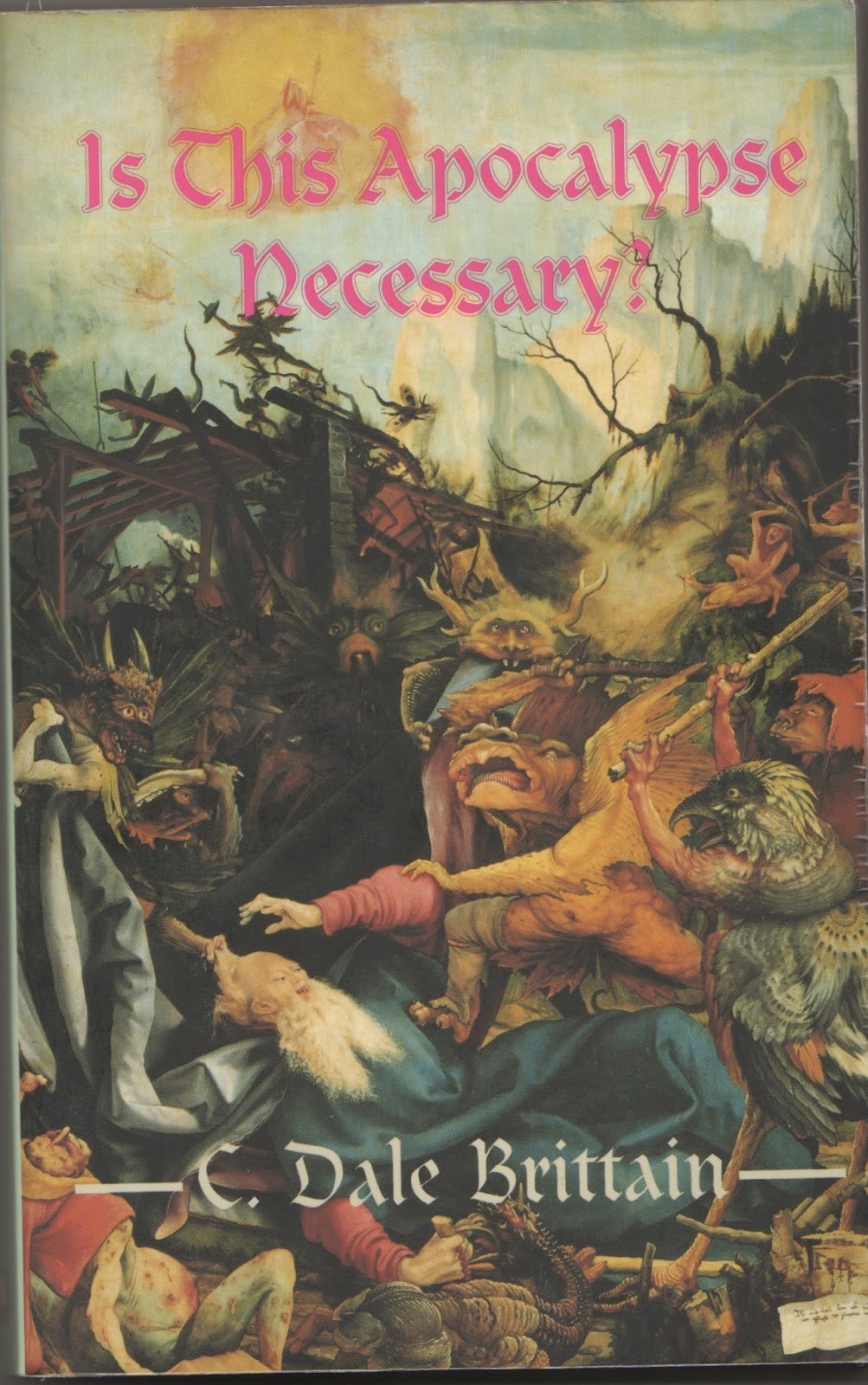
Some of what were described as "temptations" were actually very painful. I guess the idea was that people would promise the demons anything to make them stop. Below is a late medieval painting of the "temptation of Saint Anthony." The demons are having a blast, but Anthony is clearly not. I used this image for the cover of my fantasy novel, "Is This Apocalypse Necessary?" which (among many other things) includes demons.
Medieval people didn't really make deals with the devil in a nineteenth-century, Faust kind of way, because they realized how little of value the cruel demons could actually offer. Instead, demons stood by, ready to take souls away to hell, as in the below image of a rich, dying miser whose soul is being snatched while his moneybags are useless below his bed. (It illustrates the story of Dives and Lazarus.)
© C. Dale Brittain 2017
For more on demons and medieval religion, see my ebook, Positively Medieval: Life and Society in the Middle Ages, available from Amazon and other e-tailers.
The Bible doesn't have a lot to say about demons, although Jesus is recorded as having cast demons out of people, demons which made them ill or crazy. But there was plenty there for medieval people to build on. Demons were usually invisible, but they could take visible shape, such as like a black dog or other animal. A knight riding to commit a foul deed might abruptly discover that what he thought was a horse was actually a demon, planning to toss him in the nearest river.
But most commonly demons were depicted as vaguely human, usually with horns, sometimes with tails. One of the things demons loved best was hurting people, so carvings on churches often depict them doing so with great gusto.
The above grinning demon is from the eleventh-century monastery of Tournus.
Some of what were described as "temptations" were actually very painful. I guess the idea was that people would promise the demons anything to make them stop. Below is a late medieval painting of the "temptation of Saint Anthony." The demons are having a blast, but Anthony is clearly not. I used this image for the cover of my fantasy novel, "Is This Apocalypse Necessary?" which (among many other things) includes demons.
Medieval people didn't really make deals with the devil in a nineteenth-century, Faust kind of way, because they realized how little of value the cruel demons could actually offer. Instead, demons stood by, ready to take souls away to hell, as in the below image of a rich, dying miser whose soul is being snatched while his moneybags are useless below his bed. (It illustrates the story of Dives and Lazarus.)
© C. Dale Brittain 2017
For more on demons and medieval religion, see my ebook, Positively Medieval: Life and Society in the Middle Ages, available from Amazon and other e-tailers.
Subscribe to:
Posts (Atom)