Wednesday, February 16, 2022

The Restoration of Notre Dame

 Three years ago this spring, the cathedral of Notre Dame burned.  This was a heartbreaking loss of a cathedral that had stood in the middle of Paris for 850 years.  Today it is being restored, and the goal is still, as announced in April 2019 right after the fire was put out, to have it open again by the summer Olympics of 2024, which will be held in Paris.

So what exactly does "restoration" mean?  It has a specific meaning that is not just rebuilding or repairing.  It means putting it back to its "last known state," what it was like before the fire, i.e. like the image below.


This is not the twelfth-century version of Notre Dame (building began in 1163).  The twelfth-century version was a construction site.  It was not actually finished until the 1220s, some sixty years after construction began, and those bell towers were among the last things built.  And Notre Dame has had plenty of changes over the centuries, even though the overall structure has remained pretty much the same since the thirteenth century.  The flying buttresses were added not long after it was officially finished, because the weight of the roof threatened to push out the walls, built tall and thin with lots of windows.  (Once the fire took off the roof, those buttresses threatened to push the walls in, though lots of trusses have now staved off collapse.)


Other changes happened over the centuries.  In the seventeenth century, the cathedral canons decided the original stained glass was silly and old-fashioned and knocked a lot of it out, replacing it with plain glass.  In the eighteenth century, with the French Revolution, the heads of the kings and queens of the Old Testament, arrayed across the front over the doors, were knocked off.  Down with tyranny!  A smaller fire scorched the cathedral in 1830, during a revolt against the archbishop.  So when Victor Hugo published Notre-Dame de Paris in 1831 (known in the English-speaking world as The Hunchback of Notre Dame), the cathedral was in a deplorable condition, to which his book brought attention.

Viollet-le-Duc to the rescue!  He was an architect who essentially invented the restoration of historic buildings in the 1850s, putting them back to what they had been.

Before then, a damaged historic building, or one that was no longer serving the desired purpose, was either just patched up or rebuilt in whatever the current style was, whether or not it was anything like the original.  Medieval architects had little interest in restoration.  When the current Notre Dame was first being built in the twelfth century, the remains of the various cathedrals that had stood on the spot since the fourth century were cleared away.  Some of their stones were reused in the foundations of the new structure.

Viollet-le-Duc intended not only to restore Notre Dame to what it had been like in the twelfth-thirteenth centuries, but to make it what he thought it should have been like.  He thus had new heads made for the kings and queens of the Old Testament, much sweeter and more simpering looking than the thirteenth-century originals (now knocked off).  He made the gargoyles now considered iconic.  His work was finished by about 1870.


Most notably, he made a really enormous spire to rise above the crossing of the nave and transept and decorated the area with copper figures of the Apostles.  It is Viollet-le-Duc's version of the cathedral that is now being restored, medieval with a nineteenth-century twist.

I personally have doubts about that spire.  When it caught fire, it crashed through the stone vaulting below, causing most of the damage that occurred to the church's interior.  In the rest of the church, the medieval stone vaulting (sort of like a ceiling, below the roof) held up fine, protecting the cathedral's interior even while the fire raged above.  The vaulting may have indeed been weak where the spire fell, because Viollet-le-Duc had removed it at the crossing point, to bring up his enormous spire in sections from below.  He then replaced it, but I bet his techniques weren't up to the thirteenth century.

Some of the limestone from which the church walls were built was badly weakened by the fire.  Stone won't actually burn, but limestone, when heated in a lime kiln, breaks down to become one of the ingredients to make cement.  Some of the stone in the upper walls near the roof broke down badly in the heat, so new limestone is being quarried to replace it.

The biggest disaster was the roof.  It was supported by what was called a "forest" of oak beams, and the 900 year old timbers burned like crazy.  Originally it was thought that there was no way that 1200 or 1300 oaks big enough could be found in modern Europe to replace them, so other plans were suggested, including a glass roof supported by steel beams, with a garden growing on top of the stone vaulting.  But the architects claim to have found 1200 big enough oaks, mostly from France though some from eastern Europe, many planted in the eighteenth century with the intention of growing them into masts for ships.

One might wonder if building back in wood is the best plan, but they're going with it (sprinkler systems are supposed to be involved).  Timber framers have been studying medieval methods for a long time, so they will reconstruct the "forest" as it was (it was thoroughly documented), using mostly medieval techniques, though some sawmills will be involved.

The roof itself was a topic of intense discussion.  It was 500 tons of lead, which spewed toxic lead dust over central Paris with the fire.  But at least for now the plan is to go with lead, based on the argument that no one will climb up and lick the roof, so don't worry about it.

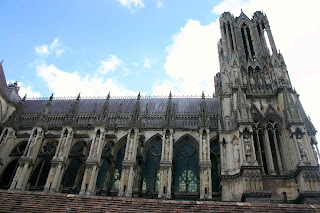
The cathedral of Reims was heavily damaged in World War I, with the vaulting taken out as well as the roof.  It was restored over a twenty year period, just in time for World War II, when fortunately it was not bombed again.  Today it looks a lot like it did in the thirteenth century, or the early twentieth century anyway (they had plenty of photos to work from).  They reused as many of the fallen stones as they could.  So Notre Dame may well soon be looking like itself again, again welcoming 50 or more times as many tourists as people attending Mass.
 

The February 2022 National Geographic has a good article on the people doing the restoration work.

© C. Dale Brittain 2022


Tuesday, February 8, 2022

Iceland

 Iceland is a parliamentary democracy, established on an island with a lot of volcanoes (a source of geothermal heat and electricity), one of the world's largest islands (in Europe second only to Great Britain, being bigger than Ireland), and a member of NATO.  Sounds sort of normal and boring, right?  But it's a country shaped by its medieval past even more than most of the rest of Europe.

The first human settlers of Iceland came from Scandinavia during the ninth century.  They found good land for their sheep and governed themselves through what was called the Althing (meaning the thing that has everyone represented), now considered the world's oldest parliament, even though it didn't meet for a century or so from the late eighteenth to nineteenth centuries.  It's back in business now, and Icelandic people are intensely proud of its ninth-century roots, making it 400 years older than Britain's Parliament.  In the year 1000, the Althing voted to adopt Christianity, the only example we know of where people voted to become Christian, rather than a ruler deciding to convert and converting his people.

From Iceland, explorers went to Greenland and to what is now maritime Canada, although the New World settlements were short-lived and the Greenland colony eventually died out after several centuries.  The other Scandinavian countries claimed Iceland as their own at various times, most recently Denmark, but in 1944 the Icelanders became their own independent democracy.

The main economy of Iceland, both then and now, was based on sheep raising and fishing.  Wool is used to make lovely warm sweaters, which you can buy in the convenient gift shop at the airport if you're changing planes or have a layover.  The Icelandic word usually translated as "meat" means lamb or mutton by itself, and then there's "cow-mutton" (beef), "pig-mutton" (pork), and so on.  

The big problem with raising sheep is that they keep all the plant life cropped short.  In fact, gracious English manors in the eighteenth-nineteenth centuries used to keep sheep to take care of the lawns.  But after the early Icelanders cut down the local trees, to build ships or open up grazing lands, trees were gone for good, any seed that somehow arrived from the mainland being nipped off before it could grow.  (These days Iceland plants and protects trees.)

These peaceful medieval sheep-farmers wrote sagas, accounts of historical events like the adoption of Christianity or the discovery of the New World, that also included a whole lot of feuds, insults, and people killing their relatives.  Although these are sometimes seen as glorifying violence, in fact they are about not getting into those situations in the first place, and women are often portrayed as the peace-keepers.

The sagas were written in Old Norse, the ancestor of the languages now spoken in Denmark, Sweden, and Norway.  In Iceland, the everyday spoken language is still very close to Old Norse.  Proud of their medieval linguistic heritage, the Icelanders have avoided adopting modern words from other languages, instead creating new words from Old Norse roots for things like television or internet.  Children learn Danish in school, which they consider a simple language, good for talking to Scandinavians who have given up on complex declensions and conjugations.

They have also continued the tradition of having surnames based on a parent's name.  So "Peterson" as a last name originally meant "son of Peter," but in Denmark-Sweden-Norway these have just become hereditary, so Torvald Peterson's kids will all have the last name Peterson, not Torvaldson or Torvaldsdottir.  Not so in Iceland!  There each person's surname is quite literally so-and-so's daughter or son.  Torvald Peterson's daughter might be Kristin Torvaldsdottir.  The phone book is arranged by first name, not last name.

© C. Dale Brittain 2022
For more on medieval Scandinavia, see my new ebook, Positively Medieval: Life and Society in the Middle Ages.  Also available in paperback.

Wednesday, February 2, 2022

Medieval Rome

As I have discussed previously, the idea of a "fall of Rome" ushering in the Middle Ages is a misconception.  Both the city of Rome itself and the idea of a Roman empire continued throughout the Middle Ages.  Since after Charlemagne was crowned Roman emperor by the pope in 800 there were Roman emperors right there in western Europe, as well as the Roman emperors in Constantinople, it's kind of hard to say that Rome disappeared.

But many things were different.  For one thing, Roman emperors were rarely in Rome.  The western emperors were also kings of Germany for much of the Middle Ages and would come to Rome to be crowned by the popes, maybe have a brief war with some Italian city states, and head north again.  For all practical purposes, the real rulers of medieval Rome were the popes, revered at least in the abstract as heirs of Peter.  They had their headquarters at the Lateran palace until the fifteenth century, when they moved to the Vatican to be closer to the basilica of Saint Peter's—the Lateran palace is not even in the modern city-state of the Vatican (officially its own country only since 1929).

Just as the rulers of Rome had changed since antiquity, so had the city itself.  Ancient Rome had been an enormous city, at least a million people, stretched over its seven hills, with a long wall (some twenty kilometers long) surrounding it, punctuated by guard towers.  But with the population declines of the early Middle Ages, it shrank to a fraction of its former size, maybe only twenty thousand people, getting a new set of walls well within the old set, to surround the population of a much smaller city.  (The Colosseum and forum in the center of this shrunken city.)

In between the old, imperial walls and the medieval walls were woodlots, orchards,  and many ancient monuments.  Some of these were monuments of antiquity, while others were basilicas or churches (or remnants thereof) that honored the early Christians who had been martyred by the pagan Romans.  Medieval pilgrims who came to Rome, of which there were always a large number, would visit both the Christian sites and the monuments erected by the ancient Caesars.  There was indeed a popular twelfth-century guidebook, "The Marvels of Rome," which instructed pilgrims on many of the interesting things to see.

Even now, Rome is thick with ancient sites that disrupt traffic and hopelessly delay things like subway tunnels or new sewer lines.  With a thousand year less of wear and tear, medieval Rome had even more.

In my most recent book, "The Knight of the Short Nose," the hero goes to Rome on pilgrimage and, following the guidebook, visits many of these sites.  (He also ends up in a fight to the death with the champion of a king who wants to sack Rome, but you have to read the book to find out what happens.)


The most important site in Rome was the basilica of Saint Peter's.  It was built over what was supposed to be the tomb of Peter, leader of the apostles, and there was a grate in the floor through which the faithful could lower bits of cloth to touch his bones, thus creating their own tertiary relics.  It was not actually within the walls of the medieval city, being instead on the outskirts, across the Tiber river.  The pope built walls around Saint Peter's and the immediately surrounding area in the ninth century.

This was not the Renaissance basilica of Saint Peter's that is there today; that was built only in the sixteenth century.  Old Saint Peter's went back to the fourth century and was considered hopelessly dark and old-fashioned when it was replaced.

Peter was certainly not the only saint venerated in Rome.  In fact, the city was thick with them, both saints who had died in Rome and saints who had died elsewhere but were honored there, with their own altars if not indeed own churches.  And then there were the countless people buried in the catacombs, tunnels below the city where originally building stone had been quarried out (see image below).  The catacombs had become a Roman graveyard, and early Christians met there if they feared persecution, not fearing the dead as did the pagan Romans.  Relics from Rome saw a brisk trade throughout the Middle Ages.


A good recent book on early medieval Rome is by Maya Maskarinec, City of Saints (University of Pennsylvania Press, 2018).

© C. Dale Brittain 2022
For more on medieval churches and pilgrimage, see my new ebook, Positively Medieval: Life and Society in the Middle Ages.  Also available in paperback.

Saturday, January 22, 2022

Medieval Fashion

Hennin - Pointed Hat

 Fashion has been important throughout human history, at least for those who could afford it.  By wearing clothes that are the latest fashion, one establishes oneself as the leading influencer, the person all others must copy.  The well to do of the Middle Ages were just as eager to dress fashionably as is a modern teenager who would (she claims) rather die than go to school dressed grossly out of fashion.

In the Middle Ages of course, just as now, the latest fashions were often mocked.  (Don't get me started on jeans, bought new, that come with big holes already worn in the front.)  In the English royal court at the end of the eleventh century, long, pointed toes on shoes were fashionable for men.  Churchmen roundly attacked them as being "girlie" and a sign of weakness, which did not keep men from wearing longer and longer points, until one day they were suddenly unfashionable.

(Court jesters are often depicted with toes on their shoes so long they have to be spiraled around.  They wore them after everyone else had given them up, proving they were fools.)

As well as establishing that one is "in the know," fashion can mark your identification with a certain group.  The white wigs of the eighteenth century (think of pictures you've seen of George Washington or Mozart) were supposed to show that one was wise, like an old person.  Jeans came into college students' wardrobes in the 1960s as a way to show solidarity with workers.  (Workers who would have thrown out jeans once they had big holes in the front, but that's a different story.)

And fashion is a way to flaunt one's wealth, to show off that one has enough money to buy new clothes whenever the fashions change, to stop wearing perfectly serviceable clothes just because they're out of style, and to employ servants to keep the delicate white bits clean and free of stains.  In the court of Louis XIV, when the French aristocracy flocked to Versailles, clothing was the single biggest expense for members of the court.

In the late Middle Ages, there was a major fashion trend in women's hats.  The tall, pointed hats that one sees in many images, hats often with trailing veils, were completely impractical, and that was the point.  No one would wear a hat like that to work in the fields or brew beer.  One wore a hat like to prove one was a person of leisure.


And then in the early modern period there was a great fashion in enormous lace collars.  They were expensive, delicate, and extremely hard to keep clean, all the things that marked the wearer as a person of wealth.  (They were also ridiculous, but that's half the point.)


© C. Dale Brittain 2022

For more on medieval clothing and other aspects of medieval history, see my ebook Positively Medieval, available on Amazon and other ebook platforms.  Also available in paperback.


Wednesday, January 12, 2022

Pork and Sauerkraut

 My husband makes a very good winter-time dish, pork and sauerkraut, which could also have been made in the Middle Ages.  It takes him a couple of hours to make.  Onions, apples, sauerkraut, and caraway seeds are fried up together with pork loin, then it's baked with some citrus juice (one could substitute white wine, though we don't).  These are all ingredients readily available in the Middle Ages, except for the juice (medieval people would have used wine).  Though it takes a while to make, mostly because of the time to slice everything up, he knows that by making a double batch we can have it again with no more effort than reheating.

Okay, but let's think about what he is not doing.  He's not planting, tending, harvesting, and drying the onions.  He's not tending the apple trees and picking the apples, going over them carefully before storing them.  He doesn't plant, tend, and harvest cabbage, chop it and mix it with salt, and let it ripen into sauerkraut, instead just opening a jar.  He doesn't slaughter the pig or cut it up.  He doesn't even harvest the caraway seeds.

So if you added up how much time all those things take, maybe rather than thinking of it as a 2-hour supper we might think of it as a 6-week supper.  And we aren't even including how long it would take to gather the wood for the cooking fire.

Somebody certainly does all those things so that he can go to the grocery store and get nicely trimmed pork loin, apples and onions, and a jar of sauerkraut, plus juice and a little jar of caraway seeds.  If they're working all day in the sauerkraut factory, how do they ever have time to do anything other than eat sauerkraut for supper?

Now in fact it's not as amazing as it may seem.  Part of it is the increase in what the economists call worker productivity, how much each worker can produce in an hour, which has been increasing steadily for over two centuries, largely due to machines that do a lot of the labor.  Part of it is also division of labor, where people who are just doing one thing can do it more efficiently than those who do that thing occasionally.

Now in fact in most pre-modern societies, including parts of the Third World today, people basically spend a major part of their waking hours involved in food:  finding it, cultivating it, harvesting it, storing it, cooking it.  Ha, ha, you say, reaching for a bag of chips and a tall cool one, I spend much of my day involved with food too.

But it's different.  We don't have to think about food because we know it will be there when we want it.  Our relationship with food, for most people in the modern West, is that we have too much of it and "need to cut down."  We're all living like high medieval aristocrats, not having to work to get our food, just making sure the "little people" are producing it, even eating more than we need.

An ordinary grocery store would have been beyond the dreams of avarice for even wealthy medieval people.

© C. Dale Brittain 2022

For more on medieval food and other aspects of medieval history, see my ebook Positively Medieval, available on Amazon and other ebook platforms.  Also available in paperback.

Thursday, January 6, 2022

Violent Overthrow of the Government

Today seemed like a good day to blog about the violent overthrow of the government in the Middle Ages.

Now of course this was not an everyday event.  Most governments carried on perfectly peacefully.  New mayors were elected, new counts came to power, new kings inherited without any sign of violence.  Pippin the Short, first Carolingian king, took the throne in 751 after (apparently) persuading his Merovingian predecessor to go off and be a monk.  (Were there threats if he didn't go peacefully? maybe.)  Boso became the first (and almost the only) Bosonid king of Burgundy in 879 by persuading the local bishops and counts to elect him, after his Carolingian predecessor had died (a death in which Boso played no role).

But violence often was involved.  The Scandinavian kingdoms had a very rapid turnover of kings during much of the Middle Ages, many of the kings being murdered by their opponents—who were sometimes their brothers.  The French kingdom in contrast experienced peaceful transfers of power from the late tenth century until the fourteenth century, which everyone agreed was unusual.

In the Middle Ages, as now, fighting was considered an appropriate way to get what one wanted when other methods failed.  Although the Middle Ages was not nearly as violent as often portrayed, as I have discussed earlier, combat was a recognized way of proving one was right–even according to the church, before the thirteenth century.  A battle could be construed as a "trial by combat," with God showing who was in the right by allowing that person to win.

Nonetheless, slaughtering a lot of people always seemed at least somewhat suspect as a Christian deed.  After William the Conqueror made himself king of England in 1066 by winning the Battle of Hastings, where King Harold (the former king) was killed, William and his wife founded a monastery and a nunnery to try to make amends.

Even when a new person had become king, that did not mean they were safe from attacks.  King Boso spent much of his short reign fighting against those who thought he should not be king, including his own brother.  King Charles the Simple was defeated in battle in 922 and locked up for the rest of his life (some have suggested he should be called Charles the Straightforward, taking his Latin nickname, Simplex, to mean not cunning or devious, but I like just plain old Simple, because he really was an incompetent king).

The English kings continued to have violence part of royal transitions after William the Conqueror.  His son became Henry I in 1100 because Henry's older brother Robert was off on Crusade, and when Robert, furious, came home, Henry defeated him in battle and locked him up for the rest of his life.  After Henry I died in 1135, his daughter Mathilda and nephew Stephen spent the next two decades battling each other over who was the rightful king of England.  The English barons forced King John to sign the Magna Carta in 1215 with threats of violence, and they did rebel violently against his son, Henry III.  English historians take the end of the Middle Ages in Britain to arrive in 1485, when King Richard III was defeated and killed in battle by Henry VII.

We now honor Joan of Arc, the only Catholic saint to have been burned at the stake as a heretic by the Catholic church, but her legacy is one of violence:  she defeated the English armies in order to put King Charles VII on the throne in 1422.

Even the leadership of smaller units of government might be determined violently.  Bishops ran their cities all during the Middle Ages, usually in concert with or in tension with the local count, but during the twelfth century the inhabitants began to insist on a role in governance, usually with an elected mayor.  Agreement between all the interested parties was usually reached (fairly) peacefully, but in the 1120s disagreements in the French city of Laon between bishop and townspeople turned into violent riots, with the bishop killed and his body left in the street.

The United States of America is a young country.  We do not have fifteen hundred years of history of Europe's countries during which there were numerous violent changes of government (though 1776, never forget, was an armed rebellion).  Our biggest example of trying to overthrow the government violently was the Civil War, 160 years ago.  Then there's the effort of one year ago, which fortunately failed, but might not next time.

© C. Dale Brittain 2022
For more on medieval political history, see my ebook Positively Medieval, available on Amazon and other ebook platforms.  Also available in paperback.

Thursday, December 16, 2021

Desert Fathers

 I've discussed before how monasticism began in the third century, when Saint Anthony decided to become a hermit and headed out into the desert of Egypt.  Monasticism, that is leading a life separated from society, devoted to prayer and contemplation, quickly developed two main versions:  eremetism, that is being a hermit by yourself, and cenobitism, living in well-disciplined groups.

Saint Anthony was soon joined in the desert by other men, and even a few women, trying to lead a holy life of prayer and privation.  Egypt was a good place to do this, because once you get away from the Nile you're out in the desert and could be miles from anywhere, even though you're only a few hours' walk from town.  And this is important, because if someone is living alone and praying all day, he needs people to bring him food and (if he didn't have the sense to set up by a desert spring) water.

Soon there were a lot of desert fathers, mostly leading solitary lives, though an oasis might support a group.  They were greatly admired for their holiness, their radically simple lives, and indeed became tourist attractions.  Accounts of their lives, their holiness, and their miracles were written up.  People would come and visit them and ask for their wisdom.  Some of the hermits hid in their cells and wouldn't answer the door when pilgrims came by.  Others welcomed pilgrims and sold them sandals or prayer mats woven from palm fronds.

By the fourth and fifth centuries, regular tours of the Egyptian desert fathers were organized out of Jerusalem.  Jerusalem, like the rest of the Roman Empire, was thoroughly Christian at this time.  One surviving traveler's account recounts all the different hermits they visited, the sayings and wisdom of each, and the travelers' various adventures, like being chased for miles by a hippopotamus.

Long after Egypt, along with the Middle East and the rest of north Africa, had become majority-Muslim regions, Christians remembered the desert fathers and read their stories.  Monasteries in western Europe liked to say they were founded "in the desert," meaning not a sandy place but somewhere desolate, wild, deserted by anyone before they showed up.

One particular monastery, Saint Martin's of Tournai (northern end of the French kingdom), had an especial attraction to the desert fathers.  It was an old monastery that had become abandoned during the time of the Vikings.  In the eleventh century, it became simply a parish church in town, served by a small group of canons (priests).  In the twelfth century, the priests read their Bibles and heard about monasteries being founded and decided to become monks, living a much more austere life than did priests:  a strictly vegetarian diet, simplicity in clothing, no personal possessions.

As a parish church, Saint Martin's had been very much part of the community, with people popping into the church to pray or ask for blessing or attend mass or to have a child baptized or a wedding performed or just to chat with the priests.  All this continued after the priests became monks.  As monks, they started to feel that maybe they had not sufficiently distanced themselves from society, especially as people were always talking and laughing and going about their business right outside the church.  But they loved their community and didn't want to drive them away.  Some community members had themselves decided to become monks, bringing a few children with them.

Reading the stories of the desert fathers, the monks had a brilliant idea.  They would head off to Egypt and become desert fathers themselves!  In the dead of the night they packed up all their books and whatever food they had on a wagon, put the little boys on top of the load, and headed out, bound for Egypt.

They didn't get far.  The townspeople discovered their absence the next morning and were distraught.  It was as bad as having Mom and Dad decide that you were so naughty they would run away from home.  Fast riders headed out on every road out of Tournai and soon caught up to the monks.  The bishop was summoned to talk sense into them.

The bishop explained to them that they could be perfectly good monks right there in Tournai, ministering to their parishioners.  For good measure, he threw himself on his face at their feet, telling them he was not worthy to be the bishop of such holy men and boys.  At this point they had no choice but to throw themselves on their faces themselves and swear they would never do it again.

The townspeople were delighted to have their monks back.  The monks indeed never tried running away again, and one has to wonder what would have happened if they actually had managed to make it to Egypt on foot.  But their experience indicates the strong hold the stories of desert fathers continued to have on monks' minds.

© C. Dale Brittain 2021

For more on medieval religious life, see my new ebook, Positively Medieval: Life and Society in the Middle Ages.  Also available in paperback.