Monday, June 7, 2021

The Vatican

 Because the Vatican seems sort of medieval—after all, the pope is guarded by guards wearing outfits inspired by those of Swiss mercenaries of the sixteenth century—it's easy to lose track of how young it is.  It's one of western Europe's newest countries, having been founded on this day (June 7) in 1929.  It's also the world's smallest sovereign state, only 121 acres (roughly 1 square kilometer), with a population of under 1000.


Above you can see a modern Swiss Guard at the Vatican.

So wait, you say, hasn't the pope been in Rome since the first century?  Well, there's been a bishop in Rome since the early church, second century for sure, and he's been called the pope since the sixth century, a term derived from the word Father (papa) and originally shared with other bishops.  (Click here for more on the early papacy.)  But the Vatican as a country is recent.

The early popes essentially took over the governance of the city of Rome once the emperors were no longer there.  During the Middle Ages, the popes claimed with greater or lesser verisimilitude to control most of Italy, or at least the central parts.  The kings of Germany, who claimed to be Holy Roman Emperors, sort of agreed, as did the Normans who decided that they were kings of Sicily and southern Italy in the twelfth century.  This of course did not reduce the amount of wars in which the papal territories were frequently involved.

The Vatican palace, the heart (now) of the Vatican City State, is located close to Saint Peter's basilica.  But the medieval popes did not live at the Vatican.  Rather, they lived at the Lateran palace, which is no longer within the borders of the Vatican State.  After the popes lived in Avignon, in southern France, for most of the fourteenth century, they returned to Rome and decided to make the Vatican palace their principal residence, handy to Saint Peter's.


This is the famous "Pieta" of Michelangelo, one of the many works of art in the basilica of Saint Peter's, rebuilt in the sixteenth century to replace the old church.

Italy was one of the last of western Europe's countries to become a single country.  Because in the Middle Ages it had been claimed in part by the popes (the so-called Papal States covered much of the middle of Italy), the king of Germany, and the king of Sicily, there was no sense that the whole peninsula was one country.  The individual city states, like Venice, had no interest in being subject to other powers.

But at the end of the nineteenth century Italy officially became a kingdom, sort of unified by 1870.  It took a while to work out all the details, to get Venice for example to agree that they were not an independent republic anymore.  Under the fascist government of Mussolini, the pope was allowed to have his very own country of the Vatican, as noted above.  (San Marino is also still an independent country within Italy.  It's bigger than the Vatican, but not by much.)  After the end of World War II and the end of fascism in Italy, Italy became a democracy.  It still has people who claim to be the righteous king.  They live in Paris.

The Vatican is officially an elective monarchy, with the pope the head of state.  Starting in 1929, the Vatican started issuing its own stamps, and some Italians will tell you that your letter will have a much better chance of making it where it's going if mailed at the Vatican.

 © C. Dale Brittain 2021


For more on the medieval church, see my ebook Positively Medieval, available on Amazon and other ebook platforms.  Also available in paperback.


Sunday, May 30, 2021

Bayeux Tapestry


 The Bayeux Tapestry is one of our best sources of information about what the 1066 Norman Conquest looked like, that is, what kind of weapons, what kind of ships, what kind of clothes were considered normal in the eleventh century.  It's not really a tapestry, but rather a series of seventy embroidered linen squares, sewn together in a long series, some 230 feet long and not quite 2 feet tall.  It is probably missing a square or two at the end.  (Officially a tapestry's design is woven in, rather than embroidered.)

The Tapestry (as we might as well call it anyway) is an unabashed effort to tell the history of how Duke William of Normandy conquered England, becoming king (he's now known as William the Conqueror), and how it was totally appropriate that Harold Godwinson, who had thought that he was rightful king of England, was killed in battle.

The story is told in a series of scenes, almost like a comic strip, where in each scene people are doing something.  A few words of Latin identify what they are doing or name the different figures.  Along the border are various small images like someone dismembered, someone pulling the armor off a dead person, a nude man flashing his stuff, and the like.  So although the Tapestry glorifies the Battle of Hastings that William won, it also is very aware of the brutal nature of war.

There are a lot of questions about the Tapestry that remain unanswered, starting with who made it.  For a long time the assumption was that Mathilda, William the Conqueror's wife, embroidered it with her ladies.  The French indeed call it la tapisserie de la reine Mathilde.  This seems based on nothing more than thinking embroidery is "women's work."

n fact it seems most likely that Odo, bishop of Bayeux (which is in Normandy), had it made.  The Tapestry has been in Bayeux almost its entire life.  Odo accompanied the Conquest, but because he was a bishop he did not shed blood, using a club rather than a sword.  "Internal injuries only."  Odo was probably hoping to be named archbishop of Canterbury (in England) after the Conquest, but if so he was bitterly disappointed, because William instead chose Anselm, abbot of the Norman monastery of Bec.  Given that Odo was William's half-brother, this must really have rankled.


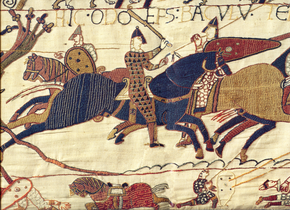
Here's an image from the Tapestry.  It shows Bishop Odo, identified over his head as ODO EPS (the EPS standing for episcopus, bishop.)  You note that although he's wearing chain mail and a helmet, he has a club, not a sword.

The Tapestry is now in its own museum in Bayeux.  It is very nicely displayed, in a long glass case that snakes around the room so that you can follow it and see all the images (I recommend the headphones with a recording explaining what each scene shows, available in English or French).

 © C. Dale Brittain 2021


For more on medieval political and social history, see my ebook Positively Medieval, available on Amazon and other ebook platforms.  Also available in paperback.


Saturday, May 22, 2021

Advertising Indie Books

 One of the biggest challenges for independent author/publishers ("indies") is having their books noticed.  There are probably at least 10 million ebooks on Amazon alone, plus 30 million paperbacks and hardcovers.  Analogies like needles and haystacks come to mind.


So indies have to advertise.  Those authors who are published by traditional publishers (think Random House) have their books advertised by the publishing house's publicity department.  After all, institutions like Random House, which have just given an author several thousand dollars if not more, know that they'll never make that back (much less costs of designing, editing, and printing) unless people buy the book.

So they put ads in places where potential readers will see them, arrange to have the author appear on radio shows or even go on a tour to bookstores, send out free copies to bookstores that they think might push the book if they knew it existed, or pay to have the book prominently featured on Amazon or other on-line sites, where people would see it when looking for something else.

Indies have to do the equivalent themselves.  Now they probably can't afford an ad in the New York Times Book Review, are unlikely to be invited onto a talk show (there are enough really weak indie books out there that their immediate reaction is No Indies Here), and have a limited selection of friends and family who can be browbeaten into buying the book.

So they advertise in other ways.  In the last few years Amazon has started allowing indie authors to advertise their ebooks on the site.  It's a complex system.  My guess is that it was developed for people selling things like socks or cookware on Amazon, and the indie authors were just tossed into the mix, without an accounting department or experienced advertising executives to figure out if it's working.

I've been giving it a try myself to see if I can get some new readers.  I've got great long-time readers, but adding new ones is always good.  Specifically I'm advertising "The Starlight Raven," with the hope that it will lure new readers both into the rest of Antonia's series and into my other books as well.

 It's an odd kind of advertising.  It works through "key words," things someone browsing Amazon might enter into the search bar, things like "fantasy" or "wizards and witches" or the names of other writers in the same genre.  As soon as someone enters a keyword, the Amazon computers begin an "auction."  Authors who want to advertise their books have already decided how much they are willing to bid on that key word (maybe 50 cents).  Highest bids win! and those authors' books get displayed as "sponsored products."

(Except it's also confused by the computers' "algorithms" for "relevance," which also come into play when deciding which books are shown and are Very Secret.)

If the author's book is displayed, it's an "impression."  An impression is free.  If the potential reader searching with that key word actually clicks the ad to learn more about the advertised book, which almost none of them do, that's a "click."  The writer is charged their bid price for an impression that leads to a click.  Experienced advertisers say you can expect maybe 1 click per 1,000 impressions.  Then only one out of 5 or 10 clicks leads directly to a sale.

As you can see, you want a lot of impressions, which means you need to bid high.  If you bid $5, you'll almost certainly get lots of impressions and lots of clicks!  But remember that every click is costing you $5, and the majority of clicks do not result in a sale, and you're only getting $3 royalties from a sale...  Okay, now you see why everyone is not bidding $5.

You can also see why new authors with just one book should not bother trying to advertise.  Let's say each click is 50 cents, 10 clicks would therefore be $5, you're getting $3 per sale...  You're not losing money as fast as on a $5 click, but you're still not breaking even.  This program only works if  a reader reads the book, loves it, and happily buys more of the author's books (ones not advertised).

Readers of course have no idea all of this is going on.  They see (and mostly ignore) books labeled as "sponsored."  They have no idea about bids.  But suppose someone sees a sponsored product book with a weird and messy cover and clicks out of curiosity?  They look at the Look Inside, to see if the interior is as bad as the cover.  Yep, it is!  They don't buy it and never will.  The author is still out 50 cents.

This is why Step One in advertising an indie book (or any other product) is to make sure it's top-notch in every way.

© C. Dale Brittain 2021


Thursday, May 13, 2021

William of Orange

 As I have discussed previously, medieval people loved epic tales.  Although there had been epics written in classical antiquity (the Greek Iliad and Odyssey, the Latin Aeneid), epic was re-invented in the eleventh and twelfth centuries.  Most famous of the medieval epics is doubtless the Song of Roland, but there were plenty of others, including the cycle of epics about William of Orange.

William was a real person, although there is only a slight overlap between the historical William, who died at the beginning of the ninth century, and the William of the epics.  The historical William, a rough contemporary of Charlemagne, was a powerful lord of southern France, of a family that for a while acted as rivals to the Carolingian dynasty.  His grandson ended up as a hostage at the royal court, and let's just say that story doesn't end well.  The real William founded the monastery of Gellone, and when he grew old he retired there.

During his time, southern France had a number of Saracen settlements; the Mediterranean was mostly controlled by Muslims, not by Christians.  This real feature of the eighth-ninth centuries was one of the few realistic elements that made it into the epics.

The epics starring William were supposedly set in the time of Charlemagne, although everything about the castles, the armors, and the culture of the people in the stories was a slightly larger-than-life version of aristocratic life in the twelfth century.  In the epics, William fights the Saracens, converts a Muslim princess to Christianity and marries her, and at the end of his life becomes a monk at Gellone.


The stories were told both as entertainment and as a commentary on the author's own twelfth century.  The same thing is true today, when authors bring into historical fiction points that they want to make about their society:  one will notice for example that a lot of women have written a lot of historical novels about queens of England.

In the case of William of Orange, much of the entertainment value was provided by big battle scenes.  The author drove a path of destruction through armies on both sides.  This person is beheaded, that person has his brains knocked out, the other person has a spear driven all the way through his body.  One assumes the audience loved it.

The stories also routinely portray priests and bishops as weak hypocrites.  Knights and great secular lords were more than a match for these fellows, the author seems to be saying.

But there was also a strong critique of knighthood in these epics.  William was portrayed as huge, ferocious, a terrific fighter, and yet also ridiculous.  When he becomes a monk, he is very bad at it, to the extent that the other monks want to drive him out.  As he faces Saracens, he keeps saying, "We're all going to die!"  It usually takes a woman to save the day, and for a twelfth-century male audience, having to be saved by a woman added to the humiliation.  Good times.

If you'd like to see these epics, they are translated as Guillaume d'Orange by Joan M. Ferrante.

© C. Dale Brittain 2021

For more on medieval knights and epics, see my new ebook, Positively Medieval: Life and Society in the Middle Ages.  Also available in paperback.

Thursday, May 6, 2021

Were medieval people white nationalists?

 Short answer: No.

As I have discussed earlier, medieval people were not advocates of "whiteness."  Sure, they were intolerant of religious difference, especially of Christian heretics, but skin color was well down the list of things they would get upset about.  This has not stopped a lot of people recently from trying to claim the Middle Ages as some golden age of white nationalism.  As a medievalist, I must object to their careless and a-historical use of medieval ideas and symbols.

One of the more recent efforts is to talk about the US as a land where "Anglo-Saxon" values should predominate.  But what is meant exactly by Anglo-Saxon?  The Saxons, from Saxony in northern Germany (hence the name), were raiders and attackers in late Roman Britain.  At that time you had Germanic peoples moving into Great Britain as the Romans pulled out, setting up their own kingdoms.  They called themselves English (England is named for them).  Only really in the nineteenth century did "Anglo-Saxon" become a collective name for these people who made England their own.

And what "values" did they have?  Well, they were ruled by kings.  The US hasn't had kings since 1776, and I hope we aren't going back.  For the first century after Angles and Saxons arrived, they weren't Christian, yet those who now want us to adopt Anglo-Saxon values also want to impose their version of Christian values.  (Protestant!  Obvious heretics by medieval standards.)  They had slavery, gone in the US for 150 years.  British scholars see Anglo-Saxons as part of the German wave that led (supposedly) to the Fall of the Roman Empire.  (And aren't we of the US supposed to be the reincarnation of Rome?  Minus slavery and imperialism and patriarchy and, well, never mind.)

At any rate, medieval society was not uniformly white and Christian.  Trade with other parts of the world continued throughout the Middle Ages.  Silk from China and spices from southeast Asia ended up in the Mediterranean, as did traders from those places.  For that matter, the Mediterranean was predominantly Muslim.  The Middle East was always of interest to medieval Christians, as site of the Holy Land.  Every city of any size had a Jewish population, tolerated during the early Middle Ages, regarded with increasing suspicion in the eleventh and later centuries, but still very much part of society—kings of both France and England relied on Jews as a source of loans.

For that matter, medieval people would not have struck us as "nationalistic."  The areas that a king considered part of his kingdom might or might not have agreed they were under him.  People identified themselves by culture and language by not necessarily by geographic boundaries.  The French epics talked about how "the French" were brave and honorable, but that was a cultural marker, not a geographic one.  People identified much more with their city or county than with their country.  The word nation (natio in Latin) meant something closer to family than country.  The Jews were considered a nation, no matter where they lived.

Medievalists get irritated when modern people try to appropriate  some medieval symbols and use them in ways medieval people would have rejected.  For example, Norse runes and Celtic symbols are sometimes mixed together as some sort of symbol of whiteness.  Well, the Vikings and the Celts were both fair-skinned.  But the Celts of the British Isles, the people who had been there before the Romans and who persisted after the English arrived (especially in the areas now called Wales and Scotland, plus of course Ireland), were attacked by the Vikings in the eighth and ninth centuries.  They would not have agreed that one could mix and match their symbols.  For that matter, the Normans of what is now France were only a few generations from Viking settlers, Vikings who had treated Christian churches as their rightful prey.

In the nineteenth century a lot of men's social groups decided they were really knights.  Some members of the Ku Klux Klan declared they were knights, "defending" their "way of life" which apparently was a way of life of prejudice and cruelty.  Knights really first appeared as a group at the beginning of the eleventh century, being persuaded by swear mighty oaths not to harm the weak.  Burning a cross on a terrified family's lawn hardly counts as not harming the weak.

© C. Dale Brittain 2014

For more on medieval culture, see my new ebook, Positively Medieval: Life and Society in the Middle Ages.  Also available in paperback.


Tuesday, April 27, 2021

Beards


 In the Middle Ages, beards were mostly worn by old men.  Venerable old men were described as having long white beards; in the epic Song of Roland, for example, Charlemagne is described like this.  The length of the beard indicated age and wisdom.  Hermits also would typically have beards.  The image below is of a reliquary at Aachen containing part of Charlemagne's skull; you will notice he is shown with a beard.


But young or middle-aged men did not have beards, nor did monks, those who tried to follow an austere religious life in a group (the monastery) rather than individually as hermits.

This meant that they had to shave.  They didn't have modern safety razors, much less Norelco electrics, and certainly no shaving cream in a handy aerosol can.  Water or, with luck, soap and water got the beard ready, then a sharp knife was used to cut the bristles, ideally not cutting any skin or blood vessels in the process.  One could shave oneself, but in the towns and aristocratic courts one was usually shaved by a barber.

Barbers also functioned as surgeons.  They had lots of sharp blades around the place, so they would do any amputations that seemed necessary.  They were also skilled in figuring out how to stop bleeding.  Alternately, they knew how to cut someone carefully and precisely if they needed to be "bled," getting rid of the bad humors, to allow someone to heal more readily (before you mock bleeding, recall that it continued into the nineteenth century).  After a battle, the barber-surgeons went out to check on the wounded and see if they could be saved.

Getting back to beards, the "clean shaven" look was not exactly what we would call clean-shaven.  In certain circles today the two-day-growth look has become popular (you can buy trimmers to keep your beard constantly at that length), and medieval men would have fitted right in.  No one bothered to shave every day.  Young men, however, were normally depicted with smooth cheeks, often rosy.  Because they were also depicted with shoulder-length hair, it might at first glance be hard to tell the men from the women in many a medieval illustration--but in fact it's easy, because men wore knee length tunics, women floor-length dresses.

It has been suggested that young men didn't wear beards because they would catch in their helmets.  This seems unlikely, because peasants and townsmen too were always depicted as beardless until they became old and venerable.  Also, until the late Middle Ages a helmet just covered the crown, back of the head, and top half of the face.

In the monastery, monks not only shaved their beards but also the top of their heads, the so-called tonsure.  The effect was something like male pattern baldness, except the rim of hair went across the front of the head too (unless the monk actually had male pattern baldness).

The monks were thus distinguished from the rest of society at a glance if they tried to run away from the monastery.

Monasteries normally shaved everybody, face and head, on Saturday to be ready for Sunday.  Saturday was also the time for the weekly bath.  They might also be bled at the same time if they were feeling too frisky.  The barbers at the monastery had a long and busy day.

© C. Dale Brittain 2021

For more on aspects of life in the Middle Ages, see my ebook, Positively Medieval, available from Amazon and other major ebook platforms.  Also available in paperback!


Thursday, April 22, 2021

A Bad Spell in Yurt

 Thirty years ago this summer, I published my first fantasy novel, A Bad Spell in Yurt.  I've been writing stories since I was in kindergarten, and I'd already published two scholarly books and a number of articles, but this was very exciting.  Fiction uses a different part of the brain than scholarship.


Yurt went on to be a national Science fiction/fantasy best-seller and is still my perennial best-seller.  Originally it was published as a mass-market (small size) paperback by Baen, a New York SF specialty publisher.  Its excellent sales meant that Baen was happy to publish the next four books in the series, as well as a couple of non-series books.  I had originally rejected the idea of a series, because the story was (and is) complete in itself, but my husband talked me into it.  I'm glad he did, because Daimbert, the wizard hero, is an excellent character and had lots more adventures ahead of him.  Also, fantasy readers like series.

In spite of Yurt's success, Baen became bored with me when each book did not sell more than the last one (their plan).  So I ended up publishing the sixth book in the series, Is This Apocalypse Necessary? the boffo finale, with a small press (Wooster Book Company).

Fast forward ten years.  The Yurt books were all out of print, so I started bringing them out as ebooks, first on Amazon for their Kindles, then at the other major ebook platforms, iTunes (now renamed iBooks), Nook (for Barnes & Noble), and Kobo.  A gratifyingly large number of new fans appeared!  Because a lot of them, including me, still prefer to read a physical book rather than read on a screen, I started bringing the books out in new editions in trade paperback (large size), mostly in omnibus volumes with more than one book per volume.

In addition, I decided that Daimbert had had a few other adventures I'd never written about, so I wrote three novellas (The Lost Girls and the Kobold, Below the Wizards' Tower, and A Long Way 'Til November) that took place in between the adventures in the six novels.  (They are also available in an omnibus volume of their own, called Third Time's a Charm).

Now I've taken the next step, and in honor of its thirtieth anniversary, I've brought the original Bad Spell out in hardcover!  It's what's sometimes called library binding, sturdy covers with the cover image printed on them, the same great Tom Kidd illustration that's been with the book from the beginning, rather than a monochrome cloth cover with a paper dustjacket.  Here's the link on Amazon.

And here's the opening to whet your appetite:


I was not a very good wizard.  But it was not a very big kingdom.  I assumed I was the only person to answer their ad, for in a short time I had a letter back from the king's constable, saying the job was mine if I still wanted it, and that I should report to take up the post of Royal Wizard in six weeks.

It took most of the six weeks to grow in my beard, and then I dyed it grey to make myself look older.  Two days before leaving for my kingdom, I went down to the emporium to buy a suitable wardrobe.

Of course at the emporium they knew all about us young wizards from the wizards' school.  They looked at us dubiously, took our money into the next room to make sure it stayed money even when we weren't there, and tended to count the items on the display racks in a rather conspicuous way.  But I knew the manager of the clothing department—he'd even helped me once pick out a Christmas present for my grandmother, which I think endeared me to him as much as to her.

 © C. Dale Brittain 2021